



Time to read :
1 min read
The dating app market has evolved far beyond simple swipe-based interactions. Today’s users expect smarter matches, meaningful conversations, and personalized experiences and that’s exactly where artificial intelligence comes in. For startups and entrepreneurs, AI dating app development is no longer a futuristic concept; it’s a competitive necessity.
By leveraging AI-driven matchmaking, behavior analysis, and real-time personalization, modern dating platforms can dramatically improve user engagement, retention, and revenue. Whether you’re planning a new venture or upgrading an existing product, understanding how AI transforms dating apps is critical to building a scalable and profitable platform.
This guide provides a detailed breakdown of ai-based dating app development, covering features, development steps, costs, and monetization strategies everything decision-makers need before investing.
What Is AI Dating App Development?
AI dating app development refers to building dating or relationship platforms that use artificial intelligence and machine learning to enhance user interactions. Unlike traditional apps that rely on filters like age or location, AI-driven systems analyze user behavior, preferences, communication patterns, and emotional signals to deliver highly accurate matches.
In an ai relationship app, the system learns continuously. Every swipe, message, pause, and interaction feeds data back into the model, allowing it to refine match suggestions and improve conversation quality over time. This results in deeper engagement and stronger emotional connections key drivers of long-term app success.
Why Startups Are Investing in AI Based Dating Apps
For entrepreneurs, dating apps represent one of the most lucrative consumer markets due to recurring revenue models and high user engagement potential. AI strengthens this opportunity by addressing matchmaking inefficiencies, engagement drop-offs, scalability limits, and operational overheads that traditionally restrict long-term platform growth.
Higher Match Accuracy
AI algorithms analyze multidimensional data such as user intent, behavioral patterns, communication frequency, and preference evolution. This data-driven compatibility modeling improves match relevance, reduces random swipes, and directly impacts engagement metrics, match success rates, and long-term user satisfaction.
Personalized User Experience
AI enables dynamic personalization across onboarding flows, profile recommendations, chat suggestions, and notification timing. By adapting in real time to user behavior, platforms deliver context-aware experiences that increase session duration, improve interaction quality, and strengthen emotional user-platform connections.
Higher Long-Term User Retention
AI-driven personalization accelerates meaningful match discovery, reducing user frustration and early abandonment. Predictive analytics identify disengagement signals early, allowing platforms to trigger corrective actions such as better match suggestions or nudges, significantly lowering churn compared to static matchmaking systems.
Scalable Growth
AI automates high-volume processes including matchmaking, content moderation, profile ranking, and fraud detection. This automation enables platforms to scale user bases without proportional increases in operational teams, infrastructure costs, or manual intervention, supporting sustainable and cost-efficient business expansion.
Core Features Required to Build a Scalable AI Dating App
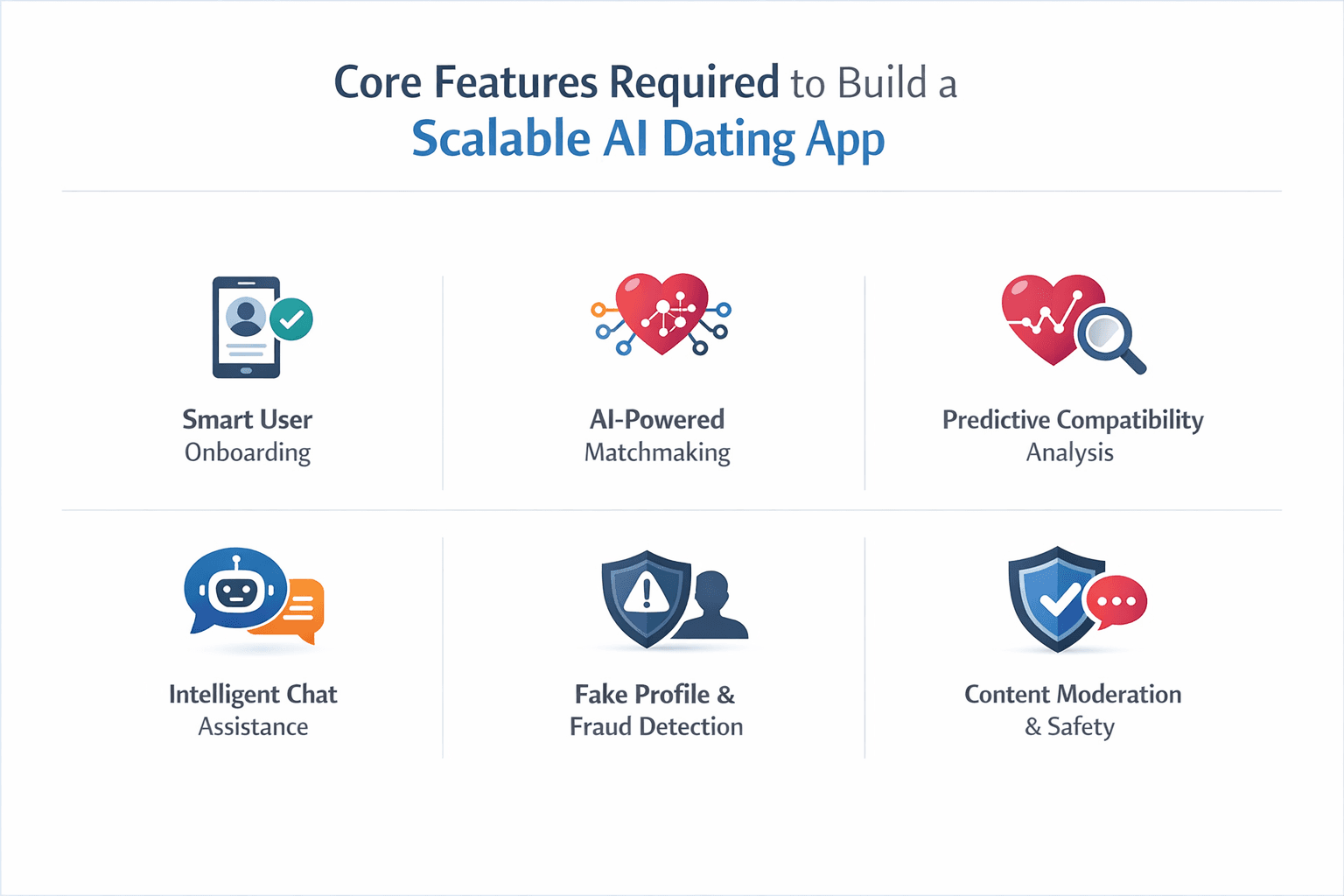
A successful AI platform must balance intelligent automation with User-focused design while supporting scalability, security, and continuous optimization. The following core features form the technical foundation of high-performing AI dating apps built for long-term growth and monetization.
Smart User Onboarding
AI-driven onboarding leverages questionnaires, behavioral inputs, and optional social data to infer personality traits and relationship intent. These insights feed directly into matchmaking algorithms through AI APIs, enabling accurate recommendations and reducing cold-start problems from the first user interaction.
AI-Powered Matchmaking
Machine learning models process user behavior, profile interactions, swipe patterns, and communication data via real-time AI integrations. These systems continuously retrain using feedback loops, ensuring matchmaking accuracy improves over time while adapting to evolving user preferences.
Predictive Compatibility Analysis
AI assigns dynamic compatibility scores by analyzing long-term indicators such as engagement depth, conversational sentiment, shared interests, and interaction frequency. These scores are calculated using predictive models integrated through backend AI services, helping users prioritize high-potential matches.
Intelligent Chat Assistance
AI chat systems use NLP models and conversational APIs to generate icebreakers, response suggestions, and tone-aware prompts. This reduces conversation friction, improves engagement quality, and increases successful match-to-conversation conversion rates across the platform.
Fake Profile & Fraud Detection
AI models monitor behavioral anomalies, messaging velocity, login patterns, and profile inconsistencies to detect bots and fraudulent accounts. Integration with identity verification and third-party security APIs strengthens platform trust while minimizing manual moderation overhead.
Content Moderation & Safety
NLP-based moderation engines analyze text, images, and interaction context in real time to flag harassment, explicit content, or policy violations. These AI moderation APIs protect users, ensure compliance, and safeguard brand reputation without impacting platform performance.
Business Advantages of AI Powered Dating App Development
For startups and entrepreneurs, investing in AI-powered dating app development delivers measurable advantages across user engagement, operational efficiency, and revenue scalability. AI enables platforms to move beyond basic matchmaking and build intelligent systems that continuously optimize performance and growth.
Data-Driven Decision Making
AI systems transform raw user interaction data into actionable insights, enabling founders to optimize features, pricing models, and engagement strategies. This data-driven approach reduces guesswork and supports smarter product iterations aligned with real user behavior.
Improved User Retention and Lifetime Value
AI personalization increases session frequency, match success rates, and conversation quality, directly improving user retention. Higher engagement extends customer lifetime value, making acquisition costs more sustainable and improving overall unit economics.
Operational Cost Optimization
AI automation reduces dependency on manual moderation, customer support, and matchmaking operations. By integrating AI and third-party APIs, platforms achieve higher efficiency while controlling infrastructure and staffing costs as the user base grows.
Faster Time to Market with AI Integrations
Pre-trained AI models and ready-to-use APIs for matchmaking, moderation, and chat assistance accelerate development cycles. This allows startups to validate ideas faster, launch MVPs efficiently, and iterate based on real-world usage data.
Enhanced Platform Security and Trust
AI-powered fraud detection, behavioral analysis, and content moderation significantly reduce fake profiles and abuse. Strong safety mechanisms increase user trust, improve app ratings, and support long-term brand credibility in competitive dating markets.
Scalable Monetization Opportunities
AI enables advanced monetization models such as premium matchmaking tiers, compatibility insights, and personalized recommendations. These intelligent features justify higher subscription pricing and unlock recurring revenue streams without degrading user experience.
Step-by-Step Process to Build an AI Dating App
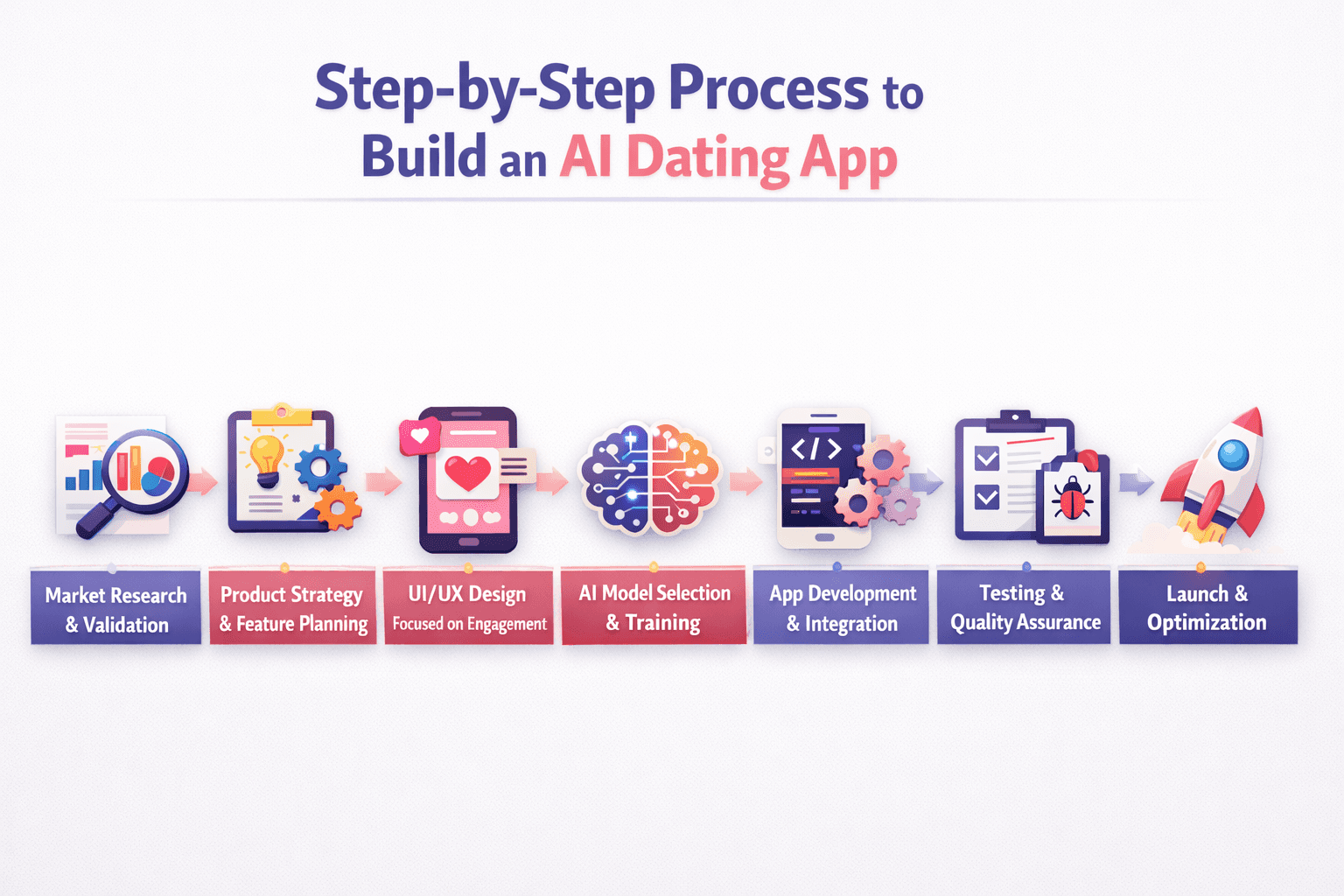
If you plan to build an AI dating app, following a structured, execution-ready development approach is essential. A well-defined process minimizes technical risks, controls costs, and ensures AI components align with long-term scalability, compliance, and monetization objectives.
Market Research & Validation
This phase involves identifying a clear niche such as casual dating, long-term relationships, or region-specific platforms. Competitor analysis, audience behavior studies, and demand validation help define differentiation, pricing potential, and feasibility before committing engineering resources.
Product Strategy & Feature Planning
Define core functionalities, AI use cases, data flow architecture, and monetization logic early. Clear product strategy prevents scope creep, aligns AI capabilities with business goals, and enables founders to prioritize features based on ROI and market impact.
UI/UX Design Focused on Engagement
UI/UX design must support AI-driven flows by reducing friction across onboarding, matching, and communication. Intuitive interfaces ensure users interact naturally with AI features, improving adoption rates, session duration, and overall engagement metrics.
AI Model Selection & Training
Selecting the right AI models depends on matchmaking complexity, personalization depth, and moderation requirements. Models require high-quality datasets, bias control, and continuous retraining pipelines to maintain accuracy as user behavior evolves.
App Development & Integration
This stage includes building scalable frontend and backend systems while integrating AI engines, third-party APIs integration, payment gateways, and analytics tools. Efficient API communication and modular architecture are critical for performance, flexibility, and future feature expansion.
Testing & Quality Assurance
AI systems must be tested for accuracy, latency, scalability, and security under real-world conditions. Continuous testing ensures reliable recommendations, stable integrations, data integrity, and compliance with privacy and platform security standards.
Launch & Optimization
Post-launch optimization focuses on monitoring AI performance using live user data. Feedback loops, behavioral analytics, and model fine-tuning help improve personalization accuracy, engagement outcomes, and monetization efficiency over time.
Challenges in AI Dating App Development
Despite its benefits, AI-based dating app development introduces technical, regulatory, and operational challenges. Addressing these risks early is critical for startups to ensure compliance, maintain user trust, and achieve scalable, long-term platform sustainability.
Data Privacy & Compliance
AI dating apps must comply with global data protection regulations by implementing secure data storage, encryption, and transparent consent mechanisms. Clear privacy policies and governance frameworks are essential to mitigate legal risks and maintain user confidence.
AI Bias & Accuracy
Biased or poorly trained AI models can produce unfair or inaccurate match recommendations. Continuous monitoring, diverse training datasets, bias audits, and model retraining pipelines are required to ensure ethical AI behavior and reliable matchmaking outcomes.
High Initial Investment
AI development involves upfront costs related to model training, infrastructure, and integrations. However, long-term automation in matchmaking, moderation, and analytics offsets initial investment by reducing operational overhead and supporting scalable revenue growth.
User Trust
Excessive automation may feel impersonal or intrusive to users. Successful platforms balance AI intelligence with user control and transparency, ensuring AI-driven decisions enhance experiences without undermining authenticity or emotional connection.
AI Dating App Development Cost Breakdown
Creating an AI dating app requires strategic planning and significant investment. The cost of developing an AI dating app in the USA directly impacts your budget strategy, scalability planning, and long-term ROI, making it a critical factor for founders and decision-makers before product launch.
App Complexity | Features Included | Estimated Cost (USD) |
|---|---|---|
Basic Dating App | User profiles, swipe right/left functionality, basic matchmaking logic, location-based search, standard messaging, basic backend architecture. | $8,000 - $12,000 |
Advanced Dating App | All basic features, AI-assisted matching, video profiles, voice and video chat, in-app purchases, analytics dashboards, enhanced security layers. | $14,000 – $22,000 |
Custom & AI-Powered Dating App | All advanced features, custom UI/UX, AI-based recommendations, predictive compatibility scoring, gamification, social media integration, community features, scalable cloud infrastructure. | $22,000 – $30,000+ |
Key Factors Affecting AI Dating App Development Cost
App Complexity
Cost varies significantly based on feature depth, AI usage, and real-time capabilities. Basic AI-assisted matchmaking is more affordable, while advanced emotional analysis, behavioral prediction, and real-time personalization require additional engineering effort and scalable infrastructure investment.
AI Model Sophistication
Pre-trained AI models reduce development time and initial cost but offer limited customization. Custom-trained models demand higher investment due to data preparation, training pipelines, bias handling, and continuous optimization to maintain accuracy and long-term scalability.
Platform Choice
Developing for a single platform reduces upfront cost, while supporting both Android and iOS increases development scope. Cross-platform frameworks can lower UI expenses, but backend systems and AI workflows must still be optimized for consistent performance.
Team Location
Development cost depends on team geography and technical expertise. Offshore teams often provide cost efficiency, while local or hybrid teams may offer faster collaboration, stronger domain knowledge, and better alignment with regulatory and data compliance requirements.
Third-Party Integrations
AI services, payment gateways, cloud infrastructure, analytics tools, moderation systems, and notification platforms introduce recurring costs. These integrations are critical for scalability, security, and monetization and must be planned into both initial development and long-term operational budgets.
Revenue Generation Strategies for AI Dating Applications
A strong monetization strategy is critical for sustainability, long-term profitability, and investor confidence. AI-powered dating platforms enable diversified revenue streams by leveraging personalization, behavioral intelligence, and predictive analytics without compromising user experience or platform trust.
Subscription Plans
Subscription models provide predictable recurring revenue by offering premium AI-driven features such as advanced matchmaking algorithms, unlimited interactions, priority profile visibility, and compatibility insights, making them highly attractive for scaling user lifetime value and investor-focused growth metrics.
In-App Purchases
In-app purchases monetize short-term user intent by offering boosts, super likes, enhanced discovery, and AI-generated match insights. These microtransactions complement subscriptions and significantly increase average revenue per user through context-aware, behavior-triggered offers.
Freemium Model
The freemium approach maximizes user acquisition by keeping core features free while gating advanced AI-powered tools behind paid tiers. This model allows startups to demonstrate value early, convert engaged users efficiently, and reduce customer acquisition cost.
Advertisements
AI-driven ad targeting enables relevant, non-intrusive advertising based on user behavior, interests, and engagement patterns. Intelligent ad placement improves click-through rates while maintaining user experience, making advertising a scalable secondary revenue stream.
Data-Driven Insights (Ethical Use)
AI aggregates anonymized behavioral data to generate high-level insights for partnerships and market research. When implemented with strict privacy compliance and consent frameworks, this approach unlocks additional revenue without exposing personal user data or violating regulations.
Why Choose Deliverables for AI Dating App Development Services?
Choosing the right dating app development company is critical for building a scalable, secure, and revenue-ready AI dating platform. Our approach combines deep AI expertise, proven engineering practices, and startup-focused execution to help entrepreneurs launch and scale confidently.
AI-First Architecture & Strategy
We design AI-first system architectures that integrate matchmaking, personalization, moderation, and analytics from day one. Our strategy ensures AI models align with business goals, scalability requirements, and long-term monetization rather than acting as standalone features.
End-to-End AI Dating App Development
From ideation and product strategy to AI model integration, app development, and post-launch optimization, we deliver complete lifecycle support. This eliminates vendor dependency and ensures consistency across design, engineering, and AI performance.
Scalable & Secure Technology Stack
We build platforms using scalable cloud infrastructure, modular APIs, and secure data pipelines. Our architecture supports rapid user growth, high concurrent activity, and strict data protection standards required for AI-driven consumer applications.
Expertise in AI & API Integrations
Our team integrates advanced AI models, third-party APIs, payment gateways, analytics tools, and moderation services seamlessly. This accelerates development timelines while ensuring reliable performance, flexibility, and future-ready expansion capabilities.
Startup & Investor-Focused Execution
We prioritize MVP readiness, cost optimization, and measurable KPIs such as retention, engagement, and revenue potential. Our development approach is designed to support fundraising conversations and long-term investor confidence.
Ongoing Support & AI Optimization
Post-launch, we continuously monitor AI performance, retrain models, and optimize personalization using real user data. This ensures sustained accuracy, improved engagement outcomes, and consistent platform evolution as market and user behavior change.
Conclusion
AI is fundamentally transforming how dating platforms are built, scaled, and monetized. From intelligent matchmaking and personalization to automated moderation and predictive insights, AI enables startups to move beyond basic swipe mechanics and create data-driven relationship ecosystems.
For entrepreneurs and decision-makers, successful AI dating app development requires more than feature implementation. It demands a clear product strategy, ethical AI design, scalable architecture, regulatory compliance, and sustainable monetization planning. At Deliverable Agency, we help startups and businesses navigate this complexity by designing and developing AI-powered dating platforms that are secure, scalable, and built for long-term growth.
Request a Custom AI Dating App Cost Estimate
Get a detailed development cost breakdown, feature roadmap, and AI integration strategy tailored to your startup.
Some Topic Insights:
Can I develop an app using AI?
Yes, you can develop an app using AI by integrating machine learning models, AI APIs, or custom-trained algorithms. AI enables personalization, intelligent recommendations, automation, fraud detection, and predictive analytics across dating and other data-driven platforms.