



Time to read :
1 min read
About a decade ago, people mostly used fuel-based vehicles. However, higher fuel demand and lower supply increase its price and make it difficult for them to afford.
Today, things are a lot different. The increase in electric vehicles helps people avoid fuel costs and save money in the long run. This shift has created a great opportunity for both startups and businesses. Companies are now focusing on building smart digital solutions to make EV charging simpler and more convenient.
Among them, one key solution is the EV charging app. This app is developed to help drivers find nearby charging stations, check prices, track charging progress, and even monitor their vehicle’s battery health.
So, if you are a startup planning to build a new app or a business looking to grow in this industry, this blog guide is for you. It provides information about EV charging app development in detail.
EV Market Statistics 2026: Why Invest Now?
The global electric vehicle (EV) market is rising significantly. This creates huge opportunities for investors and businesses to tap into this industry.
Global EV Market Growth
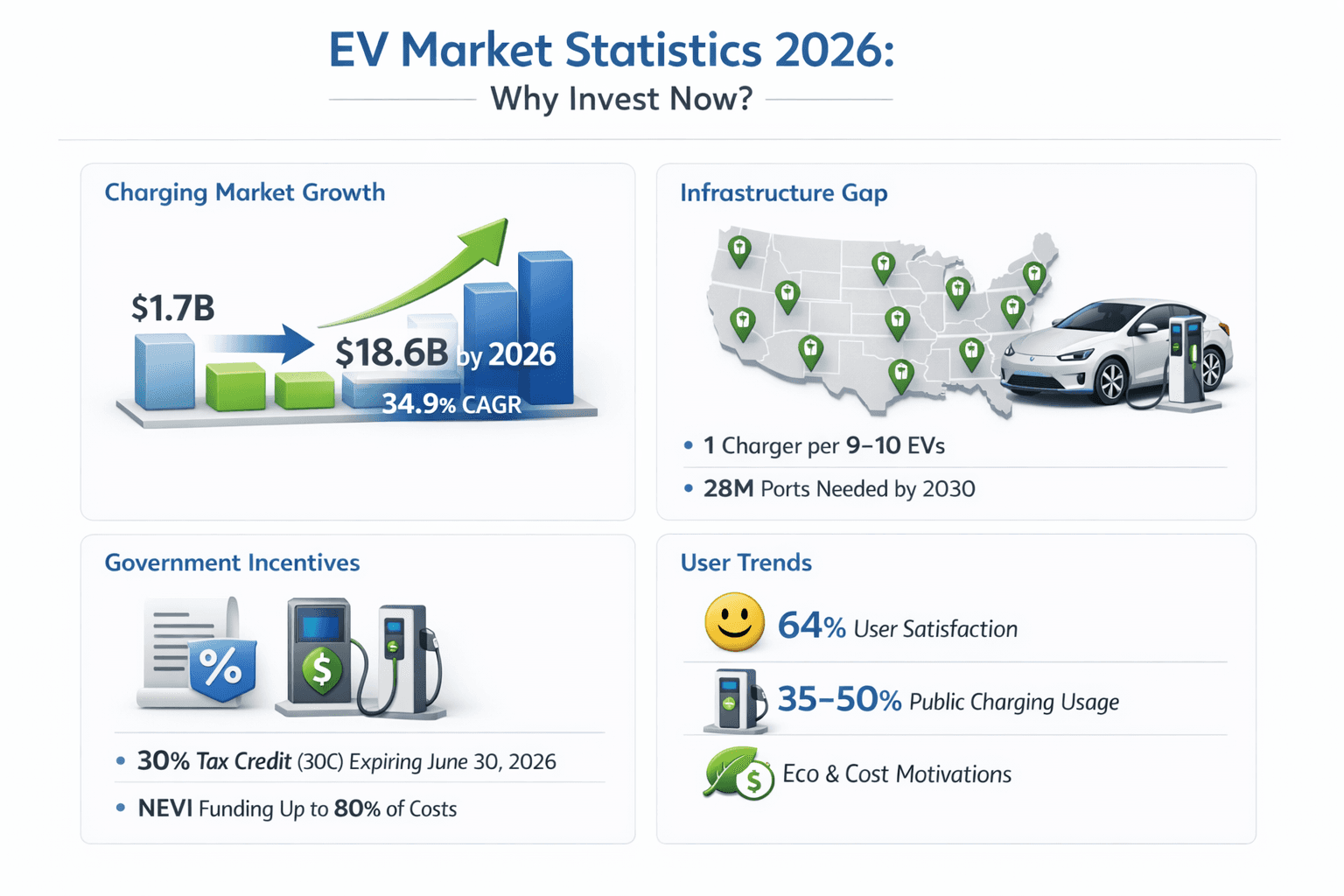
The global EV charging infrastructure is expected to grow from $1.7 billion in 2018 to $18.6 billion by 2026, at a CAGR of 34.9%. With a strong demand for fast-charging and range-extending technologies, North America is leading this change. This creates a great opportunity to invest in EV charging management software development and build smart charging ecosystems to power the next generation of mobility.
Infrastructure Gap
EV sales are rising much faster than charging stations are being built. Ideally, there should be one public charger for every 9-10 EVs. However, as of 2025, only a few US states, like Washington D.C. and Vermont, meet that target. By 2030, the US will need about 28 million charging ports to support an estimated 33 million EVs. This infrastructure gap is a sign to invest in this market and grow rapidly.
Government Incentives and Subsidies
Government programs are making it easier and more profitable to invest in EV charging infrastructure. The Alternative Fuel Vehicle Refueling Property Tax Credit (30C) gives businesses a 30% tax credit on hardware and installation costs, which is up to $1,000 per site. However, this incentive will expire on June 30, 2026, so developers and investors are under pressure to complete their projects before the deadline.
Another major program, the National Electric Vehicle Infrastructure (NEVI) initiative, is helping build fast-charging networks along highways. Over 121 stations had already gone live across 16 states by the end of 2025. NEVI covers up to 80% of total project costs, which includes hardware, software, and electrical setup. This makes it a powerful funding source for large-scale EV charging points.
User Demographics
The demand for EV vehicles is rising rapidly, and so is the need for reliable charging stations. In North America, about 64% of users are satisfied with public charging stations. However, some still find issues with slow charging speeds and unreliable equipment.
When it comes to motivation, nearly 39.7% of drivers choose EVs to help the environment. However, the gap with “cost savings” is rapidly closing as fuel prices change. Most EV owners have chargers at home, yet they still do 35% to 50% of their charging in public places. This shows how important reliable and easy-to-use charging apps are for finding and managing public stations.
Types of EV Charging Solutions You Can Build
Before getting started, investors and developers need to decide who their custom EV charging app solutions will serve. Will it be the driver, the charging station owner, or the energy grid itself?
Station Finder Apps (Aggregator Apps)
These apps are designed for drivers. They bring together information from different charging networks into one easy-to-use platform using a system called OCPI (Open Charge Point Interface). Their main advantage is to provide accurate and real-time data. Using this app, users can see which chargers are available, what plug types they support, and even read reviews from other drivers before heading out.
EV Charging Management Software (CPO Platforms)
These solutions are designed for charging station owners and operators who need a central system, or “Command Center,” to manage all their charging assets. They usually include features like:
Remote Diagnostics, which help operators monitor stations in real-time and fix up to 80% of issues remotely, without sending a technician.
Smart Load Balancing to prevent power grid overloads and reduce high electricity costs from utility companies.
These apps also allow businesses like retail brands, hotels, and apartment complexes to launch custom-branding charging portals as per users’ needs.
P2P Charging Networks (Airbnb for Chargers)
P2P charging platforms let private charger owners share their home chargers with other EV drivers. This EV charging business model works best in busy cities like New York, where public charging spots are limited. The app or software behind these networks includes time-slot booking management, secure payments, and automated billings.
OEM Branded Apps
Car manufacturers like Tesla, Ford, and GM build their own charging apps to give drivers a smooth and all-in-one experience. These charging apps are often called “Plug & Charge.” They connect directly to the car’s built-in systems and give precise battery health updates and real-time charging suggestions. The apps also recommend the best places to stop and charge based on the vehicle’s current battery level and energy usage patterns.
Monetization Strategies: How Your App Makes Money
An EV charging app development can be expensive at first. But successful platforms use multiple revenue streams to cover those costs and stay profitable over time.
Direct Transaction and Markup Fees
The simplest way to make money from an EV charging app is by reselling electricity. In this model, operators buy electricity at wholesale rates and sell it to users with a 20% to 50% markup.
You can generate revenue in these ways:
Per-kWh Charging: This is the most common model in the United States. Here, drivers pay only for the amount of energy they have used.
Time-Based Billing: In this model, users are charged by the minute. This is often used in areas with strict utility laws or to keep chargers available for more drivers.
Connection and Idle Fees: You can charge extra from the drivers who stay plugged in even after charging finishes. This helps improve station availability and reduce wait times.
Subscription Models and Membership Passes
A subscription model is something every software business aims for. Companies like Electrify America and EVgo use this approach by charging drivers a monthly fee (usually between $6.99 and $12.99) in return for discounted charging rates. This model keeps users loyal, reduces the risk of them switching to competitors, and gives investors a predictable and long-term cash flow.
In-App Advertising and Local Ecosystem Integration
Since a fast-charging session usually takes 20 to 40 minutes, drivers have plenty of free time while they wait. Your app can turn that dwell time into profit by offering:
Location-Based Offers: Show nearby cafes, restaurants, or shops with special discounts or coupons.
Affiliate Partnerships: Team up with insurance companies or home charger installers to earn commissions when users buy through your app.
Data Monetization and Grid Services
Your app can also make money from the information that does not identify individuals but shows how, when, and where people charge their vehicles.
This data is valuable for:
City Planners: They use it to find the best locations for new charging stations.
Utility Companies: They rely on it to manage energy demand, especially during peak hours. For example, the app can temporarily slow down charging during times of high grid usage. This helps utilities prevent overloads and even earn rebates in return.
eCommerce Integration
Your app can also become an online store for EV-related products. It can include items, like Level 2 home chargers, NACS-to-CSS adapters, and vehicle accessories, directly through the app. The trust you built through your charging services can be used to expand into eCommerce and create another reliable source of revenue.
Must-Have Features for a Successful EV Charging App
A great EV charging app needs to be easy for drivers to use while having a strong backend for operators to manage the system smoothly.
Here are the key features every app should include:
User Panel (For Drivers) Core Functionality
Drivers need a frictionless path to a reliable charge. That is why this panel should include features like:
Unified Registration: This feature allows users to sign up quickly using social media accounts or biometric authentication (like FaceID or fingerprint) for a faster and smoother start.
Advanced Geolocation: It provides detailed maps that show nearby chargers, their real-time status, and power output in kW.
Secure Payment Integration: This feature supports convenient payment options, like Apple Pay, Google Pay, and major credit cards, through PCI-compliant gateways for maximum security.
EV Trip Planner: It offers a smart route planner that considers speed, terrain, and weather to estimate range accurately and recommend the most efficient charging stops along the way.
Admin Panel (For CPOs and Station Owners)
This panel is the central control hub of your EV charging platform. It is where operators manage everything behind the scenes to keep the network running smoothly.
Here are the key features of this panel:
Dynamic Load Management: This feature automatically balances available power across multiple chargers to prevent overloads or tripped circuit breakers.
Financial Reconciliation: It simplifies complex billing by managing payments between site owners, energy providers, and roaming partners.
Station Health Monitoring: It shows real-time dashboards displaying each charger’s uptime, session count, and energy usage. Because of this feature, operators can spot issues early.
CRM and Customer Support: This includes built-in tools to manage user accounts, resolve billing issues, and even remotely reboot malfunctioning chargers when needed.
Advanced/USP Features
Your EV charging app should include advanced features to stand out in a competitive market. Here are some of the features to consider:
AI-Powered Port Availability Prediction: It uses machine learning to study past charging data and predict whether a charging port will be available when the driver arrives. This helps users plan their trips more efficiently.
AR Wayfinding: It uses Augmented Reality (AR) to visually guide drivers to the exact charging spot. This feature is highly useful in busy underground parking areas.
Plug & Charge (ISO 15118): It lets the car and charger communicate directly and handle authentication and payment automatically. Drivers can simply plug in and start charging without an app or RFID card.
V2G (Vehicle-to-Grid) Support: It allows EV owners to send energy back to the grid during peak demand periods and earn money or credits in return.
Tech Stack & Protocol: How It Works
EV charging app development uses technology, like Open Charge Point Protocol (OCPP), to communicate between a Charging Station (CS) and the Charging Station Management System (CSMS).
It includes:
OCPP 1.6 (JSON): This is the most widely used version today. It supports basic smart charging and firmware updates, but offers limited security features.
OCPP 2.0.1: This is the recommended standard for 2026 projects. It brings major improvements, like device management, improved security, and ISO 15118 support.
For high performance and smooth cross-platform operation, the following stack is recommended:
Component | Technology Recommendation | Reason for Choice |
|---|---|---|
Frontend Framework | Flutter or React Native | Cross-platform development reduces cost and ensures feature parity across iOS and Android. |
Backend Environment | Node.js or Go (Golang) | High concurrency and asynchronous processing are required for real-time WebSocket communication with chargers. |
Database Systems | PostgreSQL (Relational) + Redis (Caching) | PostgreSQL for robust billing; Redis for high-speed retrieval of charger availability status. |
Cloud Infrastructure | AWS (with IoT Core) | AWS provides specific tools for managing thousands of concurrent IoT device connections. |
Mapping and Routing | Mapbox SDK | Superior customization for EV range “polygons” and generally more cost-effective at scale than Google Maps. |
Step-By-Step EV Charging App Development Process
An EV charging app development process takes six to twelve months. It requires close coordination between software development and hardware testing. Here are the steps taken to develop this app:
Step 1: Market Research and Regulatory Alignment
Before writing any code, understanding the regulations and requirements of your target market is essential. For example, in the US, developers must comply with NEVI standards and keep track of OBBB tax credit deadlines. This ensures your app meets both technical and policy expectations in your launch markets.
Step 2: UI/UX Design and Prototyping
This step sets the foundation for an intuitive and driver-friendly experience. Your EV charging app should be easy to use, even in bright sunlight or by users with limited tech experience. Therefore, make sure to build interactive prototypes to test the “Happy Path” in under 15 seconds.
Step 3: Hardware Integration
This is where most projects struggle. Your app’s software must communicate smoothly with charger hardware. This connection enables your app to do things like:
Start or stop a charging session
Show real-time charging status
Process payments
Monitor charger performance and energy use
Therefore, the app must “speak the same language” as the charger. An EV app developer uses a standard communication protocol called OCPP (Open Charge Point Protocol) to mimic real-world issues.
Step 4: Backend Engineering & Security Implementation
The backend is the engine of your app. It handles user accounts and authentication, processes payments and tracks transactions, balances energy loads, and manages charger data. Therefore, use TLS 1.3 encryption to protect data transfers and certificate-based authentication to verify that only trusted devices and servers are connected.
Step 5: Testing
Testing happens in two key phases:
Simulation Testing: Here, the EV charging station app development company uses virtual charge points for unit and integration testing.
Real-World Pilot: In this phase, they run an Alpha test with actual EVs and chargers to measure payment latency, network reliability, and user flow stability.
This step ensures your app performs smoothly before the launch.
Step 6: Launch & Post-Launch Maintenance
Once your app goes live on the app stores, the work is not over. Reserve about 20% of your total budget for annual maintenance. Regular updates are essential to ensure compatibility with the new charger firmware and mobile system updates from Apple and Google.
How Much Does EV Charging App Development Cost?
The EV charging app development cost depends on three main factors, the complexity of the app, the number of features included, and the location of your development team.
Here is a general cost breakdown based on these factors:
Cost Breakdown by Complexity
Basic (MVP) App: These apps include core features like station finder, simple payment options, and a basic user interface. Hence, it costs from $40,000 to $100,000.
Mid-Level App: These types of apps offer more advanced tools, like smart routing, charging reservations, and a built-in content management system (CMS) for updates. The estimated cost of this EV charging app ranges from $100,000 to $250,000.
Enterprise-Grade App: This is a fully featured platform that includes AI and AR capabilities, Vehicle-to-Grid (V2G) integration, fleet management tools, and IoT connectivity. This app costs between $250,000 and $500,000.
Cost Breakdown by Region (Hourly Rates)
When you hire EV App developers in the US, you get the highest degree of regulatory and hardware proximity. However, it comes at a premium.
USA: $100 - $250 per hour
Western Europe: $80 - $150 per hour
Eastern Europe: $40 - $90 per hour
India/Southeast Asia: $25 - $55 per hour
Hidden Costs of Operation
The cost of an EV charging app extends beyond the development phase. Here are the key recurring costs site hosts and app owners must plan for:
Map API Scaling: Platforms like Mapbox charge about $5 per 1,000 map loads beyond the free limit. On the other hand, Google Maps costs around $7 per 1,000 loads.
Network Access Fees: Most Charge Point Operators (CPOs) charge between $400 and $1,800 per charger per year to maintain software connectivity.
Payment Gateway Fees: Standard processing fees are about 2.9% + $0.30 per transaction, which can affect profits, especially on small Level 2 charging sessions.
Maintenance: Expect to spend around 15% to 20% of your initial build cost each year for updates, bug fixes, and security patches.
Challenges in EV App Development and Strategic Solutions
Building an EV charging app comes with a set of technical and operational challenges that demand smart and scalable solutions. Here are some of these challenges and the ways to solve them:
Hardware Compatibility and the NACS Transition
The North American market is shifting from the CCS (Combined Charging System) to Tesla’s NACS (North American Charging Standard). Therefore, it is important to design your app to recognize and filter both charging standards. Operators should plan for dual-head chargers or implement adapter management systems to stay compatible with all EV models.
Data Latency and Availability Accuracy
Nothing frustrates users more than seeing a charger marked “Available” when it is already in use. Use WebSockets for real-time updates instead of slower “polling” methods. Implement edge caching so that maps and charger data load in under two seconds.
Connectivity in Dead Zones
Highways, tunnels, and underground parking lots often have poor or no network signal. Add an Offline Mode that downloads the route map and nearby stations in advance. The charger itself should support local authentication to allow users start a session even without cloud connectivity.
High Energy Demand Charges for Fast Chargers
Fast chargers that pull 150 kW or more can lead to sky-high utility costs during peak hours. Integrate the app with Battery Energy Storage Systems (BESS) to enable peak shaving. The system draws power from the battery during high-demand periods and recharges it when electricity rates are lower.
Key Takeaway
The future of EV infrastructure is transforming and growing. With the US tax credits nearing expiration, the demand for smart, reliable, and feature-rich EV charging software is increasing significantly. Therefore, it is essential to turn complex technology into an effortless user experience.
The success of an EV charging app does not lie in great design or clean mode, but in keeping stations online and drivers satisfied every single time they change. Investors and businesses that act now will shape the next decade of electric mobility.
The message is clear. The market is growing fast, the infrastructure gap is wide, and the opportunity is now.
Build the future of mobility. Get your free strategic consultation and quote for your EV charging app development from Deliverables today.
Have an Idea for an App or Website?
At Deliverables, we specialize in building custom digital products that solve real-world problems. Tell us your idea, and our expert team will help you craft a plan to build your dream.
Some Topic Insights:
What is an EV charging app and how does it work?
An EV charging app helps drivers find nearby charging stations, check availability, start or stop charging, make payments, and track charging progress in real time. It connects with charging hardware using standard protocols like OCPP to manage sessions smoothly.