



Time to read :
1 min read
AI in logistics software has moved past the pilot stage. In 2026, it sits inside daily dispatch decisions, warehouse robots, and freight pricing engines.
Early adopters using AI for supply chain automation report strong returns within the first year. Some report labor productivity gains of 25 percent and shorter order lead times of nearly 27 percent.
This shift is changing what logistics software development actually looks like. It is no longer about building a tracking dashboard and calling it done.
This guide breaks down where AI genuinely helps, where it still needs a human in the loop, and what it means if you are planning your next logistics platform.
Where AI Actually Sits Inside Logistics Software Today
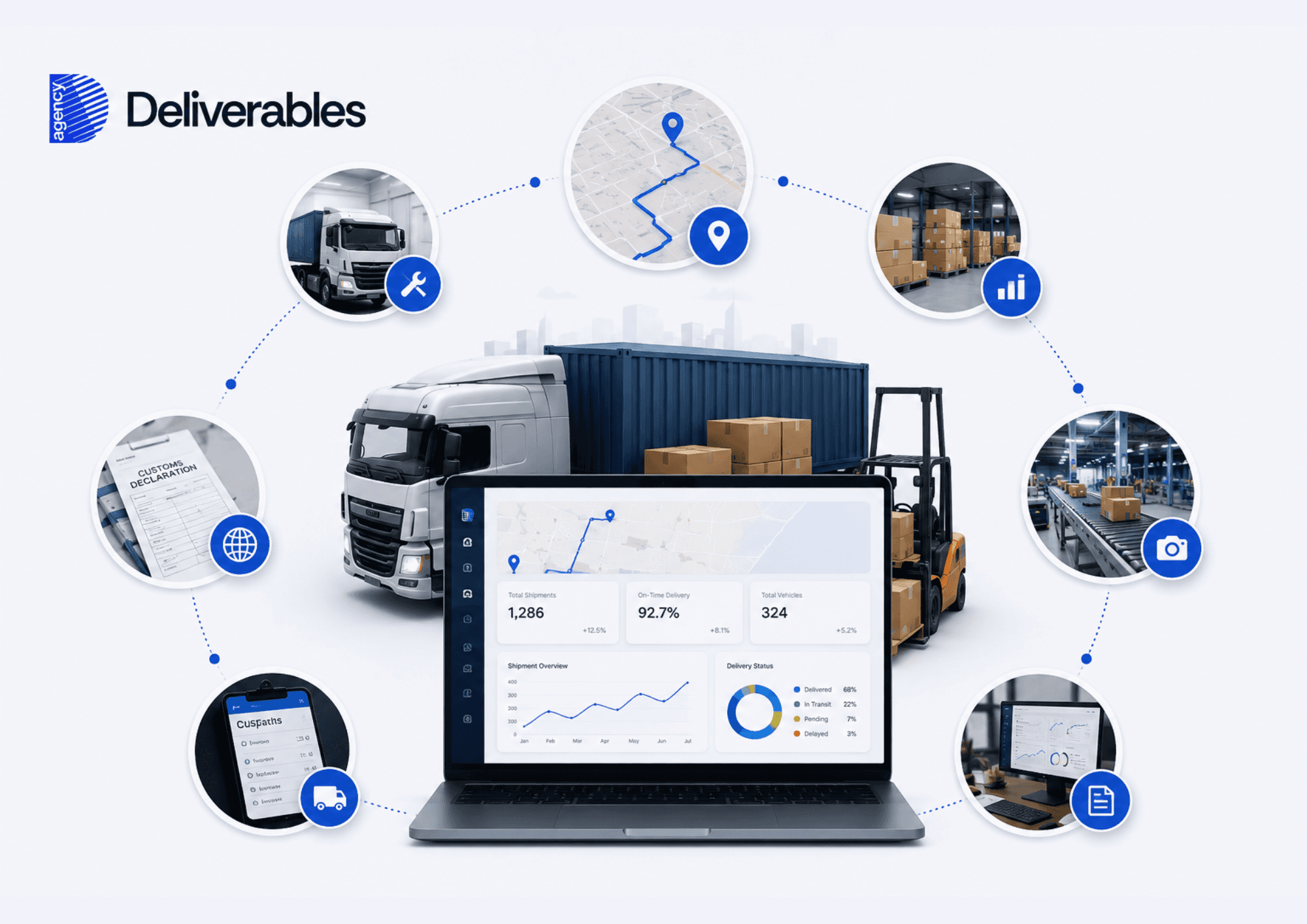
AI is not one single feature. It works across different layers of a logistics platform, each solving a different problem.
Route optimization. AI models study traffic, weather, and delivery windows together. They rebuild routes in real time instead of once at the start of the day.
Predictive maintenance. Sensors on trucks and warehouse equipment feed data into models that flag a breakdown before it happens. This cuts unplanned downtime significantly.
Demand forecasting. AI reads past order data, seasonal patterns, and even local events to predict what stock you will need and where.
Computer vision in warehouses. Cameras paired with AI now check package damage, count inventory, and guide robots without manual scanning.
Automated dispatch and load matching. AI matches freight to available trucks and drivers based on cost, distance, and delivery priority, often faster than a human planner.
Document and customs processing. Natural language models now read shipping documents, invoices, and customs forms, then pull out the data your system needs automatically.
AI Function | What It Replaces | Typical Impact |
Route optimization | Manual route planning | Lower fuel cost, faster delivery |
Predictive maintenance | Scheduled or reactive repairs | Less unplanned downtime |
Demand forecasting | Spreadsheet based forecasting | Better stock accuracy |
Computer vision | Manual quality checks | Faster, more accurate inspection |
Document processing | Manual data entry | Fewer errors, faster customs clearance |
The Real Numbers Behind AI in Logistics Software
The interest in AI in logistics software is not just talk. The data backs it up.
Recent industry research points to an average return on investment near 190 percent for logistics firms actively deploying AI. Companies that adopted AI route optimization also held their margins steady while non adopters saw them shrink.
Job market data tells a similar story. Demand for supply chain roles that require AI skills has grown sharply since 2023, and it keeps climbing through 2026.
Still, most companies remain in early stages. A large share of logistics operators are stuck experimenting with isolated tools instead of running AI across their full platform. That gap is exactly where the next wave of opportunity sits.
From Predictive to Agentic: What Changed in 2026
Until recently, AI in logistics mostly meant prediction. A model would forecast demand or flag a delay, and a human would decide what to do next.
That is shifting fast. 2026 is the year agentic AI started showing up in real logistics platforms, not just demos.
An agentic system does not just flag a delay. It checks alternative routes, reprices the shipment if needed, and reroutes it, all without waiting for a person to approve every step.
This is also changing how logistics software gets built. The newer platforms are designed as AI native from day one. Learning and decision logic sit inside the core architecture instead of being added later as a bolt on feature.
Dispatchers and planners are not being replaced by this shift. They are working alongside AI systems that hand them ranked recommendations instead of raw data.
What This Means for Choosing a Logistics Software Development Company
Building AI powered logistics software takes a different skill set than building a standard tracking app.
A capable logistics software development company today needs people who understand data pipelines, not just app screens. Clean, structured data is what makes AI models useful in the first place.
Look for a team that has handled real integrations with carrier APIs, ERP systems, and IoT sensor data. AI models are only as good as the data feeding them, and most of that data lives in messy, disconnected systems.
Ask how they handle model monitoring after launch. An AI feature that works well on day one can drift and lose accuracy over time if nobody is watching it.
A development partner offering true logistics software development services should also be honest about where AI adds real value and where a simple rule based feature does the job just as well, at a fraction of the cost.
AI Development Services Cost for Logistics Platforms
Adding AI to a logistics platform is not a flat fee. The cost depends heavily on how deep the AI goes.
Simple API integration. Connecting your platform to an existing AI service, like a mapping or forecasting API, usually costs $5,000 to $20,000.
Mid level AI features. A custom recommendation engine, demand forecasting model, or route optimization layer built on your own data typically runs $40,000 to $150,000.
Full agentic or custom trained systems. Enterprise platforms with autonomous decision making, multiple integrations, and proprietary model training can run $150,000 to $500,000 or more.
Data preparation is usually the biggest hidden driver of AI development services cost. It often takes up 30 to 60 percent of the total project time, more than the actual model building.
Plan for ongoing costs too. Annual AI maintenance, covering monitoring, retraining, and inference costs, typically runs 15 to 25 percent of the original build cost every year.
Common Mistakes Companies Make With AI in Logistics Software
Not every AI rollout goes smoothly. A few mistakes show up again and again across the industry.
Buying isolated point tools instead of a unified platform. A route optimizer that does not talk to your WMS creates more manual work, not less.
Skipping the data cleanup step. A model trained on inconsistent or incomplete data learns the wrong patterns fast.
Removing humans from the loop too early. The strongest 2026 deployments keep a person reviewing AI recommendations, especially on high value shipments.
Underestimating integration cost. Connecting AI to legacy ERP or WMS systems almost always takes longer than the model building itself.
No plan for model drift. An AI feature that is accurate at launch can quietly become less accurate as your operations change.
Industry research on AI projects overall found a large share fail to hit their intended business value, and cost overruns at production scale are common. The businesses avoiding this usually start small, measure results, and expand only once a use case proves itself.
AI in Logistics Software Across the UAE and Middle East
The Middle East logistics sector is moving fast on this, and Dubai sits right at the center of it.
Free zone operators, port authorities, and last mile delivery companies across the UAE are investing in AI driven route planning and automated customs document processing. Dubai Trade integrations paired with AI document readers are cutting manual clearance time significantly.
Local businesses often pair a UAE based logistics software development company for compliance and integration work with an offshore AI development services team for the model building itself. This keeps regulatory work close to home while controlling engineering costs.
Warehouse operators in the region are also adopting computer vision for inventory checks, especially across large scale free zone distribution centers where manual counting no longer scales with order volume.
For UAE businesses, the smartest starting point is usually one well scoped AI feature, like automated rate comparison or predictive ETA, rather than a full platform rebuild on day one.
How to Start Adding AI to Your Logistics Platform
You do not need a full AI native rebuild to get real value. A staged approach works better and costs far less upfront.
Start with a clean data foundation. Fix the gaps in your shipment, inventory, and carrier data before adding any model on top of it.
Pick one measurable use case first. Route optimization or demand forecasting are strong starting points because their impact is easy to track in dollars saved.
Run a paid discovery sprint with your logistics software development company before committing to a full build. This step alone prevents most budget overruns later.
Keep a human reviewing AI decisions until the model proves itself over a few months of real operations. Full automation should be earned, not assumed.
Final Thoughts
AI in logistics software is no longer an experiment sitting on the side. It is becoming the operating layer that routes freight, predicts demand, and catches problems before they cost you money.
The businesses winning with it are not the ones chasing every new AI feature. They are the ones with clean data, a clear use case, and a development partner who understands logistics operations, not just machine learning theory.
If you are exploring AI in logistics software, Deliverables Agency can walk you through which features would actually move the needle for your operation, and what it would realistically cost to build them.
Have an Idea for an App or Website?
At Deliverables, we specialize in building custom digital products that solve real-world problems. Tell us your idea, and our expert team will help you craft a plan to build your dream.
Some Topic Insights:
What is AI in logistics software?
It refers to machine learning and automation features built into logistics platforms that handle tasks like route planning, demand forecasting, and predictive maintenance without constant manual input.