

Time to read :
1 min read
Software products have changed the way businesses operate. From banking apps and healthcare platforms to AI tools and logistics systems, software is now at the center of almost every industry.
But building a successful software product is not as simple as writing code. Many products fail because businesses skip important steps like market validation, product discovery, user research, or long-term planning. Others launch successfully but struggle to scale because they were not designed for future growth.
This is why software product development has become a strategic business process rather than just a technical project.
Whether you are a startup planning your first SaaS platform, an enterprise replacing legacy systems, or a growing company building an internal product, understanding the complete development lifecycle helps you make better decisions, reduce risk, and launch faster.
This guide explains every stage of software product development using practical examples, modern development practices, and proven strategies that businesses use in 2026. You will also learn how to choose the right software product development company, when to invest in custom software product development, and why many organizations are partnering with experienced teams offering software development service in Dubai to build products for global markets.
What Is Software Product Development?
Software product development is the process of planning, designing, building, testing, launching, and continuously improving a software application that solves a specific business or customer problem.
Unlike one-time software projects, software products continue to evolve after launch. New features are added, security is updated, performance is improved, and customer feedback shapes future releases.
Examples of software products include:
Customer Relationship Management (CRM) platforms
Project management software
Accounting applications
AI-powered chat platforms
Food delivery applications
Real estate portals
Healthcare management systems
E-learning platforms
Banking applications
SaaS products
Every successful product begins with a problem worth solving.
For example, Slack was created to improve team communication. Shopify simplified online store creation. Uber made ride booking easier. None of these products succeeded because of technology alone. They succeeded because they solved a clear user problem.
The same principle applies whether you are developing software for thousands of customers or creating a business platform used only inside your organization.
Software Product Development vs Traditional Software Development
Many people use these terms interchangeably, but they represent different approaches.
Software Product Development | Traditional Software Development |
Built around solving customer problems | Built around completing project requirements |
Continuously improved after launch | Usually ends after project delivery |
Driven by user feedback | Driven by predefined specifications |
Long-term product roadmap | Fixed project timeline |
Focus on scalability and adoption | Focus on delivering requested functionality |
A traditional software project might end once the application is delivered.
A software product never truly finishes. It evolves based on user behavior, market trends, security updates, business goals, and new technologies.
This ongoing improvement is one of the biggest reasons businesses invest in professional software product development services instead of treating development as a one-time activity.
Why Businesses Are Investing More in Software Product Development
Companies no longer compete only through pricing or marketing. They compete through digital experiences.
Customers expect software that is fast, secure, easy to use, and available on every device.
Businesses that depend on outdated systems often face challenges such as:
Slow manual processes
Poor customer experience
Limited scalability
High operational costs
Data scattered across multiple systems
Difficulty integrating modern technologies like AI
Building the right software product helps solve these challenges while creating new opportunities for growth.
For example:
A logistics company can reduce delivery delays through route optimization.
A healthcare provider can improve patient management through digital records.
A manufacturing company can automate production monitoring.
A real estate business can simplify property management using a centralized platform.
Instead of relying on multiple disconnected tools, businesses create software products designed specifically for their workflows.
This is one of the biggest advantages of custom software product development.
When Should a Business Build a Software Product?
Not every business needs to build software immediately.
However, there are clear signs that investing in product development makes sense.
Your team spends too much time on manual work
If employees repeatedly perform the same tasks every day, software can automate those processes and improve productivity.
Existing software no longer fits your business
Many companies start with ready-made software.
As the business grows, those tools become restrictive because they were built for general use instead of your specific processes.
You want recurring revenue
Many startups build SaaS products that generate monthly subscription income instead of relying solely on service-based revenue.
Your customers expect digital experiences
Customers increasingly expect self-service portals, mobile applications, online booking, AI assistants, dashboards, and real-time updates.
Without these features, businesses often lose customers to competitors.
You want to create a competitive advantage
Custom software can include workflows, automation, analytics, or AI capabilities that competitors cannot easily copy.
Types of Software Products
Software products come in different forms depending on business goals.
SaaS Products
Software as a Service products are delivered through the cloud and accessed using a browser or mobile application.
Examples include:
CRM platforms
HR software
Accounting systems
Marketing automation platforms
SaaS products usually follow a subscription pricing model.
Enterprise Software
Large organizations often build enterprise software to manage operations across departments.
Examples include:
ERP systems
Inventory management
Supply chain software
Manufacturing platforms
Financial systems
These applications focus on performance, security, compliance, and scalability.
Mobile Applications
Mobile products allow customers to access services from anywhere.
Examples include:
Banking apps
Fitness apps
Food delivery apps
Taxi booking apps
Healthcare applications
Many businesses now launch both Android and iOS applications alongside their web platforms.
Internal Business Software
Not every software product is customer-facing.
Many companies develop internal software to improve operations.
Examples include:
Employee management systems
Leave management platforms
Payroll systems
Internal dashboards
Knowledge management platforms
Although customers never see these products, they often improve productivity across the entire organization.
The Complete Software Product Development Lifecycle
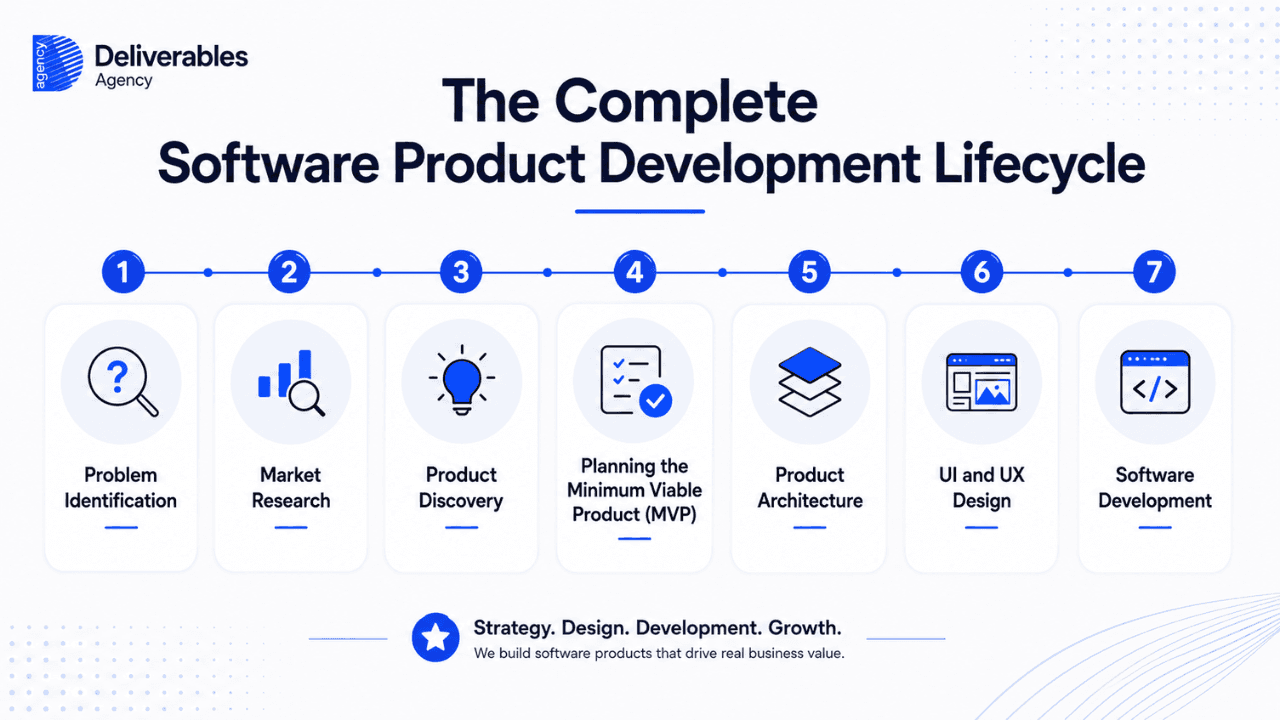
One of the biggest misconceptions is that software development starts with coding.
In reality, coding represents only one stage of the entire product lifecycle.
Successful products follow a structured process that reduces uncertainty before major investments are made.
Stage 1: Problem Identification
Every successful product begins with understanding a real business problem.
Instead of asking,
"What software should we build?"
Successful companies ask,
"What problem are we solving?"
This shift changes the entire development process.
A product built around a genuine customer pain point has a much higher chance of long-term success.
Stage 2: Market Research
Before development begins, businesses validate demand.
This involves studying:
Target audience
Competitor products
Industry trends
Existing solutions
Customer complaints
Pricing expectations
One useful exercise is reviewing competitor reviews instead of only visiting their websites.
Negative reviews often reveal the exact problems customers still want solved.
These insights help shape features that provide meaningful differentiation instead of simply copying what already exists.
Stage 3: Product Discovery
Product discovery is one of the most overlooked stages in software product development.
Many projects fail because businesses skip this step and move directly into development.
During product discovery, teams define:
Business objectives
User personas
Core functionality
Success metrics
Technical feasibility
Budget expectations
Risks
Product roadmap
The outcome is a clear development strategy before any code is written.
This saves both time and money by preventing expensive changes later in the project.
Stage 4: Planning the Minimum Viable Product (MVP)
An MVP is the smallest version of a product that delivers real value to users.
The goal is not to launch an incomplete application.
The goal is to launch only the features users actually need first.
For example, a food delivery application does not need loyalty programs, coupons, AI recommendations, or advanced analytics on day one.
The first version may only include:
User registration
Restaurant listings
Order placement
Payment
Order tracking
Everything else can be introduced after gathering feedback from real users.
Businesses that launch focused MVPs often reach the market faster while reducing development costs.
Stage 5: Product Architecture
Once the MVP is defined, software architects design the technical foundation.
Architecture decisions determine how well a product performs years after launch.
These decisions include:
Database structure
API architecture
Cloud infrastructure
Security layers
Authentication
Integration capabilities
Scalability planning
Strong architecture allows products to grow without requiring a complete rebuild later.
Many businesses underestimate this stage, but it directly affects future development speed, maintenance costs, and system reliability.
Stage 6: UI and UX Design
Many software products fail because users find them difficult to use, not because they lack features.
A clean user interface (UI) and a smooth user experience (UX) reduce the learning curve and encourage people to keep using the product. Before designers create screens, they first understand how users complete tasks. This process helps remove unnecessary steps and makes common actions faster.
For example, imagine an inventory management platform. If a warehouse employee needs six clicks to update stock levels, productivity drops. If the same task takes one click from the dashboard, the software becomes more valuable.
A typical UI and UX process includes:
User research
User journey mapping
Wireframes
Interactive prototypes
Visual design
Usability testing
Design improvements
Good design is not about making software look attractive. It is about helping users achieve their goals with as little effort as possible.
Stage 7: Software Development
Once planning and design are complete, developers begin building the product.
Modern software product development usually follows Agile development rather than a traditional waterfall approach. Instead of building everything over many months before release, Agile divides development into smaller cycles called sprints.
Each sprint focuses on delivering a working part of the product. This allows stakeholders to review progress regularly and request improvements before the next sprint begins.
A typical development team includes:
Product Manager
Project Manager
Front End Developers
Back End Developers
Mobile Developers
QA Engineers
DevOps Engineers
Each role contributes to delivering a stable and scalable product.
Front End Development
The front end is everything users interact with directly.
It includes:
Dashboards
Buttons
Navigation
Forms
Charts
Product pages
Customer portals
A responsive front end ensures the software works smoothly across desktops, tablets, and mobile devices.
Performance also matters. Slow-loading interfaces often lead to poor user satisfaction and lower customer retention.
Back End Development
The back end powers everything users cannot see.
It handles:
Business logic
Databases
Authentication
Payment processing
Notifications
APIs
Security
File management
For example, when someone logs into an application, the back end verifies credentials, retrieves user data, and securely sends it to the interface.
Without a strong back end, even the best-looking software cannot perform reliably.
API Development and Integrations
Modern software rarely operates in isolation.
Businesses often need to connect their products with existing systems and third-party platforms.
Common integrations include:
Payment gateways
CRM systems
ERP software
Accounting platforms
Email services
SMS providers
Cloud storage
AI services
Analytics platforms
Well-designed APIs allow software to exchange data securely and efficiently while making future integrations much easier.
Quality Assurance Is More Than Finding Bugs
Many people think testing happens after development.
In reality, quality assurance begins much earlier.
QA teams review requirements, test user flows, verify business logic, and identify potential issues throughout development.
Testing usually includes:
Functional Testing
Verifies that every feature behaves as expected.
Performance Testing
Measures how the software performs under heavy traffic or large amounts of data.
Security Testing
Checks for vulnerabilities that attackers could exploit.
Compatibility Testing
Ensures the application works correctly across different browsers, operating systems, and devices.
Regression Testing
Confirms that newly added features do not break existing functionality.
Fixing issues during development is significantly less expensive than resolving them after launch.
Deployment and Product Launch
Launching software is more than publishing code to a server.
Before release, development teams typically complete:
Final testing
Security checks
Database migration
Performance optimization
Backup configuration
Monitoring setup
Error logging
User acceptance testing
Many organizations now use Continuous Integration and Continuous Deployment (CI/CD).
Instead of waiting months between releases, updates can be deployed quickly while maintaining product stability.
This allows businesses to introduce improvements without disrupting users.
Launch Is the Beginning, Not the Finish
One of the biggest differences between a software project and a software product is what happens after launch.
Successful software products improve continuously.
Product teams monitor:
User behavior
Feature adoption
Customer feedback
Crash reports
System performance
Revenue metrics
User retention
These insights influence future development priorities.
Rather than adding features based on assumptions, businesses make decisions using real usage data.
AI Is Changing Software Product Development
Artificial intelligence is becoming part of modern software across almost every industry.
Instead of existing as a separate feature, AI now supports everyday workflows.
Examples include:
Intelligent search
Personalized recommendations
Chat assistants
Predictive analytics
Document processing
Image recognition
Workflow automation
Fraud detection
Demand forecasting
The most successful products use AI to remove repetitive work rather than simply adding AI for marketing purposes.
For example, an accounting platform can automatically categorize expenses.
A logistics platform can predict delivery delays.
A healthcare application can summarize patient records for clinicians.
These practical improvements create measurable business value.
Should You Build AI Features From Day One?
Not always.
Many businesses assume every product requires AI before launch.
In reality, the best approach is to solve the core problem first.
Once users actively use the product, AI can improve efficiency through automation, recommendations, or predictive insights.
Adding AI too early often increases complexity without improving customer satisfaction.
A better strategy is to launch a stable product, collect user behavior, and then introduce AI features that solve proven pain points.
Cloud Native Development
Most modern software products are built for the cloud.
Cloud infrastructure provides several advantages over traditional on-premise systems.
These include:
Better scalability
Automatic backups
Higher availability
Improved disaster recovery
Faster deployment
Lower infrastructure maintenance
Cloud platforms also make it easier to serve customers across multiple countries with consistent performance.
As user demand grows, businesses can increase computing resources without rebuilding the application.
Security Must Be Built Into Every Stage
Security should never be treated as a final checklist before launch.
It should be considered from the beginning of the project.
Important security practices include:
Secure authentication
Multi-factor authentication
Role-based access control
Data encryption
API security
Regular vulnerability assessments
Secure coding practices
Activity logging
Backup and recovery planning
Industries such as healthcare, finance, and government often have additional compliance requirements that influence how software is designed and maintained.
Building security into the product from the start reduces long-term risk and protects both businesses and their customers.
How Software Products Scale Successfully
Many applications perform well with hundreds of users but struggle when usage grows into the thousands or millions.
Scalability should be planned early rather than treated as a future problem.
Key considerations include:
Modular architecture
Load balancing
Distributed databases
Caching
Background processing
Content delivery networks
Monitoring tools
Automated infrastructure scaling
A scalable architecture allows businesses to expand into new markets without major technical limitations.
This is one reason experienced software product development services focus on long-term architecture instead of only delivering short-term functionality.
Measuring Product Success
Launching software is only one milestone.
Long-term success depends on measurable outcomes.
Instead of tracking downloads alone, businesses monitor metrics such as:
Daily active users
Monthly active users
Customer retention
Feature adoption
Customer acquisition cost
Lifetime customer value
Churn rate
System uptime
Average response time
Customer satisfaction
These metrics reveal whether the product is creating real value and where future improvements should be made.
The most successful software products evolve through continuous measurement rather than assumptions.
How Much Does Software Product Development Cost?
One of the first questions businesses ask is, "How much will it cost to build a software product?"
There is no fixed answer because every product has different goals, features, and technical requirements.
Instead of focusing on a single price, it is better to understand the factors that influence the overall investment.
1. Product Complexity
The biggest cost driver is complexity.
A simple internal dashboard with user authentication and reporting requires significantly less effort than a multi-tenant SaaS platform with AI capabilities, payment processing, and third-party integrations.
As more functionality is added, development, testing, security, and maintenance requirements also increase.
2. Number of Platforms
Will your product run on:
Web only?
Android?
iOS?
Desktop?
All of the above?
Developing for multiple platforms increases both development time and testing requirements.
Many businesses start with one platform, validate demand, and expand later.
3. Design Requirements
Products with custom animations, complex dashboards, interactive visualizations, and highly personalized user experiences require more design and development effort than standard business applications.
A thoughtful design investment often improves adoption and reduces user support costs after launch.
4. Third Party Integrations
Most modern software products connect with external services.
These might include:
Payment gateways
ERP systems
CRM platforms
Accounting software
AI APIs
Mapping services
Email platforms
Identity verification providers
Every integration adds development, testing, and ongoing maintenance work.
5. Security and Compliance
Industries such as healthcare, banking, insurance, and government require additional security measures and regulatory compliance.
These requirements affect architecture, infrastructure, documentation, and testing.
Although they increase development effort, they are essential for protecting sensitive data.
6. Future Scalability
Many businesses build software only for today's requirements.
A better approach is to prepare for future growth.
Planning for scalability from the beginning usually costs less than rebuilding the application after customer demand increases.
Common Mistakes Businesses Make During Software Product Development
Even experienced organizations make costly mistakes.
Avoiding these issues can save months of development time and significant investment.
Building Features Before Validating Demand
One of the biggest reasons products fail is building features customers never wanted.
Successful teams validate ideas before investing in development.
Simple customer interviews, surveys, prototype testing, and competitor review analysis often reveal what users actually need.
Trying to Build Everything at Once
Many businesses attempt to launch every feature in the first version.
This increases development time, delays market entry, and makes products more difficult to improve.
A focused MVP reaches users faster and provides valuable feedback for future releases.
Ignoring User Feedback
Launching software without listening to customers slows product growth.
Customer feedback helps identify usability issues, missing functionality, and opportunities for innovation.
The best products evolve continuously based on real user experiences.
Choosing Technology Instead of Solving Problems
Businesses sometimes choose technologies because they are popular.
Instead, technology should support business goals.
The right architecture depends on the product, expected traffic, security requirements, integration needs, and long-term roadmap.
Underestimating Maintenance
Software requires ongoing updates after launch.
Operating systems change.
Security vulnerabilities emerge.
Cloud services evolve.
Customer expectations increase.
Planning for continuous improvement keeps the product secure, reliable, and competitive.
How to Choose the Right Software Product Development Company
Selecting a development partner is one of the most important decisions in the entire project.
The right team contributes far more than technical execution.
They help shape product strategy, reduce risk, and identify opportunities that may otherwise be overlooked.
When evaluating a software product development company, consider the following factors.
Look Beyond the Portfolio
A polished portfolio shows completed projects.
A better question is:
What business outcomes did those products achieve?
Ask about user growth, performance improvements, operational efficiency, or revenue generated.
These results provide a clearer picture of the company's capabilities.
Evaluate Their Discovery Process
A professional development partner should ask questions before discussing technology.
They should understand:
Your business goals
Target users
Competitive landscape
Revenue model
Product vision
Technical challenges
If the conversation begins with coding rather than strategy, important opportunities may be missed.
Check Technical Expertise
Modern products often combine multiple technologies.
Look for experience in areas such as:
Cloud development
Mobile applications
API development
DevOps
Cybersecurity
Data engineering
A multidisciplinary team can support the product throughout its lifecycle.
Ask About Long-Term Support
Software products continue evolving after launch.
Choose a partner that offers:
Performance monitoring
Feature enhancements
Security updates
Infrastructure management
Technical support
Product optimization
Long-term collaboration often delivers better outcomes than one-time development.
Why More Businesses Are Choosing Software Development Services in Dubai
Dubai has become one of the world's fastest-growing technology ecosystems.
Government initiatives, strong digital infrastructure, and a business-friendly environment have encouraged companies across industries to invest in software products.
Businesses choose a software development service in Dubai for several reasons.
Access to Global Talent
Development companies in Dubai work with international clients and multidisciplinary teams capable of delivering products for global markets.
Strong Focus on Innovation
Many organizations are investing in AI, automation, fintech, healthcare technology, logistics, construction technology, and smart city solutions.
This creates an environment where modern software products can evolve quickly.
Enterprise Grade Infrastructure
Cloud adoption, cybersecurity awareness, and digital transformation initiatives continue to support businesses building scalable software products.
Strategic Business Location
Dubai connects businesses across the Middle East, Europe, Asia, and Africa, making it an attractive location for companies launching products internationally.
Why Businesses Choose Deliverables Agency
Building software is only one part of creating a successful product.
The larger challenge is transforming an idea into a solution that users adopt and businesses can scale.
At Deliverables Agency, software product development begins with understanding your business objectives rather than immediately writing code.
Every engagement focuses on identifying user needs, validating product ideas, planning scalable architecture, and delivering software that creates measurable business value.
Whether you are building:
A SaaS platform
An enterprise application
An AI powered product
A customer portal
An internal business system
A mobile application
Our team works alongside your business throughout the complete product lifecycle.
From discovery workshops and UI design to development, cloud deployment, and continuous improvement, every stage is designed to reduce risk while accelerating product growth.
If your business requires custom software product development, our team creates solutions built around your workflows instead of forcing your operations into generic software.
For organizations expanding across the Middle East, our experience delivering software development service in Dubai helps businesses launch secure, scalable, and future-ready digital products.
Final Thoughts
Successful software products are not created by chance.
They are built through careful planning, user research, thoughtful design, strong engineering, and continuous improvement after launch.
The businesses leading their industries today are not simply investing in technology. They are investing in products that improve customer experiences, streamline operations, and create long-term competitive advantages.
Whether you are validating a new SaaS idea, modernizing enterprise systems, or building a platform from the ground up, choosing the right development approach is just as important as choosing the right technology.
Working with an experienced software product development company gives you access to the expertise needed to navigate every stage of the journey, from product discovery to post-launch optimization.
If you're ready to turn your idea into a scalable digital product, Deliverables Agency offers end-to-end software product development services tailored to your business goals. Our team helps organizations build secure, scalable, and future-ready software products that support sustainable growth in competitive markets.
Build a Software Product That Is Ready to Scale
A great software product starts with the right strategy. At Deliverables Agency, we help businesses validate ideas, design scalable solutions, and develop secure software products that are built for long-term growth. Whether you're launching an MVP or a full-scale platform, our team is ready to help.
Some Topic Insights:
What is software product development?
Software product development is the complete process of planning, designing, developing, testing, launching, and continuously improving a software application that solves a specific business or customer problem.