



Time to read :
1 min read
GPS tracking is one of the most important technologies in modern logistics.
Every day, millions of shipments move across cities, states, and countries. Customers expect accurate delivery times. Fleet managers want lower fuel costs. Operations teams need visibility into every vehicle and shipment.
None of this is possible without knowing where assets are at any given moment.
That is why GPS tracking has become a core component of logistics software.
However, many people misunderstand what GPS tracking actually does. They assume it simply shows a vehicle's location on a map. In reality, location tracking is only the beginning. The real value comes from how logistics software processes GPS data and turns it into decisions that improve efficiency, reduce costs, and help companies serve customers better.
In this guide, you'll learn exactly how GPS tracking works in logistics software, the technology behind it, how leading logistics companies use it, and what businesses should know before building GPS-enabled logistics platforms.
Why GPS Tracking Matters More Than Ever in 2026
The logistics industry is becoming more complex every year.
Companies now manage:
Larger fleets
Faster delivery expectations
More delivery locations
Rising fuel costs
Driver shortages
Growing customer demands
At the same time, customers want real time updates rather than vague delivery windows.
A simple "your order is on the way" notification is no longer enough.
Businesses need precise information such as:
Where a vehicle is right now
Whether it is following the planned route
How long the delivery will take
Whether delays are likely
Which vehicles are operating efficiently
GPS tracking provides the foundation for all of these capabilities.
Without location visibility, logistics operations rely heavily on manual communication, which often creates delays, confusion, and unnecessary costs.
What Is GPS Tracking in Logistics Software?
GPS tracking in logistics software refers to the process of collecting location data from vehicles, drivers, trailers, containers, or shipments and displaying that information inside a software platform.
The system continuously gathers location updates and combines them with business data to provide operational visibility.
For example, instead of simply showing a truck's coordinates, modern logistics software can display:
Current vehicle location
Route progress
Delivery status
Estimated arrival time
Driver activity
Vehicle utilization
Historical trip records
This information helps dispatchers, operations managers, and customers understand exactly what is happening throughout the delivery process.
How GPS Actually Works
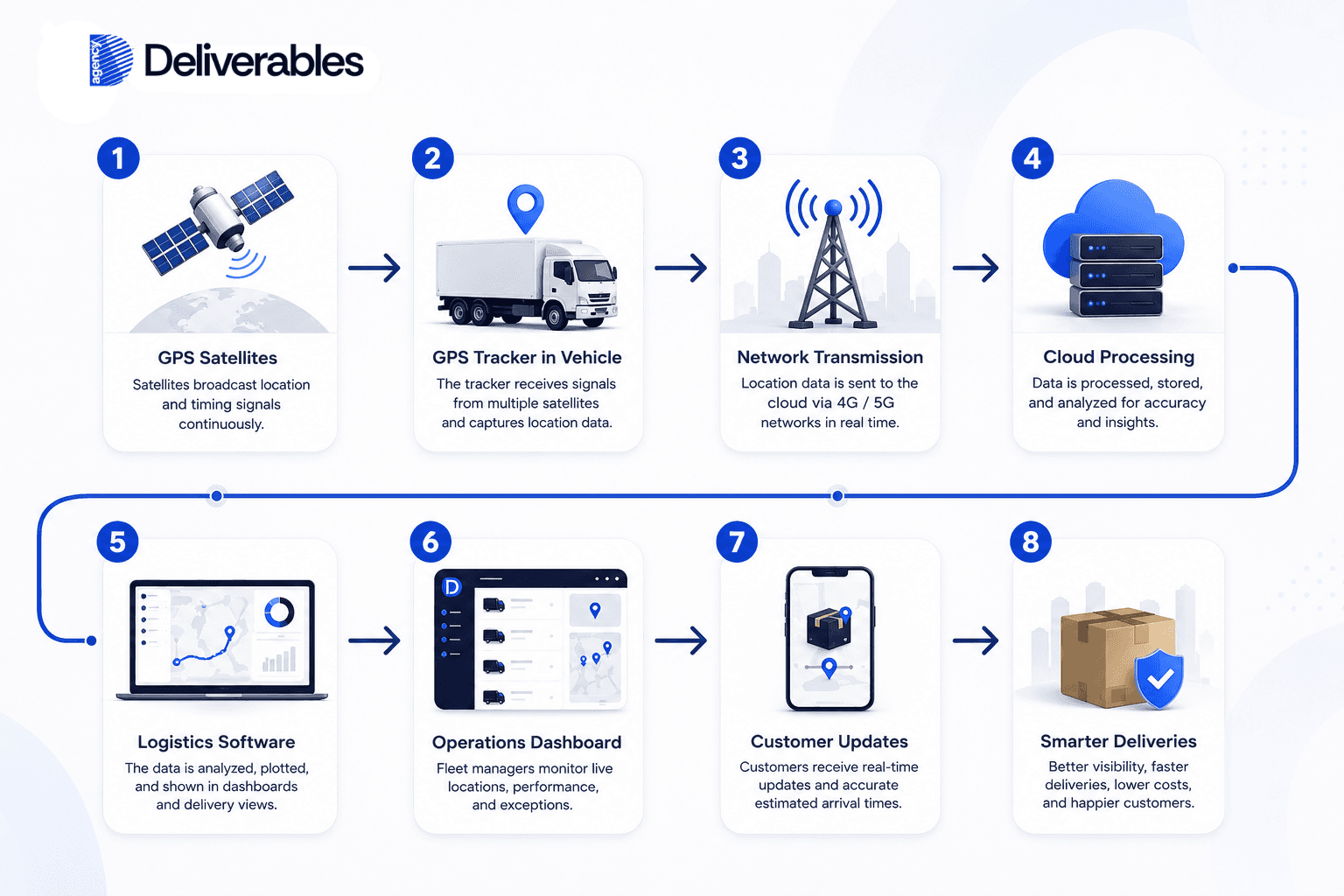
Before understanding logistics software, it helps to understand how GPS itself works.
GPS stands for Global Positioning System.
It is a satellite-based navigation system originally developed by the United States government and now used worldwide.
The system consists of a network of satellites orbiting the Earth.
These satellites continuously transmit signals containing:
Satellite position
Current time
Identification information
A GPS device installed inside a vehicle receives signals from multiple satellites simultaneously.
Using a mathematical process known as trilateration, the device calculates its precise location.
The result includes:
Latitude
Longitude
Altitude
Speed
Direction of travel
Once the location is calculated, the GPS tracker sends that information to logistics software through a communication network.
This entire process happens automatically and continuously.
The Journey of GPS Data Inside Logistics Software
Many articles stop after explaining satellites and coordinates.
The truth is that coordinates alone have very little value for a logistics business.
The real magic happens after the software receives the data.
Let's follow a delivery vehicle from the moment it leaves a warehouse.
Step 1: Vehicle Begins the Route
A GPS device installed inside the vehicle starts collecting location information.
The tracker records:
Current position
Speed
Travel direction
Time stamps
Step 2: Data Is Transmitted
The device sends information through:
4G networks
5G networks
LTE networks
IoT communication systems
Depending on system requirements, updates may occur every few seconds or every few minutes.
Step 3: Cloud Infrastructure Receives the Data
The information is sent to cloud servers where it is processed and stored.
This creates a live stream of vehicle activity.
Step 4: Software Converts Data Into Meaningful Information
This is where logistics software development becomes important.
Raw GPS coordinates mean very little to a dispatcher.
For example: 25.2048, 55.2708
This coordinate alone does not answer any business questions.
Instead, logistics software transforms it into information such as:
Vehicle 42 is approaching Customer A's location and is expected to arrive in 14 minutes.
Or:
Vehicle 18 has been stationary for 37 minutes outside its planned route.
That transformation is what creates business value.
Why GPS Coordinates Alone Are Not Enough
One of the biggest misconceptions in logistics is that GPS tracking and logistics software are the same thing.
They are not.
GPS tracking provides location data.
Logistics software provides context.
Imagine two companies using the exact same GPS hardware.
The first company only sees vehicle locations.
The second company sees:
Predicted delivery times
Route efficiency scores
Driver productivity metrics
Delivery success rates
Fuel consumption trends
Both companies collect the same location data.
Only one extracts meaningful insights from it.
This is why software plays a much larger role than many businesses realize.
Core Components of a Modern GPS Tracking System
A complete logistics tracking solution involves multiple technologies working together.
GPS Hardware
This is the physical tracking device installed in:
Trucks
Vans
Delivery vehicles
Containers
Trailers
The hardware collects location information and movement data.
Connectivity Layer
Once data is collected, it must be transmitted.
Most systems use:
4G
5G
LTE-M
NB-IoT
Without connectivity, real time tracking becomes impossible.
Mapping Services
Coordinates must be translated into visual routes.
Popular mapping solutions include:
Google Maps
Mapbox
HERE Technologies
These services help convert location data into understandable navigation information.
Cloud Infrastructure
Cloud systems process millions of tracking events every day.
They store:
Historical routes
Vehicle activity
Delivery records
Operational reports
Logistics Software Platform
This acts as the command center.
Fleet managers use dashboards to monitor operations and make decisions based on incoming data.
How GPS Tracking Helps Logistics Companies Reduce Costs
Many businesses initially invest in GPS tracking to improve visibility.
The biggest long term benefit is often cost reduction.
Reduced Fuel Consumption
Fuel remains one of the largest expenses in logistics.
GPS tracking helps reduce waste by identifying:
Unnecessary detours
Traffic delays
Excessive idling
Poor route planning
Even small improvements can create substantial savings across large fleets.
Better Route Planning
Drivers can avoid:
Congested roads
Road closures
High traffic areas
This leads to faster deliveries and lower operating costs.
Improved Fleet Utilization
Many companies discover that some vehicles are overused while others remain underutilized.
GPS data provides clear visibility into fleet performance.
Lower Administrative Work
Manual check-ins and status updates become less necessary when location data updates automatically.
The Hidden Cost of Poor Tracking
Many businesses focus only on software expenses.
The larger issue is often the cost of operating without proper visibility.
Poor tracking can lead to:
Missed deliveries
Customer complaints
Fuel waste
Unauthorized vehicle usage
Driver inefficiencies
Scheduling problems
A company operating dozens or hundreds of vehicles may lose significant revenue each month simply because operational issues remain invisible.
Without tracking, managers often discover problems only after customers complain.
By then, the damage had already occurred.
GPS Tracking vs Telematics
The terms GPS tracking and telematics are often used together.
However, they serve different purposes.
GPS Tracking
GPS focuses primarily on location information.
It answers questions such as:
Where is the vehicle?
What route is it following?
When will it arrive?
Telematics
Telematics expands beyond location.
It also collects:
Fuel usage
Engine diagnostics
Driver behavior
Vehicle health
Maintenance information
Modern logistics platforms typically combine both technologies to create a complete operational picture.
How Leading Logistics Companies Use GPS Data
Large logistics organizations do not use GPS simply to locate vehicles.
They use it to improve decision-making.
Route Optimization
Location data helps determine the fastest and most efficient routes.
Traffic conditions, road closures, and historical delivery patterns all influence routing decisions.
Delivery Prediction
Companies can estimate delivery times with much greater accuracy.
Customers receive more reliable updates.
Driver Performance Analysis
Managers can identify patterns such as:
Excessive speeding
Long idle times
Inefficient routes
Frequent delays
Capacity Planning
Historical location data helps businesses understand:
Fleet demand
Delivery density
Resource allocation
These insights support better long term planning.
The Shift From Tracking to Prediction
One of the biggest changes happening in logistics software today is the move from tracking events to predicting them.
GPS systems no longer focus only on answering:
Where is the vehicle?
Instead, businesses want answers to questions such as:
Will this delivery be late?
Which route is likely to experience delays?
Which vehicle may require maintenance next month?
GPS data plays a major role in these predictions. When location information is combined with traffic patterns, delivery history, weather conditions, and operational data, software can identify risks before they become problems. This growing use of predictive systems is one reason AI in logistics is becoming increasingly important. Companies are no longer satisfied with visibility alone. They want systems that help them make better decisions before issues affect operations.
Common Challenges of GPS Tracking
Despite its advantages, GPS technology has limitations.
Weak Signal Areas
Tracking accuracy may decrease in:
Tunnels
Underground parking structures
Dense urban environments
Network Coverage Issues
A GPS device can calculate its location without internet access.
However, location updates cannot reach the software platform without network connectivity.
Data Management
Large fleets generate enormous volumes of information.
Without strong reporting systems, companies can struggle to turn data into useful insights.
Privacy Concerns
Organizations must balance operational visibility with employee privacy expectations.
Clear policies are essential.
What Businesses Should Consider Before Building GPS Tracking Software
Companies often assume GPS tracking is a simple feature.
In reality, building a reliable logistics platform requires much more than displaying vehicle locations on a map.
Important considerations include:
Scalability
Can the platform support future fleet growth?
Real Time Performance
Can thousands of location updates be processed simultaneously?
Hardware Integration
Will the system support multiple tracking device manufacturers?
Security
Location information is sensitive operational data.
Strong encryption and access controls are necessary.
Future Expansion
Many companies begin with vehicle tracking and later add:
Route optimization
Fleet management
Driver apps
Delivery management
Analytics dashboards
These decisions significantly influence development complexity and overall project investment. Features such as real time tracking, route optimization, telematics integrations, driver applications, customer portals, and analytics dashboards can all affect the overall logistics software development cost.
What the Future Looks Like
GPS tracking will continue to evolve over the next few years.
Several technologies are already shaping the next generation of logistics software.
AI Driven Decision Making
Systems will increasingly recommend actions rather than simply display information.
Digital Twins
Virtual representations of logistics operations will help businesses test scenarios before making changes.
Connected IoT Ecosystems
Vehicles, warehouses, drivers, and shipments will share data continuously.
Autonomous Transportation
Self-driving logistics systems will rely heavily on GPS and location intelligence.
Edge Computing
More processing will happen directly inside vehicles, reducing latency and improving response times.
Conclusion
GPS tracking has become the foundation of modern logistics operations.
Yet the real value is not the location itself.
The true value comes from transforming location data into operational intelligence.
A GPS device can tell you where a truck is.
A well-designed logistics platform can tell you whether a delivery will be late, which route is wasting fuel, which vehicle is underperforming, and where operational improvements can be made.
That difference is what separates basic tracking systems from modern logistics software.
As logistics networks become more complex and customer expectations continue to rise, businesses that use GPS data effectively will have a significant advantage. The companies that succeed in 2026 and beyond will not simply track their fleets. They will use location intelligence to make faster decisions, reduce costs, improve delivery performance, and build more efficient supply chains. For organizations planning custom logistics solutions, partnering with an experienced custom software development company can help transform GPS data into a scalable platform that supports long term business growth. At the Deliverables Agency, we have seen how modern logistics software can improve visibility, streamline operations, and create measurable operational efficiencies across the supply chain.
Build Smarter Logistics Software with Real-Time GPS Tracking
Transform location data into actionable business intelligence. Whether you're developing a fleet management platform, delivery tracking system, or end-to-end logistics solution, our team can help you build scalable software tailored to your operations.
Some Topic Insights:
What is GPS tracking in logistics software?
GPS tracking in logistics software collects real-time location data from vehicles, drivers, containers, or shipments and displays it within a centralized platform. It helps businesses monitor operations, track deliveries, and improve fleet visibility.