

Time to read :
1 min read
Launching your mobile app feels rewarding after months of planning and development work. Soon after launch, real users start testing your app in real situations. That is when hidden issues appear without warning or preparation. Screens load slowly, or crashes interrupt normal usage. Ongoing app maintenance becomes imperative once users rely on your app daily.
Ignoring routine checks often translates into diminished user satisfaction across platforms. Research shows that 62% of users uninstall an application after encountering bugs.
An unreliable app erodes trust faster than most marketing efforts can rebuild it. When problems arise, you face pressure to act quickly and fix issues. Users expect immediate responses and visible improvements after reporting concerns.
Deliverables Agency is here to help you understand why mobile app maintenance has become integral right after the launch. We know that consistent maintenance enables you to protect user confidence while managing updates, user feedback, and performance fixes simultaneously. Let’s understand more details.
An Overview of App Maintenance
App maintenance services refer to the ongoing work you do after your app goes live. You keep the app stable, secure, and relevant as users interact with it daily. Maintenance includes fixing bugs, updating features, improving performance, and supporting new devices or operating system changes. You also review security gaps and refine existing functionality based on real feedback.
Corrective work fixes visible issues. Adaptive work supports platform changes. Preventive work reduces future risks. Perfective work improves usability and value. Together, these efforts protect user trust and business credibility. Your app's long term success depends more on maintenance than on the launch itself.
Mobile App Maintenance Checklist – The Fundamental Essentials

Mobile App Maintenance relies on several core components that work together to keep your application stable. Each component addresses a different risk area. Skipping even one creates gaps that users notice quickly.
Performance Monitoring
Track load speed, crashes, and responsiveness during real usage. Regular monitoring helps you detect slowdowns early. This keeps the app stable, reliable, and comfortable for daily users across devices.
Security Updates
You update security layers to protect user data and system integrity. Regular checks reduce risks of breaches and compliance issues. Strong security protects trust and prevents long-term damage to your brand.
User Feedback
You review ratings, comments, and support queries to understand user expectations. Feedback highlights pain points and areas for improvement. Acting on real input helps your app stay relevant and user-focused.
OS Compatibility
You adjust the app for new operating system releases from Apple and Google. Compatibility updates prevent feature failures after upgrades. This keeps functionality consistent across devices and platform versions.
App Store Optimization & Marketing
You refresh keywords, visuals, and descriptions to maintain store visibility. Regular updates support discoverability and steady downloads. This helps your app attract new users beyond the launch phase.
The Need for Mobile App Maintenance
After launch, your app enters a live environment shaped by users' devices and behavior. Real usage reveals performance gaps, security risks, and experience flaws. Ongoing application upkeep keeps your application dependable as conditions change. It protects your product reputation and supports steady business growth over time.
Allows the App to Run Smoothly
Every update feature and integration affects performance in some way. Without ongoing checks, small issues turn into visible failures. Regular maintenance helps you identify bugs, fix crashes, and stabilize load times. Your app stays responsive even during peak traffic. Users notice consistency quickly.
Protects User Data
Security threats do not stay static after launch. New vulnerabilities appear through updates, integrations, and user actions. Maintenance allows you to patch risks, strengthen data handling, and comply with evolving standards. Users trust apps that consistently protect their personal information.
Engages Users & Keeps Them Satisfied
Users judge your app by their daily experience. Slow screens, broken features, and outdated design push users away. Maintenance supports usability improvements and feature refinements. Engagement grows when your app feels reliable and current.
Compatibility with New Devices & OS Updates
Operating systems change often, and devices evolve quickly. Maintenance keeps your app compatible across screen versions and hardware. You avoid sudden failures after system updates. Your app continues to function smoothly for all users.
Improves Team Productivity and Focus
Unresolved issues slow down your internal teams. Developers spend time reacting instead of improving features. Maintenance creates structured workflows for updates and monitoring purposes. Your teams work with clarity and fewer disruptions. Productivity improves across development and support efforts.
What Strategies Do We Implement for Mobile App Maintenance at Deliverables?
We at Deliverables treat post-launch care as a continuous responsibility. Once your app goes live, real users, real devices and real expectations shape its future. Our mobile app development services focuses on stability & long-term performance. We work closely with your product goals and user behavior.
Releasing Timely App Updates
No app reaches perfection at launch. Real users reveal gaps that testing cannot predict. Updates allow you to refine features, fix friction points, and add improvements aligned with changing technology. Regular releases show commitment to progress. They keep your app relevant, functional and aligned with user expectations without forcing disruptive overhauls.
When do you need timely updates-
When users face repeated issues | When crash reports or functional errors repeat, we release fixes without delay. Fast updates restore stability and protect confidence in your product across user groups. |
When operating systems change | OS updates often disrupt permissions, background tasks, and UI behavior. We push compatibility updates early so your app continues to work without interruptions. |
When performance metrics decline | Reduced speed, responsiveness, or session flow signals deeper issues. We deploy performance updates to keep your app reliable under real usage conditions. |
When security risks emerge | New vulnerabilities demand immediate attention. We release security updates that protect data handling and support safe application maintenance for business-critical apps. |
When growth increases, system load | Higher traffic stresses infrastructure and logic. We roll out updates that support scale and sustain consistent Mobile App Maintenance as your business expands. |
Testing Every Upgrade Scenario
Users update apps in different ways. Some install fresh versions. Others upgrade from older builds holding stored data. Each path demands careful testing. You validate performance data handling and stability before release. This prevents crashes, data loss, and broken experiences. Proper testing protects trust during every update cycle.
Refining Existing Features
User behavior changes quickly after launch. Features that once felt intuitive may become less relevant. You review usage patterns and feedback to refine what already exists. Improvements often outperform new additions. Small enhancements increase usability and satisfaction. Over time, your app evolves naturally, rather than feeling outdated or cluttered. Here’s when we can refine existing features-
• When user behavior shows frequent drop-offs within key app flows
• When features receive consistent feedback about confusion or usability gaps
• When analytics show low adoption of once popular features
• When workflows feel slow due to outdated logic or interface
• When business goals shift and features no longer align
Resolving Bugs Without Delay
Bugs frustrate users faster than missing features. Even minor issues damage confidence when they repeat. You identify problems early through monitoring and user reports. Quick fixes prevent escalation and reduce long-term costs. Consistent bug resolution keeps your app stable & dependable across user communities. Here are the types of bugs we fix-
Crash-related bugs | These bugs force the app to close unexpectedly during normal use. Crashes interrupt workflows and push users away quickly if left unresolved. |
Performance bugs | Slow loading screens, laggy animations, or delayed responses fall under this category. These bugs reduce usability and frustrate users during daily interactions. |
UI and layout bugs | Buttons misalign, text overlaps, or screens break across devices. These issues harm visual clarity and reduce confidence in the app experience. |
Functional bugs | Features fail to work as intended. Forms do not submit, payments fail, or notifications stop triggering. These bugs block core app actions. |
Compatibility bugs | These bugs appear after OS updates or device changes. Features stop working across specific versions, screens, or hardware configurations. |
Security-related bugs | Weak data handling, improper permissions, or exposed endpoints create risk. These bugs demand immediate fixes to protect user information. |
Updating the User Interface
Design preferences shift as users grow familiar with your product. A static interface feels dated quickly. You adjust layouts, flows, and visuals based on behavior and trends. Subtle UI updates improve clarity and comfort. Users stay engaged when the interface feels modern, intuitive, and responsive to their needs.
Using Analytics & User Feedback
Numbers tell part of the story. Feedback fills the gaps. You track usage patterns to see what works and what stalls engagement. Direct input highlights real pain points. Combined insights guide smarter decisions. Transparency around analytics builds trust and gives users control over their data preferences.
Reviewing Software Licenses Regularly
Every app depends on licensed tools, frameworks, and integrations. You track renewals and usage limits proactively. This avoids disruptions, unexpected expenses, and compliance issues. License management stays predictable when planned early. It keeps your app running smoothly without sudden legal or operational interruptions.
Types of App Maintenance on Which We Work
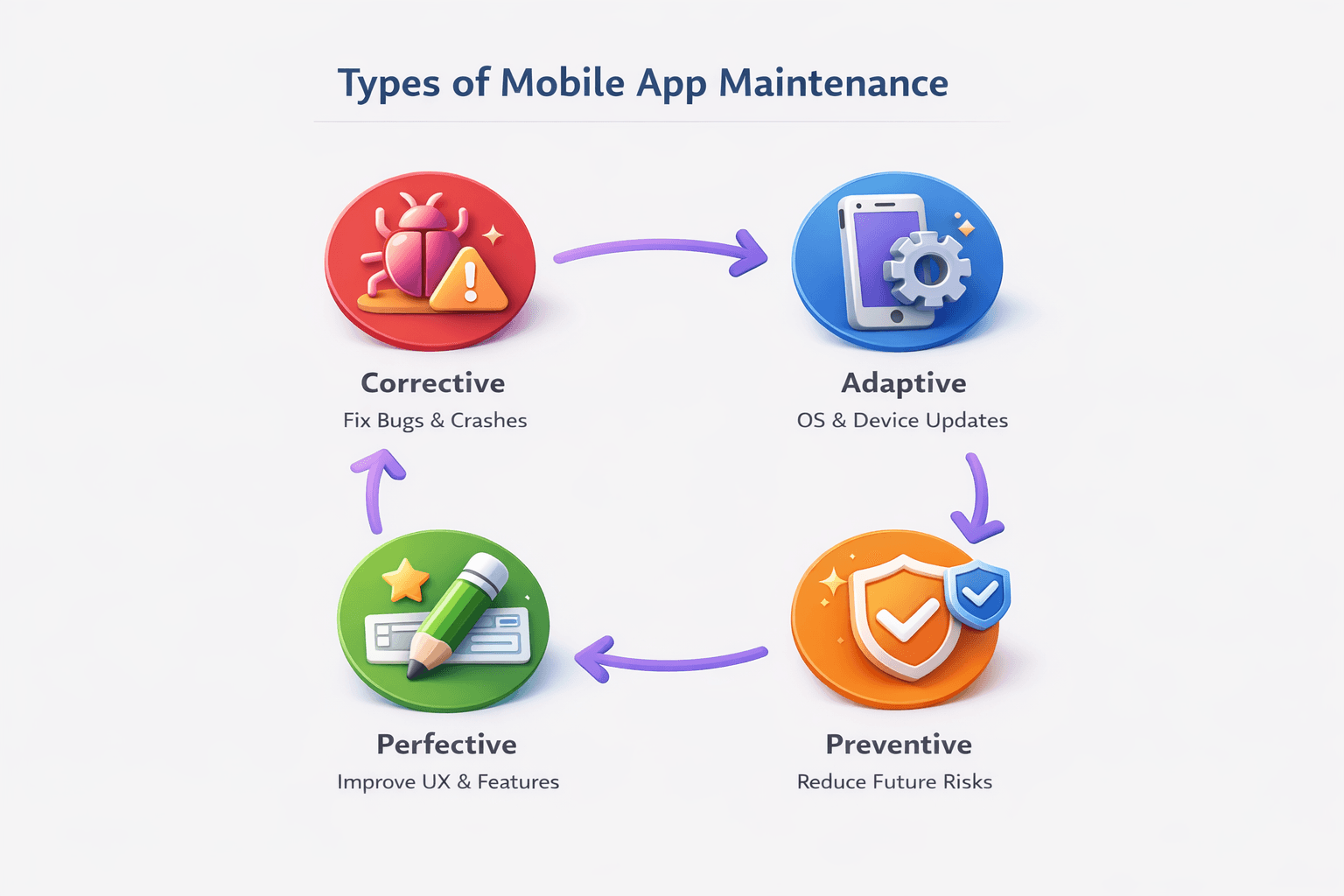
Real usage begins to shape the app's future once it goes live. Different situations call for different types of maintenance. In practice, teams rely on four core approaches. Each type supports stability, usability, and long-term value in its own way after launch.
Corrective Maintenance
Corrective maintenance focuses on fixing issues that arise during actual use. These include crashes, failed transactions, broken logins, or features that stop working after updates. Quick corrective action limits disruption, restores functionality, and prevents user frustration from spreading across platforms.
Adaptive Maintenance
Adaptive maintenance supports changes outside the app itself. Operating system updates, API changes, device variations, and third-party tool updates often affect app behavior. This maintenance keeps the app compatible with new environments, so features continue to work smoothly across iOS and Android versions.
Perfective Maintenance
Perfective maintenance improves existing features based on user behavior and feedback. It includes refining flows, simplifying navigation, improving load speed, or adding small enhancements. These updates increase usability, reduce friction, and help the app stay relevant as user expectations evolve.
Preventive Maintenance
Preventive maintenance reduces future risks before users feel the impact. It includes performance monitoring, security updates, infrastructure reviews, and code cleanup. Such an approach reduces downtime, controls long-term costs, and protects user trust by keeping the app dependable over time.
Mobile App Maintenance Mistakes to Avoid
Many apps fail after launch, not because of poor ideas, but because of avoidable maintenance mistakes. Small oversights compound over time and slowly damage performance, trust, and growth. Knowing where teams usually slip helps prevent costly rework and unhappy users down the line.
Ignoring User Feedback
User reviews, support tickets, and ratings reveal real problems. Teams that ignore this input miss early warning signs. Repeated complaints can lead to poor ratings and uninstalls. Listening closely helps guide fixes and refinements that align the app with real usage, not internal assumptions.
Delaying Bug Fixes
Minor bugs rarely stay minor. Small glitches repeat, frustrate users, and weaken confidence. Delayed fixes increase technical debt and raise long-term costs. Fast resolution keeps issues contained and prevents simple errors from spreading across devices and versions.
Skipping OS Compatibility Checks
Operating systems update often, and apps must keep pace. Teams that skip compatibility testing risk broken features after OS releases. Users face crashes or blocked actions overnight. Regular checks keep the app functional across new versions and protect store ratings from sudden drops.
Overloading the App With Features
Adding features without reviewing usage creates clutter. Unused tools slow performance and confuse users. Maintenance should refine what already exists. Focused updates improve clarity and speed. A simpler app often performs better and keeps users engaged longer.
Neglecting Security Updates
Security gaps rarely announce themselves early. Outdated libraries, weak permissions, or ignored patches expose data risk. Once trust breaks, recovery becomes difficult. Regular security updates protect user information and preserve credibility, especially for apps handling payments or sensitive business data.
Mobile App Maintenance KPIs We Track
At Deliverables, we measure the right metrics to ensure your app stays reliable, secure, and user-friendly. Tracking KPIs helps us spot problems early and make informed decisions that protect performance and user satisfaction. Key indicators we focus on include:
Crash Rate – We monitor how often the app crashes during real usage. Lower crash rates indicate stability, while spikes highlight areas needing immediate corrective action.
App Load Time – Fast and responsive apps keep users engaged. We track screen load times and app responsiveness to ensure smooth performance across devices.
Update Success Rate – We measure how often updates install correctly without errors. High success rates ensure users receive new features and fixes seamlessly.
Store Rating Stability – App ratings reflect user satisfaction. We monitor trends in app store reviews to identify issues early and maintain a positive reputation.
Security Incidents – Any breaches, vulnerabilities, or data risks are tracked. Proactive monitoring helps prevent threats and strengthens user trust in your application.
The above KPIs guide our mobile app maintenance service, ensuring apps remain stable, secure, and aligned with business goals while providing measurable results.
What is the Price of App Maintenance?
Mobile app maintenance pricing depends on several practical factors. Each parameter reflects the effort, risk, and expertise required to keep the app stable after launch. At Deliverables, we assess these elements carefully before defining scope and cost.
App complexity – Apps with advanced features, integrations, or custom workflows require more ongoing attention. Higher complexity increases the effort required for monitoring, testing, and updates.
Platform coverage – Maintenance costs differ for Android, iOS, or cross-platform apps. Supporting multiple platforms increases testing cycles and update frequency.
Update frequency – Apps that require frequent feature updates, security patches, or OS compatibility checks involve higher maintenance effort over time.
Third-party integrations – APIs, payment gateways, analytics tools, and external services require monitoring and updates. More integrations increase maintenance scope.
Security requirements – Apps that handle payments or sensitive data require stronger security checks and frequent patching, which affects overall pricing.
User volume and traffic load – Higher user activity demands stronger monitoring, infrastructure support, and performance tuning.
Support and response time – Faster issue response and dedicated support windows increase maintenance effort and cost.
Maintenance scope – Corrective, adaptive, perfective, and preventive maintenance coverage directly impacts pricing. Broader coverage requires deeper involvement.
These pricing parameters help us define a maintenance plan that fits your app’s real needs, supports long-term stability, and delivers consistent value without unnecessary overhead.
Country-Wise Cost for Mobile App Maintenance
These ranges help you understand how location affects app maintenance costs through talent availability, operating expenses, and support expectations. Final pricing always depends on scope and complexity.
Europe
Maintenance Level | Monthly Pricing Range | Scope Included |
|---|---|---|
Basic | 2,200$ to 4,500$ | Bug fixes, OS compatibility updates, basic monitoring |
Standard | 4,500$ to 9,000$ | Performance optimization, feature refinements, security updates |
Advanced | 9,000$ to 18,000$ | Full application maintenance, analytics tracking, scaling support |
United States
Maintenance Level | Monthly Pricing Range | Scope Included |
|---|---|---|
Basic | 2,500$ to 5,000$ | Issue resolution, OS updates, store compliance |
Standard | 5,000$ to 10,000$ | Performance tuning, feature improvements, security patches |
Advanced | 10,000$ to 20,000$ | Dedicated support, proactive monitoring, scaling assistance |
Australia
Maintenance Level | Monthly Pricing Range | Scope Included |
|---|---|---|
Basic | 2,000$ to 4,500$ | Bug resolution, OS compatibility |
Standard | 4,500$ to 9,000$ | Performance updates, feature refinements |
Advanced | 9,000$ to 18,000$ | Full app maintenance and support coverage |
India
Maintenance Level | Monthly Pricing Range | Scope Included` |
|---|---|---|
Basic | 500$ to 1,200$ | Bug fixes, OS checks, basic monitoring |
Standard | 1,200$ to 3,000$ | Performance optimization, security updates |
Advanced | 3,000$ to 6,000$ | Complete application maintenance and support |
Why Choose Deliverables for Mobile App Maintenance?
Keeping a mobile app running smoothly requires more than occasional fixes. Deliverables ensure your app remains reliable, secure, and up-to-date while supporting growth and user experience. Here’s why businesses rely on them for mobile app maintenance:
Complete Support: From building to maintaining apps, the same team manages every step, ensuring deep understanding and consistent quality.
Regular Updates: Frequent bug fixes, operating system updates, and performance improvements keep your app running flawlessly.
Scalable Solutions: Apps are maintained to handle more users, traffic, and features without slowing down.
Security First: Continuous monitoring and updates protect your app from potential threats and data breaches.
Quick Response: Agile workflows enable fast issue resolution and smooth integration of new features.
Trusted Partner: Clear communication, timely support, and proven reliability make Deliverables a dependable choice.
Simplified Management: Handling development and maintenance under one roof reduces delays and ensures seamless operation.
Ensure your mobile app remains efficient, secure, and user-friendly with expert care. Ready to keep your app performing at its best? Contact Deliverables to secure professional maintenance support.
Have an Idea for an App or Website?
At Deliverables, we specialize in building custom digital products that solve real-world problems. Tell us your idea, and our expert team will help you craft a plan to build your dream.
Some Topic Insights:
What services does Deliverables provide for mobile app maintenance?
Deliverables offers comprehensive support, including bug fixes, operating system updates, performance improvements, security monitoring, and feature enhancements, ensuring your app remains functional, fast, and reliable for users across different devices and platforms.