



Time to read :
1 min read
The mobile app your business launches today could become tomorrow's security nightmare. One weak point creates a domino effect. User data gets exposed. Trust evaporates. Legal troubles pile up.
Security cannot be an afterthought anymore. The stakes climb higher every year as cybercriminals sharpen their tools and regulators tighten requirements.
Key Takeaways
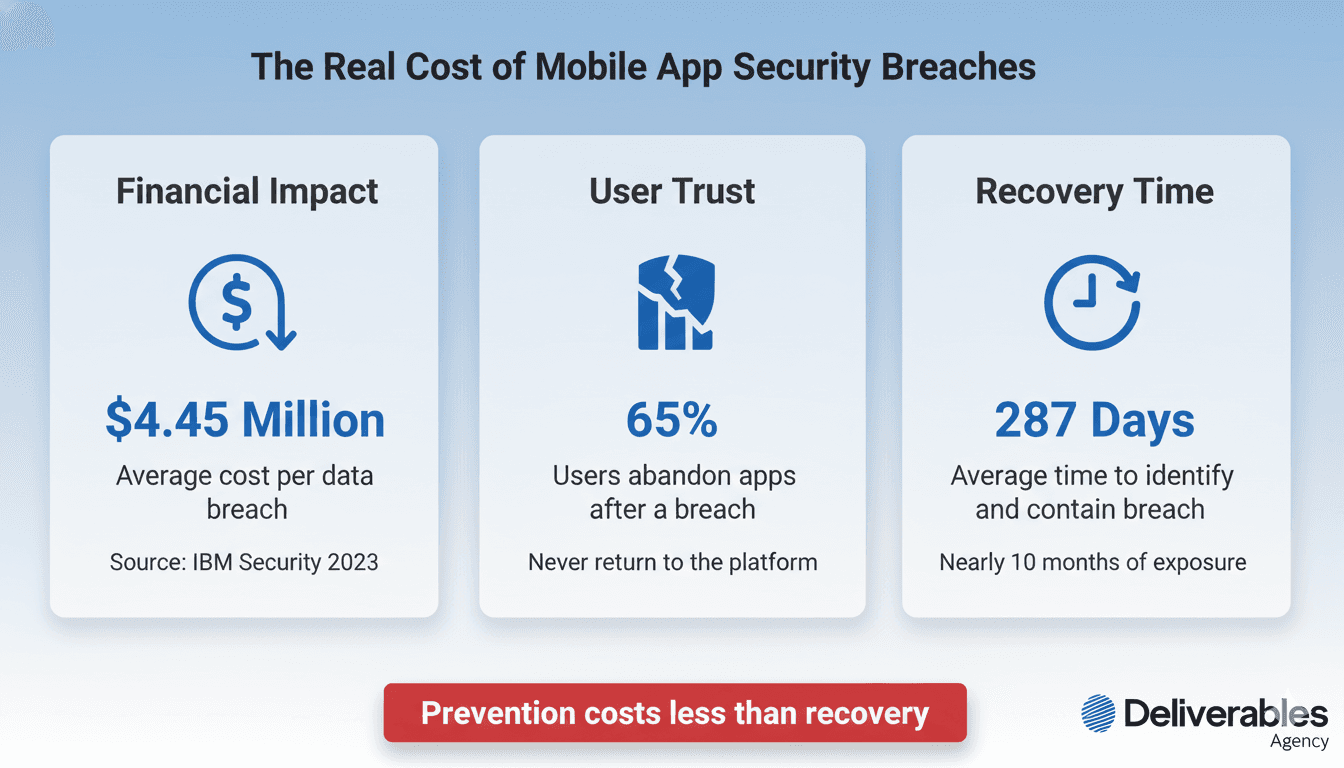
Data breaches cost mobile app companies an average of $4.45 million per incident
97% of mobile malware targets Android devices, making security essential for all platforms
Secure coding practices must start during the planning phase, not after development
Regular security audits catch 80% of vulnerabilities before hackers exploit them
User authentication layers provide the first defense against unauthorized access
Why Mobile App Security Matters More Than Ever
Mobile apps handle everything now. Banking transactions. Health records. Private conversations. Business secrets.
Hackers know this. They target mobile apps because the payoff justifies the effort. A single breach exposes thousands or millions of users.
The 2023 MOVEit breach affected over 2,000 organizations. Attackers exploited a vulnerability that developers missed during security reviews. The damage spread across healthcare providers, government agencies, and financial institutions.
Companies that ignore mobile application security face consequences beyond data loss. Regulatory fines under GDPR or CCPA reach into millions. Customer lawsuits follow breaches. Brand reputation takes years to rebuild.
Start Security Before Writing Code
Security begins before the first line of code appears on screen. The planning phase sets the foundation.
Threat modeling identifies risks specific to your app. What data will users share? Where does that data travel? Who might want to steal it?
Create a security requirements document. List every potential vulnerability. Rank them by severity. Build solutions into the architecture from day one.
Most developers skip this step. They rush into coding and patch security holes later. That approach costs more time and money than doing it right initially.
Partnering with experts in mobile app development ensures security becomes part of the foundation rather than an afterthought.

Protect Data in Transit and at Rest
Data moves constantly in mobile apps. From device to server. Between microservices. Through third party APIs.
Every movement creates vulnerability. Encryption shields data during these journeys.
TLS 1.3 provides the current standard for data in transit. Older versions contain exploitable weaknesses. Configure servers to reject connections using outdated protocols.
Certificate pinning adds another protection layer. The app only trusts specific SSL certificates. Even if attackers compromise a certificate authority, they cannot intercept communications.
Data sitting on devices needs protection too. Device storage offers several encryption options. Never store sensitive information in plain text. Passwords, tokens, and personal details belong in encrypted containers.
iOS provides the Keychain for secure storage. Android offers the Keychain and EncryptedSharedPreferences. Use these built-in tools instead of creating custom solutions.
Some developers store API keys directly in code. This creates an easy target. Extract those keys during reverse engineering takes minutes. Environment variables or secure key management systems work better.
Build Strong Authentication Systems
Passwords alone fail to stop determined attackers. Credential stuffing attacks use leaked passwords from other breaches to gain access.
Multi-factor authentication (MFA) blocks most unauthorized access attempts. Combine something users know (password) with something they have (phone) or something they are (fingerprint).
Biometric authentication provides convenience without sacrificing security. Face recognition and fingerprint scanning verify identity quickly.
Session management determines how long users stay logged in. Short timeout periods reduce risk. Refresh tokens allow seamless reauthorization without forcing constant logins.
OAuth 2.0 and OpenID Connect offer standardized authentication frameworks. These protocols handle common security scenarios. Building custom authentication systems introduces unnecessary risks.
Write Secure Code From the Start
Code vulnerabilities create entry points for attacks. Common mistakes appear repeatedly across mobile apps.
SQL injection happens when apps fail to validate user inputs. Attackers insert malicious SQL commands through input fields. Parameterized queries prevent this attack vector.
Cross-site scripting (XSS) exploits apps that display user-generated content without sanitization. Input validation and output encoding stop XSS attacks.
Buffer overflows occur in apps written in C or C++. Bounds checking prevents reading or writing beyond allocated memory.
Code obfuscation makes reverse engineering harder. Tools like ProGuard for Android and SwiftShield for iOS scramble code structure. Attackers spend more time understanding obfuscated code, giving security teams time to respond.
Regular code reviews catch vulnerabilities before deployment. Integrating security checks into your development process ensures consistent quality. Automated tools scan for common issues. Manual reviews find logic flaws that automated tools miss.
Manage Third Party Libraries Carefully
Modern apps rely on dozens of third party libraries. Each library introduces potential security risks.
The Log4Shell vulnerability demonstrated this danger. A flaw in a widely used logging library affected millions of applications. Attackers exploited it for months before developers patched their apps.
Track every dependency. Know what libraries your app uses. Monitor security advisories for those libraries.
Software composition analysis tools automate this process. They scan code for known vulnerabilities in dependencies. OWASP Dependency-Check and Snyk identify problematic libraries.
Update libraries regularly. Security patches address discovered vulnerabilities. Delaying updates leaves apps exposed.
Evaluate libraries before adding them. Check maintenance status. Active projects receive security updates promptly. Abandoned projects accumulate unpatched vulnerabilities.
Minimize dependencies. Each library expands the attack surface. Use only necessary libraries with strong security records.
Implement Proper API Security
APIs connect mobile apps to backend services. Poorly secured APIs expose entire systems.
API keys authenticate requests. Store them securely. Rotate them periodically. Revoke compromised keys immediately.
Rate limiting prevents abuse. Attackers cannot overwhelm servers with requests. Legitimate users experience better performance.
Input validation happens server-side, not just client-side. Attackers bypass client-side validation easily. Server validation provides real protection.
Implement proper authorization checks. Verify users have permission for requested actions. Check authorization on every API call, not just the first one.
API versioning allows security updates without breaking existing apps. Following API security best practices from organizations like OWASP helps prevent common vulnerabilities. Deprecate vulnerable versions. Force updates when necessary.
Test Security Regularly
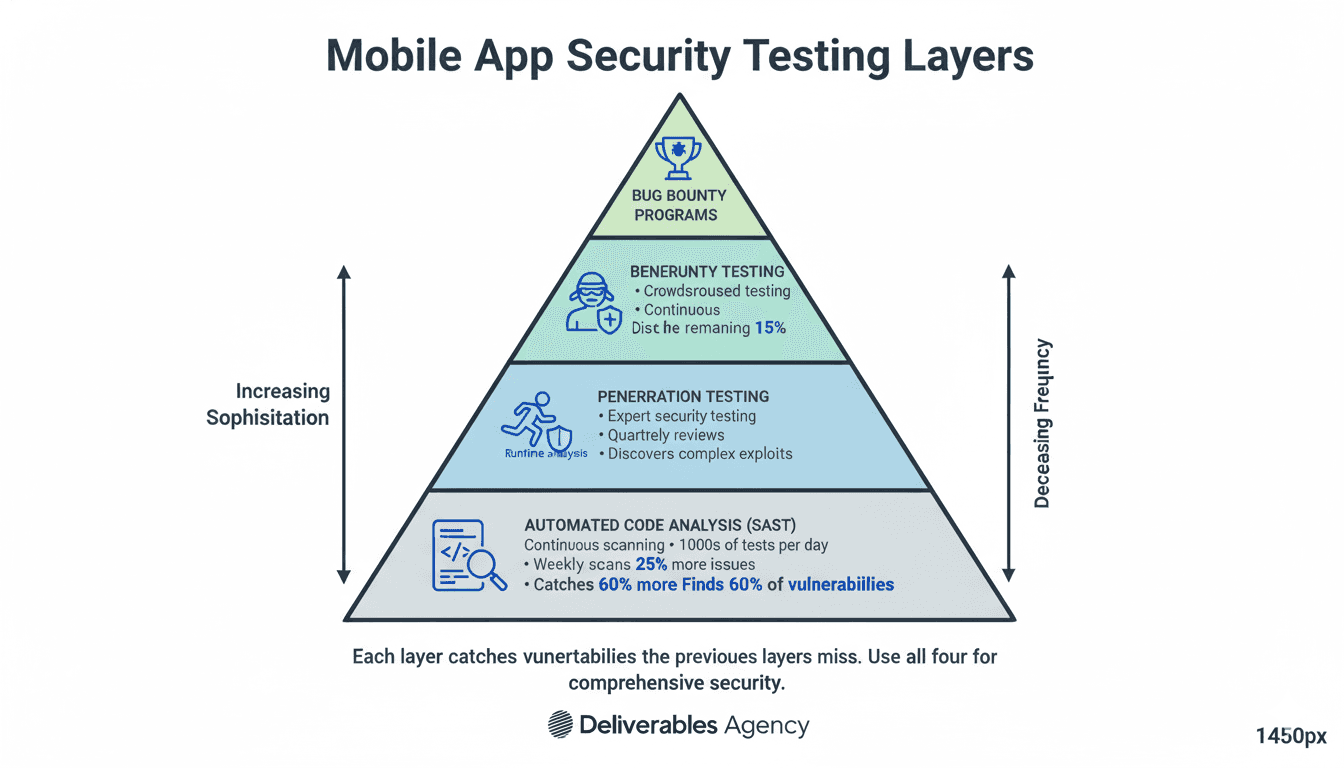
Security testing reveals vulnerabilities before attackers discover them. Multiple testing approaches provide comprehensive coverage.
Static application security testing (SAST) analyzes source code without executing it. These tools find coding errors and security flaws early in development.
Dynamic application security testing (DAST) tests running applications. It simulates attacks to find runtime vulnerabilities.
Penetration testing hires experts to attack your app. They use the same techniques as real hackers. Their findings show exactly how attackers might breach security.
Bug bounty programs crowdsource security testing. Researchers worldwide look for vulnerabilities. Companies pay for verified bugs. This approach finds issues traditional testing misses.
Automate security testing in CI/CD pipelines. Every code commit triggers security scans. Problems get caught immediately.
Secure the Backend Infrastructure
Mobile apps represent the visible tip. Backend infrastructure holds the real treasure trove of data.
Server hardening removes unnecessary services and closes unused ports. Default configurations often contain security weaknesses. Custom configurations tailored to specific needs work better.
Web application firewalls filter malicious traffic. They block common attack patterns before they reach applications.
Database security prevents unauthorized data access. Encrypt sensitive data. Restrict database permissions. Regular backups enable recovery from attacks.
Container security matters for modern architectures. Docker and Kubernetes introduce new attack vectors. Image scanning catches vulnerabilities in container images.
Plan for Security Incidents
Breaches happen despite best efforts. Response speed determines damage extent.
Incident response plans outline specific steps. Who gets notified? How do teams contain breaches? What communications go to users?
Logging captures security events. Detailed logs help reconstruct attack timelines. They reveal entry points and affected systems.
Monitoring detects unusual activity. Sudden spikes in failed login attempts signal attacks. Geographic anomalies suggest compromised accounts.
Regular drills test incident response plans. Teams practice their roles. Gaps in plans become obvious during practice runs.
Have legal counsel review breach notification requirements. Different jurisdictions impose different timelines and notification methods.
Keep Security Updated
Security never reaches a finished state. New vulnerabilities emerge constantly.
Operating system updates patch security holes. Encourage users to update devices. Some apps check OS versions and warn about outdated systems.
App updates deliver security patches. Push critical security updates quickly. Explain security improvements in release notes.
Security training keeps development teams current. Threats evolve. Training teaches new attack vectors and defensive techniques.
Follow security researchers and advisories. OWASP, CERT, and vendor security bulletins announce new vulnerabilities.
Privacy Regulations and Compliance
Privacy laws impose strict requirements on data handling. GDPR in Europe. CCPA in California. Similar laws spread globally.
Data minimization collects only necessary information. Apps should not request permissions they do not need. Users notice and question excessive data collection.
Transparent privacy policies explain data usage in plain language. Legal jargon confuses users and erodes trust.
User consent matters. Give users real choices about data sharing. Make opting out as easy as opting in.
Right to deletion allows users to remove their data. Build this capability into apps from the beginning.
Regular compliance audits verify adherence to regulations. Document security measures. Regulators want proof of compliance.
Platform Specific Security Features
iOS and Android offer different security features. Leverage platform capabilities.
iOS security features:
App Sandbox isolates apps from each other
Code signing verifies app authenticity
App Transport Security enforces secure connections
Keychain provides secure storage
Android security features:
App signing prevents tampering
Permissions model controls resource access
Verified boot prevents unauthorized modifications
Hardware-backed Keystore protects keys
Use these features instead of reinventing security mechanisms. Platform vendors invest heavily in security research.
User Education Matters
The most sophisticated security fails when users make mistakes. Education reduces user-caused vulnerabilities.
Clear security prompts explain why permissions matter. Users understand context better than technical jargon.
Security tips within apps remind users about best practices. Password strength indicators encourage better choices.
Phishing awareness helps users recognize social engineering. Teach them to verify unexpected messages.
Two-factor authentication adoption increases with clear explanations. Show benefits, not just technical requirements.
Real World Security Lessons
Learning from actual breaches prevents repeating mistakes.
The Equifax breach happened because they failed to patch a known vulnerability. A fix existed for months. They never applied it. The breach exposed 147 million people.
The Capital One breach exploited misconfigured cloud security. A firewall misconfiguration allowed unauthorized access. Proper configuration management would have prevented it.
The Facebook Cambridge Analytica scandal showed API security failures. Excessive data sharing through APIs enabled misuse. Granular permissions would have limited damage.
These cases share common themes. Known vulnerabilities left unpatched. Configuration mistakes. Insufficient access controls. All preventable problems.

Building Security Into Company Culture
Security works best as a shared responsibility. Everyone on the team contributes.
Security champions within teams promote best practices. Working with experienced development teams that prioritize security from the start saves time and prevents costly vulnerabilities. They stay current on threats and share knowledge.
Secure development lifecycle integrates security into every stage. Requirements gathering includes security requirements. Design reviews consider security implications. Testing includes security validation.
Metrics track security improvements. Vulnerability counts. Time to patch. Security test coverage. Numbers make progress visible.
Recognition rewards security contributions. Developers who find vulnerabilities get acknowledgment. This encourages proactive security thinking.
The Future of Mobile App Security
Security challenges evolve as technology advances.
Artificial intelligence changes both attack and defense. AI helps detect anomalies faster. It also helps attackers find vulnerabilities more efficiently.
Quantum computing threatens current encryption. Post-quantum cryptography prepares for this future. Forward-thinking apps begin transitioning now.
IoT integration expands attack surfaces. Mobile apps controlling smart devices create new vulnerability chains.
Zero trust architecture assumes breach. Verify everything. Trust nothing. This model suits mobile environments well.
Taking Action Today
Security improvements start with small steps. Pick three vulnerabilities from this guide. Fix them this week.
Schedule security reviews. Monthly code reviews catch issues early. Quarterly penetration tests validate defenses.
Document security decisions. Future team members need context. Documented reasoning prevents repeating mistakes.
Measure progress. Track metrics over time. Celebrate improvements.
Security never finishes. But every improvement makes apps safer. Users deserve protection. Businesses need trust. Strong security delivers both.
The mobile apps built today will handle tomorrow's sensitive data. Security decisions made now echo for years. Choose wisely. Act deliberately. Protect relentlessly.
Have an Idea for an App or Website?
At Deliverables, we specialize in building custom digital products that solve real-world problems. Tell us your idea, and our expert team will help you craft a plan to build your dream.
Some Topic Insights:
What are the top security risks for mobile applications?
The top risks include insecure data storage, weak server-side controls, insufficient cryptography, insecure authentication, and code tampering. Poor input validation and insecure communication channels also rank high on vulnerability lists.
How often should mobile apps undergo security testing?
Should mobile apps store sensitive data on devices?
How do you prevent unauthorized API access?
What security certifications should mobile app developers have?