
Time to read :
1 min read
Building an app is exciting. Getting people to download it feels even better. But here comes the question that keeps founders awake at night: how do you monetize an app without driving users away?
The truth is most apps never make money. Not because they lack users or solve fake problems. They fail because their creators treat monetization as an afterthought instead of a core feature.
Key Takeaways:
App monetization must be planned during development, not added later
The freemium model converts better when premium features solve real pain points
In app advertising works best when ads match your user experience naturally
Combining multiple revenue streams protects your income from single point failure
User experience always comes before revenue in successful apps
Testing different pricing models early helps you find what your audience will pay for
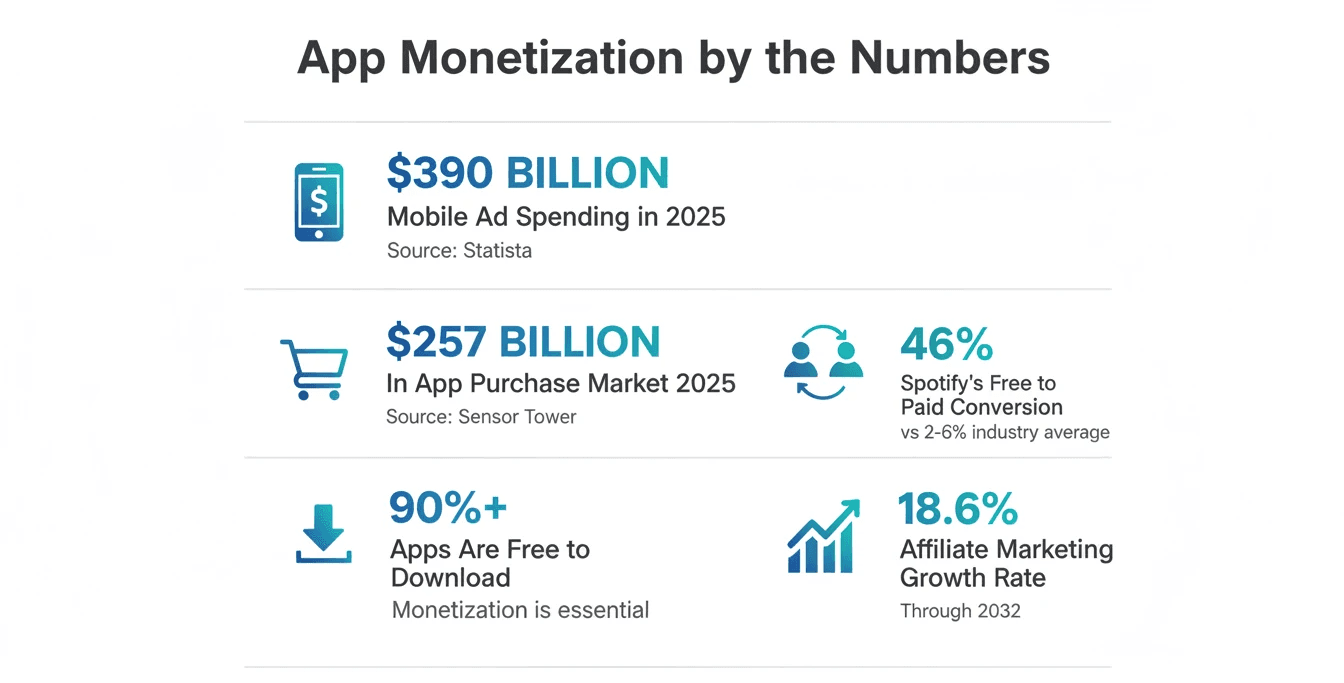
Over 90% of apps in major app stores are free to download. That means every developer faces the same challenge: turning free users into paying customers or finding other ways to generate revenue. The good news? There are proven app monetization strategies that work when implemented correctly.
But here's what most guides won't tell you: monetization planning must start before you write a single line of code. If you're still exploring how to make an app, understanding revenue models now will save you from costly rebuilds later. And knowing your app development costs upfront helps you set realistic revenue targets and calculate when you'll actually turn a profit.
This guide shows you exactly how to monetize apps based on real data and tested methods.
Understanding App Monetization in 2026
App monetization means turning your user base into a revenue stream. Simple concept. Hard execution.
The global app market continues to grow. Ad spending in mobile apps will hit $390 billion in 2025. In app purchases are expected to reach $257 billion. These numbers tell you one thing: money flows through mobile apps when done right.
But those billions get split among millions of apps. Most get nothing. A small percentage captures most of the revenue. The difference? Strategic monetization planning from day one.
Your app category matters more than you think. Gaming apps thrive on in app purchases. News apps work better with subscription models. Utility apps often rely on freemium tiers. Forcing the wrong model onto your app is like trying to sell ice to penguins.
14 Powerful App Monetization Strategies
1. Freemium Model: Give Value First, Charge for More
Freemium lets users access basic features free while charging for premium upgrades. This model works because people try before they buy.
Spotify proves freemium works at scale. They convert 46% of free users to paid subscribers. Compare that to typical freemium conversion rates of 2% to 6%. The difference? They make the free version good enough to use but premium compelling enough to upgrade.
The freemium trap is giving away too much for free. Users need a reason to upgrade. That reason must solve a real problem they experience while using your free version. Not artificial limits. Real value.
How to make freemium work:
Premium features should remove friction or add capabilities users genuinely want. Unlimited storage. Advanced tools. Ad removal. Faster processing. These upgrades feel worth paying for because they enhance an experience users already enjoy.
Test your freemium boundaries. Track where free users hit walls. Measure which premium features drive conversions. Adjust based on data, not assumptions.
2. In App Advertising: Turn Traffic into Revenue
In app advertising puts ads inside your app. Banner ads, video ads, native ads, interstitial ads between screens. Users see ads. Advertisers pay you.
This remains one of the most popular app monetization strategies because it generates revenue without charging users directly. Mobile ad spending keeps climbing year after year.
But ads annoy users when done badly. Too many ads kill retention. Poorly placed ads ruin user experience. The sweet spot balances revenue with satisfaction.
Types of in app ads that work:
Banner ads sit at top or bottom of screens. They have low click rates around 0.1% but don't interrupt usage. Interstitial ads cover the full screen at natural transition points and command higher rates. Native ads blend into your content and perform better than standard banners. Rewarded video ads let users watch ads in exchange for in app rewards.
Native ads outperform others because they match your app's look and feel. Click through rates for native ads hit 0.38% on mobile compared to 0.11% for traditional banners.
Timing matters as much as format. Show ads during natural breaks in usage. After level completion in games. Between articles in news apps. During loading screens. Never interrupt critical user actions.
3. In App Purchases: Let Users Buy What They Want
In app purchases let users buy virtual goods, features, or content inside your app. Mobile games made this model famous, but it works across categories.
The in app purchase market is massive. It hit $209 billion in 2024 and keeps growing at 23% annually. By 2029, experts predict it will reach $657 billion.
Four types of in app purchases:
Consumable purchases get used up and bought again. Game currency, power ups, extra lives. Users spend repeatedly on these. Non consumable purchases last forever. Level unlocks, character skins, tool upgrades. Auto renewing subscriptions charge users regularly for ongoing access. Non renewing subscriptions require manual renewal.
Gaming apps lead in app purchases but other categories use them too. Productivity apps sell template packs. Photo apps sell filters. Fitness apps sell workout plans. Music apps sell individual songs.
The psychology matters here. Small purchases add up faster than big ones. Offering a $0.99 item sells better than only having $9.99 options. Give users spending ladders with multiple price points.
4. Premium Subscriptions: Build Predictable Revenue
Premium subscription apps charge users a recurring fee to access content or features. Monthly or annual. This creates steady, predictable revenue that investors and banks love.
Subscription revenue has exploded. The US alone expects 458 million video streaming subscriptions by 2027. Netflix, Disney+, and Amazon Prime Video all prove people will pay recurring fees for content they value.
Subscription models work best for apps that deliver ongoing value. Streaming media, cloud storage, professional tools, educational content, fitness programs. Users need to keep coming back for the subscription to make sense.
Making subscriptions stick:
Your first month determines everything. If users don't engage deeply in their trial period, they cancel. Build strong onboarding that shows value immediately. Send reminders about unused features. Create habits that make your app essential.
Offer annual subscriptions alongside monthly ones. Annual plans reduce churn and bring cash upfront. Price them at 10 to 12 months worth of monthly fees. Users save money. You secure longer commitments.
The subscription fatigue is real in 2025. Users already pay for Netflix, Spotify, cloud storage, and a dozen other subscriptions. Your app must justify another recurring charge. If it doesn't, users will churn.
5. Hybrid Monetization: Combine Multiple Revenue Streams
Why choose one monetization method when you can use several? Hybrid monetization mixes different strategies to maximize revenue while minimizing risk.
Smart apps layer monetization methods. Free version with ads. Premium subscription removes ads and adds features. In app purchases for extra content. Affiliate links to related products. Each stream catches different user segments.
The risk with single revenue streams is simple: if it fails, your whole business fails. Ad rates drop. Subscription churn spikes. In app purchases slow down. Having multiple streams protects you when one underperforms.
Building your hybrid model:
Start with your core monetization. What fits your app and users best? Build that first and optimize it. Then add complementary streams that don't conflict with your primary revenue.
A meditation app might use freemium for basic content, subscriptions for full library access, one time purchases for premium courses, and affiliate links for meditation cushions. Each method serves different users or use cases.
Track revenue by source. Know which streams perform and which waste development time. Double down on winners. Cut or improve losers.
6. Sponsored Content and Partnerships
Sponsored content involves brands paying to appear in your app in ways that feel natural. Not intrusive ads. Integrated brand experiences that add value for users.
This works especially well for apps with engaged niche audiences. Fitness apps partner with supplement brands. Recipe apps feature kitchen equipment. Travel apps work with hotels and airlines. The brand gets access to your audience. You get paid.
Partnership deals can be one time campaigns or ongoing relationships. One time sponsorships work for product launches or seasonal promotions. Ongoing partnerships provide steady income and deepen brand integration.
The key is matching sponsors to your audience. A finance app partnering with luxury cars makes sense. That same partnership in a budgeting app for students feels tone deaf. Authenticity matters. Users smell forced partnerships instantly.
7. Affiliate Marketing: Earn from Recommendations
Affiliate marketing means promoting other products or services and earning commissions on resulting sales. You recommend something. Users buy it through your referral. You get a percentage.
The affiliate market will hit $48 billion by 2027, growing at 18.6% annually. Mobile traffic drives 62% of affiliate visits. Your app sits right where this money flows.
Apps naturally create affiliate opportunities. Shopping apps link to products. Recipe apps connect to grocery delivery. Travel apps book hotels and flights. Fitness apps recommend equipment. If your users need something related to your app's purpose, affiliate links work.
Implementing affiliate links effectively:
Make recommendations genuinely helpful. Don't spam users with random products. Suggest things that solve problems your app highlights. A running app recommending running shoes makes sense. That same app pushing random electronics does not.
Track which products your users actually buy. Some affiliate categories convert better than others. Focus on high converting, high commission products that match your audience.
Disclose affiliate relationships clearly. Users appreciate honesty. Hidden affiliate links damage trust when discovered.
8. Data Licensing: Monetize Anonymized User Data
If your app collects valuable data as part of its core function, you might monetize that data through licensing agreements. Navigation apps track traffic patterns. Weather apps gather local conditions. Social apps understand user behavior.
This model requires extreme care. Users must explicitly consent to data collection and understand how their information gets used. Privacy regulations like GDPR and CCPA impose strict rules. Violating these brings massive fines and reputation damage.
Waze successfully licenses traffic data to businesses wanting to place location based ads. Users benefit from free navigation. Waze generates revenue from the crowd sourced traffic information users create while using the app.
Data licensing considerations:
Only license anonymized, aggregated data. Never sell individual user information. Be transparent about what data you collect and how it gets used. Give users control over their data sharing preferences.
Data licensing works best as a supplementary revenue stream, not your primary model. Users tolerate it when your app delivers strong value for free. They revolt when they feel like the product being sold.
9. White Label Licensing: Sell Your App Infrastructure
White label licensing means selling your app's underlying technology to other companies who rebrand it as their own product. You built something great. Others want to use it without building from scratch.
This model works well for apps with strong technical infrastructure but broad use cases. Messaging apps can be white labeled for corporate communication. Booking apps can be licensed to different service industries. Payment apps can power multiple merchant platforms.
The advantage is multiple revenue streams from one development effort. You build it once. License it many times. Each client pays recurring fees. Your development costs get spread across multiple customers.
Making white labeling work:
Your core product must be highly customizable. Clients need to make it look and feel like their own brand. Build flexibility into your infrastructure from the start. Color schemes, logos, feature toggles, custom domains.
Provide strong documentation and support. White label clients need to implement and maintain your technology. Make that easy or they'll build their own solution instead.
Price based on value provided, not development cost. If your app helps a company make millions, charge accordingly. If it saves them years of development time, capture some of that value.
10. Transaction Fees: Take a Cut of Value Created
Transaction fee models take a percentage of transactions happening inside your app. Marketplace apps charge sellers. Payment apps take processing fees. Booking apps collect commissions from service providers.
This model aligns your success with user success. The more value users create through your app, the more you earn. When your app helps people make money or complete valuable transactions, taking a small cut feels fair.
Rideshare apps pioneered this in the app world. Uber and Lyft take 20% to 30% of each ride fare. Food delivery apps charge restaurants and customers. Freelance marketplaces take commissions from project payments.
Setting transaction fees:
Your fee must feel worth the value provided. If your app just connects buyers and sellers, high fees seem greedy. If you handle payments, provide trust systems, resolve disputes, and market listings, higher fees make sense.
Competitors set price ceilings. If similar apps charge 10% and you charge 25%, users will switch unless you offer dramatically better value. Research competitor fees before setting yours.
Start lower and raise gradually. Users accept small fee increases on a platform they already use and trust. Launching with high fees scares early adopters away.
11. Crowdfunding: Fund Development Through Community
Crowdfunding raises money from future users before or during development. Platforms like Kickstarter, Indiegogo, and Patreon connect creators with supporters who believe in their vision.
This works best for apps solving problems existing communities care about. Niche tools for specific professions. Apps serving underserved audiences. Creative tools for specific art forms. If people are already looking for your solution, crowdfunding can fund its creation.
The advantage goes beyond money. Successful crowdfunding validates demand before you build. It creates a community of early adopters invested in your success. These people become your first users, your beta testers, your word of mouth marketers.
Running effective crowdfunding:
Your pitch must clearly explain what problem you solve and why existing solutions fail. Show mockups or prototypes. Prove you can deliver. Explain how the money will be used.
Offer backer rewards at multiple price points. Early access. Lifetime subscriptions. Custom features. Merchandise. Give people reasons to back at different levels based on their enthusiasm and budget.
Update backers regularly during and after the campaign. Show progress. Share challenges. Build trust. Your backers invested in you personally as much as your app. Maintain that relationship.
12. SMS and Email Marketing: Monetize Your User Base
SMS and email marketing involve collecting user contact information and promoting offers, features, or partner products. Done right, it drives engagement and revenue. Done wrong, it annoys users into uninstalling.
SMS marketing achieves an 18% click through rate compared to email's 2.5%. Text messages get read. Emails get ignored. For time sensitive offers or urgent updates, SMS wins.
But SMS marketing requires explicit user consent. Regulations around text message marketing are strict. Users must opt in. You need clear unsubscribe options. Violations bring heavy penalties.
Using direct marketing effectively:
Segment your messages. Not every user wants every offer. Send relevant messages to relevant users based on their behavior and preferences. A user who never made in app purchases won't respond to purchase prompts.
Timing matters enormously. Don't blast messages at 2am. Don't interrupt users during peak usage. Send messages when users are likely to be receptive and have time to respond.
Provide value beyond promotions. Send helpful tips. Share updates about new features. Offer exclusive content. If every message is a sales pitch, users will opt out.
13. Advertising App Itself: Promote Premium Versions
Free apps can promote their own premium versions through in app messaging, upgrade prompts, and feature comparisons. This costs nothing but generates upgrades when done thoughtfully.
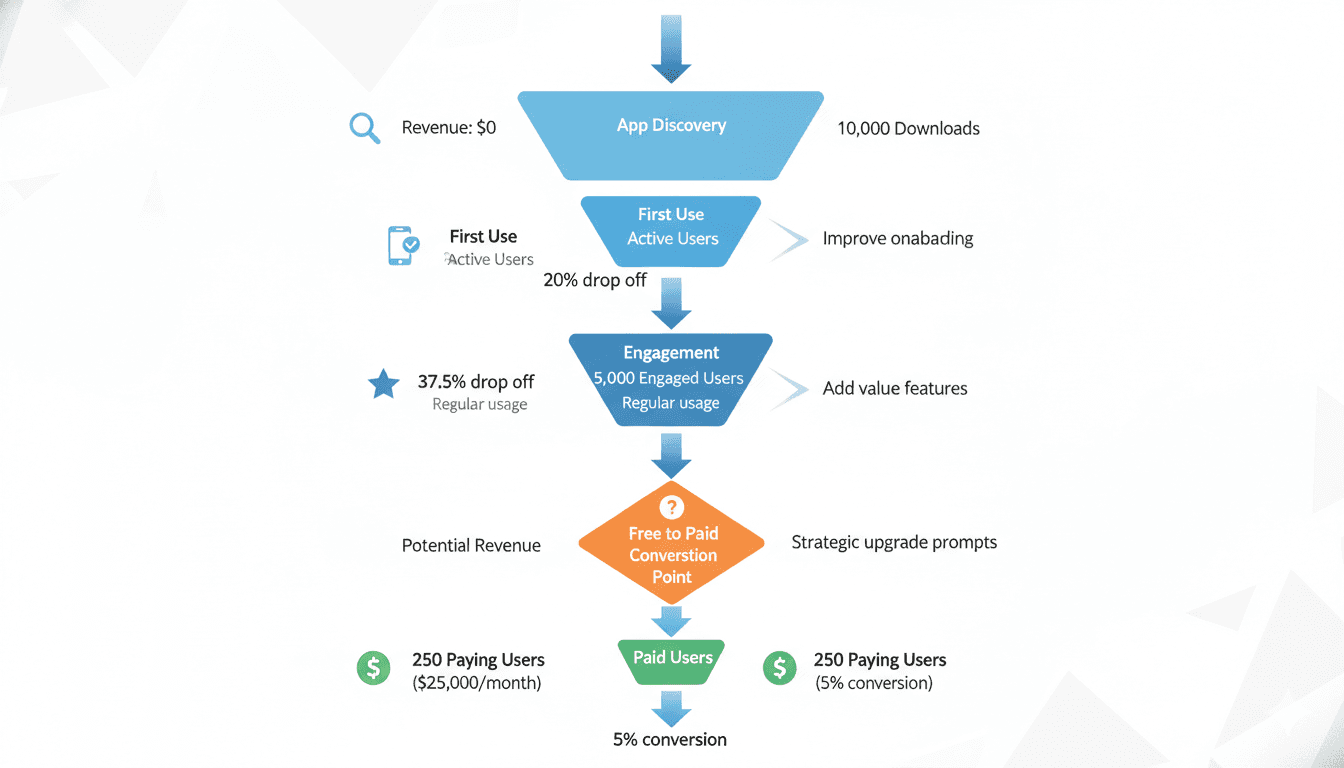
The conversion funnel starts when users first open your app. Onboarding screens can highlight premium features available after trial. In app notifications can remind users about premium benefits. Paywalls can appear at strategic moments when users want access to locked features.
Timing these prompts separates good monetization from annoying spam. Show upgrade options when users hit limits or want features you've gated behind premium. Not randomly. Not constantly. When it solves a problem the user just encountered.
Optimizing upgrade prompts:
Test different messaging. "Upgrade to Premium" converts differently than "Unlock All Features" or "Remove Ads Forever." Small word changes create big conversion differences.
Show exactly what users get when upgrading. Vague promises perform poorly. Specific benefits convert better. Instead of "Get more features," try "Unlock unlimited projects, priority support, and advanced analytics."
Make upgrading easy. One tap purchases work better than multi step processes. Support multiple payment methods. Reduce friction between intent and payment.
14. Event Based Monetization: Charge for Special Access
Event based monetization involves charging for participation in special events, challenges, workshops, or time limited content. This works particularly well for community focused apps and educational platforms.
Fitness apps host virtual races. Photography apps run monthly contests. Language learning apps offer live tutoring sessions. These events create urgency and community while generating revenue beyond standard subscriptions.
Limited time offers leverage FOMO (fear of missing out). Users pay to participate because the opportunity won't last. Unlike permanent features, events create natural purchase deadlines that motivate action.
Creating monetizable events:
Events must offer unique value not available through regular app usage. Exclusive content. Expert access. Community competition. Recognition or rewards. Users need compelling reasons to pay beyond normal app access.
Promote events well in advance. Give users time to mark calendars and budget. Last minute event announcements generate fewer participants.
Record and package popular events as purchasable content afterwards. A live workshop becomes a premium course. A virtual race becomes an on demand challenge. One event creates multiple revenue opportunities.
Choosing the Right Monetization Strategy for Your App
Not every app monetization strategy works for every app. Trying to force subscriptions onto an app users open once monthly fails. Putting ads in premium productivity tools frustrates paid users.
Match strategy to app category:
Gaming apps excel with in app purchases and rewarded ads. Users expect to buy virtual goods and watch ads for bonuses. Utility apps work better with freemium or one time purchases. Users want tools that just work. News and media apps thrive on subscriptions. Users consume content regularly, making recurring payments logical. Social apps often use advertising or data licensing. Free access drives network effects.
Consider your target audience:
Younger users tolerate ads better than older demographics. Business users pay for subscriptions if apps improve productivity. Budget conscious users prefer free ad supported models. Affluent users prefer premium ad free experiences.
Survey potential users early. Ask what they'd pay for. How they prefer to pay. What monetization they find acceptable. This research prevents building monetization users reject.
Test multiple strategies in parallel if possible. Offer both ad supported free version and paid ad free version. See which generates more total revenue. Data beats assumptions every time.
How Deliverables Agency Builds Monetizable Apps
Building apps with strong monetization requires more than adding payment buttons. The entire user experience must support your revenue model from the first screen users see.
Deliverable Agency has developed apps across industries and monetization models. The lesson learned? Monetization must be designed into the app architecture, not tacked on later. Our custom software development services build apps with monetization strategies integrated from day one.
Planning monetization during initial development saves time and money. Retrofitting payment systems, ad placements, or subscription logic into finished apps creates technical debt and poor user experience. Understanding the full scope of your app development costs and timeline from the beginning ensures you budget properly for revenue features that actually work.
Building these systems correctly from the start ensures smooth implementation and better performance. Use our app cost calculator to understand the investment required to build monetization features properly from day one, rather than paying double to fix them later.
The development process matters as much as the final features. Agile methodology lets teams test monetization approaches early with real users. Quick iterations help identify what works before committing to full development. This approach reduces risk and improves outcomes.
Technical implementation affects revenue directly. Slow payment processing loses sales. Confusing upgrade flows reduce conversions. Poor ad integration crashes apps. Professional development ensures monetization features work reliably under real world conditions.
Common App Monetization Mistakes to Avoid
Most apps that fail at monetization make predictable mistakes. Learning from others' errors saves time and money.
Monetizing too early: Apps without strong user engagement can't monetize effectively. Build something people love first. Monetize second. An app with 100 engaged users beats an app with 10,000 uninterested downloads.
Too many ads: Flooding your app with advertisements drives users away faster than it generates revenue. Every ad is a chance for users to leave. Balance ad density with retention rates. More ads doesn't always mean more money.
Ignoring user feedback: Users tell you what they will and won't pay for. Listen. If everyone complains about your subscription pricing, your pricing is wrong. If users love a feature but won't pay for it, find what they will pay for.
Choosing models that don't fit: Subscription models fail for apps users open occasionally. In app purchases flop in apps without virtual economies. Match your monetization to your app's usage patterns and user expectations.
Complicated pricing: Users shouldn't need spreadsheets to understand your pricing. Simple beats clever. Three clear options convert better than ten confusing ones. Transparent pricing builds trust. Hidden fees destroy it.
No monetization testing: Launching with untested pricing is gambling. A/B test prices, features, and messaging before committing. Small tests prevent expensive mistakes.
Measuring App Monetization Success
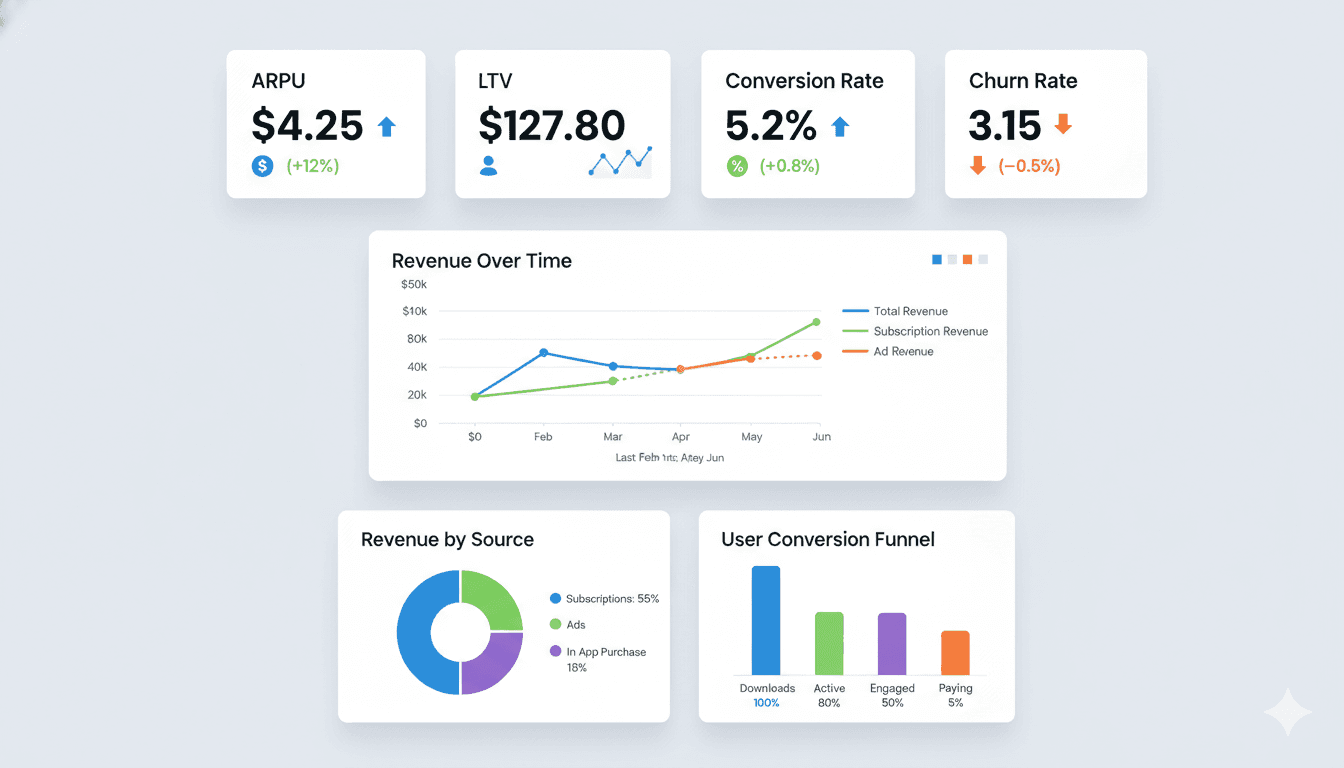
Average Revenue Per User (ARPU): Total revenue divided by total users. This shows how much value you extract from your user base. Higher ARPU means better monetization or more valuable users.
Lifetime Value (LTV): How much revenue you expect from a user over their entire relationship with your app. LTV must exceed user acquisition cost for sustainable growth.
Conversion rate: Percentage of users who complete desired actions. Free to paid conversions. Ad clicks. In app purchases. Every monetization model has critical conversion points to optimize.
Churn rate: Percentage of users who stop using your app or cancel subscriptions. Lower churn means more predictable revenue and lower acquisition costs.
Retention rate: Percentage of users still active after specific time periods. Day 1, day 7, day 30 retention numbers predict long term success. Apps that retain users can eventually monetize them.
Set up analytics from day one. Google Analytics, Mixpanel, Amplitude, or similar tools track user behavior and revenue metrics. Without data, you're flying blind.
Review metrics weekly during launch and monthly once established. Look for trends and anomalies. Sudden drops in conversion rates signal problems. Unexpected spikes reveal opportunities.
Future Trends in App Monetization
App monetization continues evolving as technology, regulation, and user expectations shift. Staying ahead of trends gives competitive advantages.
Privacy first monetization: As privacy regulations tighten and users demand more control over their data, monetization models relying heavily on user tracking will struggle. First party data and contextual advertising will replace behavioral targeting.
AI powered personalization: Machine learning will optimize pricing, offers, and ad placements for individual users. Dynamic pricing based on user behavior and willingness to pay will become standard.
Blockchain and crypto payments: Some apps will experiment with cryptocurrency payments and NFT based virtual goods. This remains niche but growing, especially in gaming and creator economy apps.
Subscription fatigue solutions: As users hit subscription limits, apps will offer more flexible options. Pay per use pricing. Pausing subscriptions. Micro subscriptions for specific features. The rigid monthly subscription model will evolve.
Super app monetization: Western apps may follow Asian super app models like WeChat, combining multiple services and monetization streams in single platforms. These apps capture more user time and spending.
The core principle stays constant regardless of trends: create value worth paying for. Monetization models change. Human psychology around value and fairness does not.
Start Monetizing Your App the Right Way
Monetization makes or breaks apps. Beautiful design matters. Smooth functionality matters. But if your app doesn't generate revenue, it won't survive.
The apps that succeed with monetization share common traits. They provide genuine value users appreciate. They choose monetization models matching their user base and usage patterns. They implement revenue features professionally without damaging user experience. They test and optimize continuously.
Start with clear monetization goals before writing a single line of code. Understand what users will pay for. Build that value into your product. Design payment flows that feel natural. Test with real users early. Measure everything. Adjust based on data.
Your app can generate substantial revenue through smart monetization. The strategies exist. The tools are available. The market is ready to pay for value. Execute well and your app becomes a sustainable business, not just another abandoned project.
Ready to build an app with strong monetization built in from day one?
Deliverables Agency custom software development services help you design, develop, and launch apps with revenue strategies that actually work. Our team has built monetizable apps across industries and business models. We know what works because we've done it dozens of times.
Some Topic Insights:
How much money can a mobile app make?
App revenue varies wildly based on category, user base, and monetization strategy. Successful apps can generate anywhere from a few hundred dollars monthly to millions. Gaming apps with in app purchases often earn the most. Utility apps typically generate less per user but have longer retention. Focus on building engaged users first. Monetization follows engagement.
What is the best monetization strategy for a new app?
How many users do you need to monetize an app?
When should you start monetizing your app?
What monetization strategies work best for small apps?