
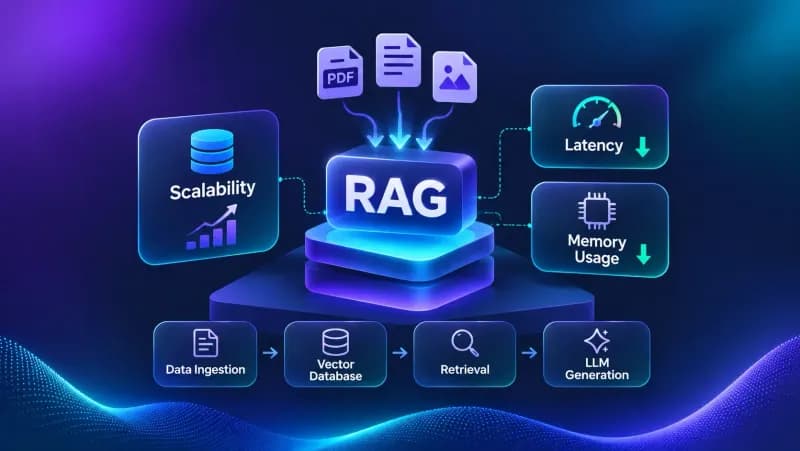
Retrieval-Augmented Generation (RAG) has become an important approach for building AI applications that can retrieve relevant information from enterprise data and use large language models (LLMs) to generate context-aware responses. From enterprise AI assistants and customer support chatbots to knowledge management platforms, RAG systems help businesses connect generative AI with their internal information.
However, building a RAG application that works with a small dataset is very different from operating one in a production environment. As document collections grow, user requests increase, and retrieval workloads become more complex, developers face challenges related to RAG models scalability, latency, memory consumption, and infrastructure costs.
A system that responds quickly with thousands of documents may struggle when it needs to process millions of document chunks and support hundreds of concurrent users. Vector indexes consume additional memory, retrieval pipelines introduce processing overhead, and large prompts can increase the time required for an LLM to generate its first response.
Understanding RAG computational requirements and scalability is therefore essential before moving an AI application from development to production.
This guide explains how RAG systems behave at scale, what affects their computational requirements, how to calculate vector storage needs, and which architecture and optimization strategies can improve performance without unnecessarily increasing infrastructure costs.
What Makes RAG Models Difficult to Scale?
A typical RAG architecture combines document processing, embedding generation, vector storage, retrieval, optional reranking, and LLM-based response generation. Each component performs a different task and has its own resource requirements.
During initial development, these components may operate within a single application or a small infrastructure environment. However, production workloads require a more structured approach.
Consider an enterprise knowledge assistant that initially processes 50,000 documents. As the organization adds product manuals, support tickets, internal policies, and customer records, the dataset may grow to millions of searchable chunks.
At the same time, more employees begin using the assistant. The system must now handle larger indexes, increased query traffic, and multiple requests that compete for CPU, GPU, memory, and network resources.
Several challenges emerge:
Vector database memory requirements increase as the embedding collection grows.
Retrieval latency can increase when indexes become too large or poorly configured.
LLM inference requires additional GPU resources as concurrent requests increase.
Large retrieved contexts increase prompt processing requirements.
Reranking and embedding services can become bottlenecks under heavy traffic.
Replication, indexing, and data synchronization introduce additional infrastructure overhead.
These challenges are interconnected. Increasing the number of retrieved documents, for example, may improve context coverage but also increase prompt size and LLM processing time.
An effective scaling strategy must therefore consider the complete RAG pipeline rather than optimizing vector search alone.
[[widget:marketing-consultation::Build Scalable RAG Applications with Deliverable Agency::Overcome RAG performance issues, high memory consumption, and slow response times with scalable AI solutions tailored to your data, infrastructure, and business requirements.]]
Understanding RAG Computational Requirements and Scalability
RAG computational requirements depend on the size of the document collection, embedding dimensions, retrieval strategy, LLM configuration, and expected user traffic.
It is useful to divide these requirements into four main resource categories.
1. CPU Requirements
CPU resources support several operations across the RAG pipeline, including document parsing, text preprocessing, metadata filtering, request handling, and parts of vector search.
A production RAG application may need additional CPU capacity when:
Large volumes of documents are uploaded simultaneously.
Document extraction and chunking happen frequently.
Multiple users perform retrieval requests concurrently.
Metadata filtering and database operations become more complex.
The application uses CPU-based vector indexing or search.
Separating document ingestion from query processing helps prevent resource-intensive indexing jobs from affecting the responsiveness of user-facing requests.
2. GPU Requirements
GPU resources are primarily associated with embedding generation, LLM inference, and GPU-accelerated reranking or vector operations.
The actual requirement depends on the selected models and workload.
For example, an application using a large language model for response generation will have different GPU requirements from one using a smaller model with fewer retrieved context tokens.
GPU memory must also accommodate model weights, intermediate activations, and inference-related key-value cache requirements.
As concurrent requests increase, the application may need additional inference capacity to maintain its response-time targets.
3. RAM Requirements
RAM plays an important role in vector database performance. It may store vector data, search indexes, metadata, caches, and other frequently accessed information.
When the working set exceeds available memory, the database may need to access slower storage more frequently. This can increase retrieval latency and create unpredictable performance under load.
Memory planning should account for more than the raw embedding size. Index structures, metadata, replicas, and operational overhead must also be considered.
4. Storage and Network Requirements
Production RAG applications need persistent storage for source documents, processed chunks, embeddings, database snapshots, and backups.
Network resources also become important when the application separates its embedding service, vector database, reranker, and LLM inference infrastructure.
Communication between these services introduces additional latency. Poor network configuration or overloaded service endpoints can affect overall response time even when individual components are performing efficiently.
How to Calculate RAG Model Memory Usage
One of the most important aspects of RAG models scalability is understanding how much memory the vector database requires.
Every document chunk is converted into an embedding containing a fixed number of numerical values. The embedding dimension and numerical precision determine its raw storage requirement.
A simple formula for calculating raw vector memory is:
Raw Vector Storage = Number of Vectors × Embedding Dimensions × Bytes per Dimension
For example, consider a RAG application with:
10 million document embeddings
768 dimensions per embedding
FP32 numerical precision
4 bytes per dimension
The calculation becomes:
10,000,000 × 768 × 4 = 30,720,000,000 bytes
This represents approximately 30.72 GB of raw vector data using decimal units.
However, this is not the complete memory requirement of a production vector database.
Additional memory may be required for:
Vector indexing structures such as HNSW.
Document identifiers and metadata.
Search buffers and temporary operations.
Application-level caching.
Database replicas.
Background indexing and maintenance operations.
The actual memory requirement depends on the vector database, index configuration, deployment architecture, and workload.
How Embedding Dimensions Affect Memory Consumption
Embedding dimensions directly affect the amount of memory required to store vectors.
A higher-dimensional embedding contains more numerical values, increasing storage requirements. However, reducing dimensions without evaluating retrieval quality can affect semantic similarity and search accuracy.
For example, consider 10 million embeddings stored using FP32 precision.
Embedding dimensions | Approximate raw storage |
|---|---|
384 | 15.36 GB |
768 | 30.72 GB |
1,024 | 40.96 GB |
1,536 | 61.44 GB |
3,072 | 122.88 GB |
These figures represent raw vector storage only. They exclude indexes, metadata, replicas, and other database overhead.
This calculation helps engineering teams estimate initial storage requirements before selecting a vector database or infrastructure configuration.
RAG Latency: Where Does Response Time Go?
RAG latency refers to the time a system takes to process a user query and return a response.
A typical RAG request passes through multiple stages:
Query preprocessing.
Query embedding generation.
Vector database retrieval.
Optional reranking.
Prompt construction.
LLM inference.
Response generation and streaming.
Each stage contributes to the overall response time.
However, not every stage contributes equally. In many RAG deployments, LLM prompt processing and response generation account for a significant portion of the total latency.
For example, retrieving relevant documents may take relatively little time, while processing a large context and generating a detailed answer may take considerably longer.
NVIDIA's enterprise RAG scaling guidance also highlights the importance of measuring individual pipeline components, including embedding, vector search, reranking, and LLM inference, rather than assuming the vector database is always the main bottleneck.
Time to First Token vs. End-to-End Latency
Two metrics are particularly important when evaluating RAG performance.
Time to First Token (TTFT) measures how long users wait before receiving the first generated token. It is an important indicator of perceived responsiveness.
End-to-end latency measures the total time required to complete a request.
A system may have a relatively low retrieval latency but still deliver a slow user experience because the LLM takes longer to process the retrieved context or generate the final response.
For this reason, engineering teams should monitor:
Average response latency.
p50 latency.
p95 latency.
p99 latency.
Time to First Token.
Inter-token latency.
Requests per second.
Concurrent user capacity.
Average latency alone can hide problems. For example, most users may receive fast responses while a smaller group experiences substantial delays.
Monitoring p95 and p99 latency helps identify these performance issues.
8 Strategies to Improve RAG Model Scalability and Performance
Improving RAG performance requires a combination of architecture changes, retrieval optimization, memory management, and infrastructure planning.
The following strategies can help developers build systems that support growing datasets and increasing user traffic.
1. Separate Document Ingestion and Query Processing
Document ingestion and query serving have different computational requirements.
Ingestion involves extracting information, splitting documents into chunks, generating embeddings, and updating vector indexes. These operations can require substantial CPU, GPU, and storage resources.
Query serving focuses on returning relevant information with minimal delay.
Running both workloads on the same resources can create performance conflicts. A large document upload may consume resources needed to process user queries.
A better architecture separates the two workflows.
The ingestion pipeline can process documents asynchronously, while the serving pipeline remains optimized for real-time requests.
This separation also makes it easier to scale ingestion capacity independently from user-facing services.
2. Optimize Chunk Size and Retrieval Top-K
Chunking determines how documents are divided before generating embeddings.
If chunks are too small, important information may become fragmented. If they are too large, retrieval may return unnecessary context and increase the amount of information sent to the LLM.
Similarly, the Top-K setting controls how many results the retrieval system returns.
Increasing Top-K may improve context coverage, but it can also increase:
Prompt token count.
LLM prefill computation.
Memory requirements during inference.
Reranking workload.
Overall response latency.
The best configuration depends on the application.
For a customer support assistant, retrieving a small number of highly relevant passages may be sufficient. A research assistant handling complex queries may need a broader retrieval strategy.
Developers should evaluate chunk size and Top-K using a representative dataset and query benchmark rather than selecting values based on assumptions.
3. Use Vector Quantization to Reduce Memory Usage
Vector quantization reduces the amount of memory required to store embeddings by representing numerical values with fewer bits or compressed codes.
Common approaches include:
FP16: Half-precision floating-point storage uses two bytes per dimension instead of four bytes for FP32. This can reduce raw vector storage by approximately 50%.
INT8 Quantization: Eight-bit integer representations use one byte per dimension. This can reduce raw vector storage to approximately one-quarter of FP32 storage, subject to the implementation and its accuracy trade-offs.
Product Quantization (PQ): Product quantization divides vectors into smaller subspaces and stores compressed representations. It can significantly reduce storage requirements for large vector collections.
However, quantization may affect nearest-neighbor search quality. Developers should evaluate recall and retrieval relevance before deploying compressed embeddings in production.
A practical approach is to compare the compressed index against a full-precision baseline using representative queries.
4. Choose Between Sharding and Replication
Sharding and replication are two common strategies for scaling vector database infrastructure.
They solve different problems.
Sharding divides a large dataset across multiple database nodes. Each node stores a portion of the overall index.
It is useful when:
The index no longer fits comfortably on one node.
Query workloads need to be distributed across multiple partitions.
Data growth requires additional storage capacity.
A single-node architecture cannot meet performance requirements.
Replication creates additional copies of the same data across multiple nodes.
It is useful when:
Query traffic exceeds the capacity of one node.
More read capacity is required.
High availability is important.
The application needs additional serving capacity.
Factor | Sharding | Replication |
|---|---|---|
Primary purpose | Distribute data | Increase read capacity |
Data placement | Different data partitions | Copies of the same data |
Memory usage | Distributed across nodes | Increases with replicas |
Main benefit | Dataset capacity | Query availability and throughput |
Main consideration | Cross-shard coordination | Synchronization and infrastructure cost |
Choosing the wrong approach can create unnecessary complexity.
For example, adding shards when the existing index already fits comfortably in memory may introduce coordination overhead without solving the actual bottleneck.
The architecture should be selected after measuring dataset size, query traffic, and resource utilization.
5. Implement Semantic Caching
Caching can reduce repeated computation when users submit similar queries or retrieve frequently accessed information.
Traditional caching relies on exact matches, while semantic caching can identify queries with similar meanings.
For example, users may ask:
How can I reset my account password?
What is the process for changing my password?
How do I recover access to my account?
A semantic cache may identify these questions as sufficiently similar and reuse an eligible previous result.
However, cache similarity thresholds, document freshness, permissions, and user-specific context must be handled carefully.
A cached response should not be reused when the underlying information has changed or when access permissions differ.
When implemented correctly, semantic caching can reduce repeated retrieval and generation work.
6. Optimize Embedding and Reranking Models
Embedding models convert text into numerical representations that allow semantic search.
The choice of embedding model affects vector dimensions, retrieval quality, computational requirements, and storage consumption.
For some applications, a smaller domain-adapted embedding model may provide a better balance between performance and resource usage than a larger general-purpose model.
These decisions often require machine learning development expertise to evaluate model behavior, retrieval quality, and computational trade-offs. A suitable AI development approach can also help teams assess model configurations against application-specific requirements.
Reranking can further improve retrieval quality by evaluating the relevance of initial search results against the user's query.
However, reranking introduces additional inference work.
Developers should consider:
Model size and inference requirements.
Embedding dimensions.
Batch processing.
Quantization support.
Retrieval quality.
Reranking latency.
Fine-tuning or distilling models may also help reduce computational requirements, but these approaches should be validated against the quality requirements of the application.
7. Scale RAG Components Independently
A RAG architecture contains multiple services, and each service may reach its resource limits at a different time.
For example:
The embedding service may become overloaded during large ingestion jobs.
The vector database may struggle with increased query traffic.
The reranker may introduce delays during complex retrieval requests.
The LLM inference service may become the primary bottleneck as concurrency increases.
Instead of scaling every component together, developers should monitor service-level metrics and scale the component responsible for the bottleneck.
Horizontal scaling can distribute workloads across additional service instances, while vertical scaling increases the resources available to an existing instance.
The choice depends on workload characteristics, infrastructure costs, and application architecture.
NVIDIA's RAG Scaling Guidelines provide an example of independently scaling LLM, embedding, reranking, RAG server, and vector database components based on measured latency and throughput requirements.
8. Monitor and Benchmark the Complete RAG Pipeline
Performance optimization should be based on actual application behavior.
A system that performs well with a small test dataset may behave differently when exposed to production traffic.
Before making infrastructure changes, developers should establish a baseline using representative queries and realistic concurrency levels.
Important measurements include:
Retrieval latency.
Embedding generation time.
Reranking time.
LLM prefill time.
Response generation time.
CPU and GPU utilization.
RAM and GPU memory consumption.
Cache hit rate.
Retrieval recall.
Throughput under concurrent requests.
Distributed tracing can help identify which service contributes the most to overall response time.
Benchmarking should also include different query types, document sizes, and traffic patterns.
This makes it easier to identify whether a performance issue comes from retrieval, inference, memory pressure, or service communication.
[[widget:marketing-consultation::Ready to Scale Your AI Applications?::Build production-ready RAG solutions with optimized retrieval pipelines, efficient vector databases, and scalable AI architecture tailored to your business needs.]]
Choosing the Right Vector Database for a Scalable RAG Application
The vector database is an important part of RAG infrastructure because it stores embeddings and supports similarity-based retrieval.
Different vector database platforms offer different indexing methods, deployment models, scaling options, and operational capabilities.
Some commonly evaluated options include:
Vector database | Key consideration |
|---|---|
Pinecone | Managed vector database with infrastructure operations handled through its service |
Weaviate | Supports vector search and hybrid retrieval capabilities |
Milvus | Designed for large-scale vector search and distributed deployments |
Qdrant | Provides vector search, filtering, and deployment flexibility |
PostgreSQL with pgvector | Useful when vector search needs to operate alongside relational application data |
The right choice depends on dataset size, filtering requirements, expected query volume, hosting preferences, operational expertise, and budget.
A managed database may reduce infrastructure management responsibilities, while a self-hosted deployment can provide more control over configuration and resource allocation.
There is no universally best vector database for every RAG application. Teams should benchmark their actual workload before selecting a long-term platform.
RAG Scalability Checklist for Production Applications
Before deploying a RAG system at scale, engineering teams should evaluate the following areas.
Area | What to evaluate |
|---|---|
Data ingestion | Document volume, chunking strategy, processing throughput |
Embeddings | Model selection, dimensions, precision |
Vector storage | Raw memory, index overhead, metadata |
Retrieval | Search latency, Top-K, recall |
Reranking | Model cost, relevance improvement, latency |
LLM inference | GPU capacity, TTFT, token generation |
Caching | Repeated queries, cache freshness, access control |
Infrastructure | CPU, GPU, RAM, storage, network |
Scaling | Horizontal scaling, sharding, replication |
Monitoring | p95/p99 latency, throughput, utilization, errors |
These checks help teams identify capacity constraints before they become production incidents.
Common Mistakes That Affect RAG Performance
Even well-designed RAG applications can experience scalability issues when optimization decisions are made without measuring their impact.
Some common mistakes include:
Increasing Top-K Without Measuring Prompt Size
Retrieving more documents does not automatically improve answer quality. Excessive context can increase LLM processing requirements and introduce irrelevant information.
Selecting an Embedding Model Without Considering Storage
A high-dimensional embedding model may increase memory consumption substantially. Model selection should consider retrieval quality and infrastructure requirements together.
Scaling the Vector Database Before Profiling the LLM
Vector search is only one stage of the RAG pipeline. If LLM inference accounts for most of the response time, increasing vector database capacity may have little impact on the user experience.
Using Sharding Without a Clear Capacity Requirement
Sharding introduces distributed query coordination. It should solve a genuine data capacity or workload distribution problem rather than being treated as a default optimization.
Ignoring Tail Latency
A low average response time does not guarantee a consistent experience. Monitoring p95 and p99 latency helps identify requests that take significantly longer than normal.
How Deliverable Agency Can Help Build Scalable RAG Applications
Building a production-ready RAG application requires more than connecting a vector database to an LLM. It requires a well-planned architecture that accounts for data processing, retrieval quality, memory consumption, inference performance, and future growth.
Deliverable Agency helps businesses approach custom AI application development with a focus on their operational requirements and application goals.
From selecting suitable embedding models and designing retrieval pipelines to integrating vector databases and optimizing LLM inference, each component should support the application's expected workload.
A structured development approach can include:
Requirement analysis and workload estimation.
RAG architecture and technology selection.
Document ingestion and embedding pipeline development.
Vector database integration and retrieval optimization.
LLM integration and response generation.
Performance testing and infrastructure optimization.
Production deployment and ongoing improvements.
Whether a business is developing an internal knowledge assistant, an AI-powered customer support platform, or an enterprise search application, scalability should be considered from the beginning. These projects may also involve AI chatbot development, custom software development, and AI automation solutions to connect retrieval capabilities with business workflows
If you are planning to build or improve a RAG-based AI application, connect with Deliverable Agency to discuss your architecture, development requirements, and performance goals.
Conclusion
RAG model scalability is not determined by a single component. It depends on how efficiently the entire pipeline processes documents, stores embeddings, retrieves relevant information, and generates responses.
Understanding RAG computational requirements and scalability helps businesses make better decisions about memory allocation, vector database selection, model configuration, and infrastructure expansion.
By separating ingestion and serving workloads, optimizing chunk size and retrieval settings, applying quantization where appropriate, and scaling individual services based on measured bottlenecks, developers can build RAG applications that support growing datasets and increasing user demand.
The objective is not simply to add more infrastructure. It is to build an architecture that delivers consistent retrieval quality, predictable latency, and efficient resource utilization as the application grows.