



Time to read :
1 min read
Most software projects do not fail because of poor coding. They fail because the process was never planned properly.
If you're planning to build custom software, understanding the software development process in Dubai can save you months of delays, unexpected costs, and expensive rework. Whether you're building an internal business system, an AI platform, a SaaS product, or a customer portal, every successful project follows a structured development process.
The right process keeps everyone aligned. It defines project goals, reduces risks, improves communication, and ensures the final product solves real business problems instead of creating new ones.
A professional Custom Software Development Company in Dubai doesn't start by writing code. It starts by understanding your business, your users, and what success looks like for your project.
In this guide, you'll learn how the software development process works from idea to launch, what happens at every stage, how long each phase usually takes, and what you should expect before choosing a Software Development Service in Dubai.
What Is the Software Development Process?
The software development process is a step by step approach used to plan, design, build, test, launch, and maintain software.
Each phase has a specific purpose. Skipping even one step often leads to budget overruns, missed deadlines, security issues, or software that doesn't meet business goals.
A typical software development process includes:
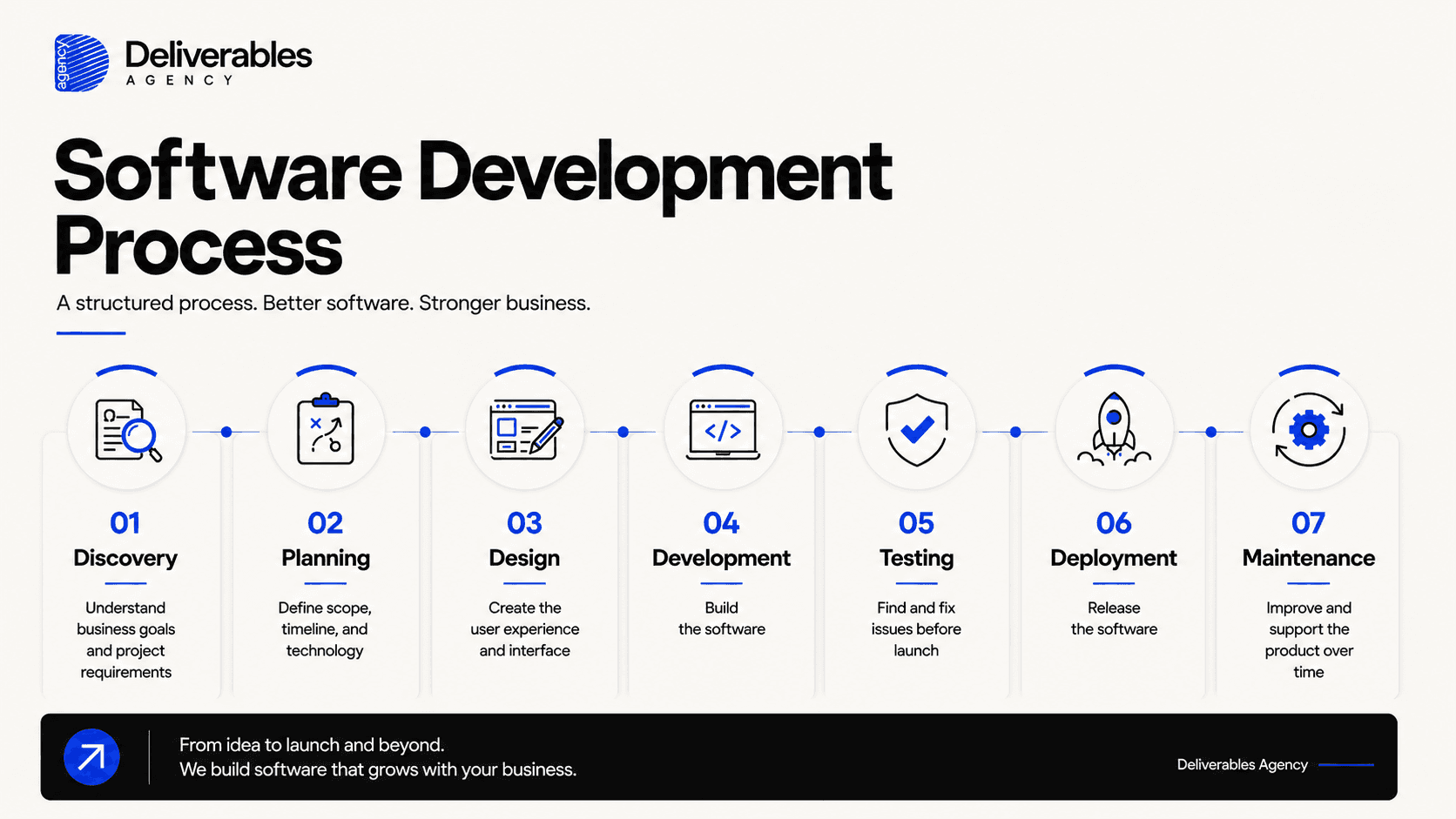
Stage | Purpose |
Discovery | Understand business goals and project requirements |
Planning | Define scope, timeline, and technology |
Design | Create the user experience and interface |
Development | Build the software |
Testing | Find and fix issues before launch |
Deployment | Release the software |
Maintenance | Improve and support the product over time |
Businesses investing in software development in Dubai increasingly prefer structured Agile workflows because they provide regular progress updates, faster feedback, and greater flexibility when requirements change during development.
Why Following the Right Software Development Process Matters
Many businesses focus only on the final product.
Experienced development teams focus on the process instead.
A structured process helps you:
Launch faster with fewer delays.
Keep the project within budget.
Reduce expensive changes later.
Improve software quality.
Protect user data.
Build software that can grow with your business.
For example, imagine a retail company in Dubai wants to launch an inventory management platform.
If development starts without understanding warehouse operations, reporting needs, and user roles, the software may require major changes after launch. Those changes could cost far more than addressing them during the planning stage.
This is why every experienced Software Development Company in Dubai invests significant time in planning before development begins.
Step 1: Discovery and Requirement Gathering
Every successful software product starts with one question:
What problem are we solving?
The discovery phase is where your development partner learns about your business before making any technical decisions.
This stage creates the foundation for the entire project.
Instead of discussing programming languages or frameworks, the focus stays on your business objectives.
During discovery, the team works with stakeholders to understand:
Business goals
Current challenges
Target users
Required features
Existing systems
Budget expectations
Timeline
Long term growth plans
The outcome is a clear roadmap that everyone agrees on before development begins.
Without this stage, projects often suffer from changing requirements, unclear expectations, and budget increases.
Questions a Good Software Development Company Will Ask
A reliable Software Development Company in Dubai will spend time asking questions before offering technical solutions.
Some of the most common questions include:
What business problem should this software solve?
Who will use the system?
What processes should become faster or easier?
Are there existing tools that need integration?
What are your security requirements?
Which platforms should the software support?
What does success look like after launch?
These discussions help avoid assumptions that can later become expensive mistakes.
Defining the Minimum Viable Product (MVP)
One of the biggest reasons software projects exceed their budget is trying to build everything at once.
A better approach is to identify the Minimum Viable Product, often called the MVP.
An MVP includes only the features required to solve the main business problem.
For example, if you're building a logistics platform, the first version may include:
Driver management
Shipment tracking
Delivery status
Customer notifications
Features like AI route optimization, analytics dashboards, and predictive reporting can be added later.
Launching with an MVP allows businesses to:
Reach the market faster.
Collect user feedback.
Reduce initial investment.
Improve future development decisions.
Many successful software products started with a simple MVP before expanding into larger platforms.
Deliverables from the Discovery Phase
By the end of discovery, you should have a clear understanding of your project.
A professional Software Development Service in Dubai will usually provide:
Business requirement document
Feature list
User journey overview
Technical recommendations
Development roadmap
Estimated timeline
Budget estimate
Risk assessment
These documents become the blueprint for every stage that follows.
Skipping discovery may seem like a way to save time, but it often results in higher costs and longer development cycles.
Step 2: Planning and Technology Selection
Once the discovery phase is complete, the next step is creating a detailed project plan.
This stage answers one important question:
How will the software be built?
Every decision made here affects the project's timeline, cost, performance, and future scalability.
An experienced Software Development Company in Dubai doesn't choose technologies based on trends. It chooses tools that match your business goals, expected users, security requirements, and future growth.
For example, a startup launching an MVP needs a different architecture than an enterprise building software for thousands of daily users.
What Happens During the Planning Phase?
The development team creates a roadmap for the entire project before coding begins.
This usually includes:
Project scope confirmation
Feature prioritization
Technology stack selection
Database planning
Software architecture
API planning
Third party integrations
Development milestones
Timeline estimation
Team allocation
At the end of this stage, everyone knows what will be built, how it will be built, and when each milestone should be completed.
Choosing the Right Technology Stack
The technology stack is the foundation of your software.
It includes everything needed to build and run your application.
This often includes:
Component | Examples |
Frontend | React, Angular, Vue |
Backend | Node.js, .NET, Laravel, Python |
Mobile | Flutter, React Native, Swift, Kotlin |
Database | PostgreSQL, MySQL, MongoDB |
Cloud | AWS, Microsoft Azure, Google Cloud |
APIs | Payment, Maps, CRM, ERP, Email |
The right stack depends on your project.
For example:
A SaaS platform needs scalability.
A banking application needs security.
A logistics platform needs real time tracking.
An AI application requires powerful data processing.
This is why selecting technologies should never be based on popularity alone.
Defining the Software Architecture
Software architecture acts as the blueprint of your application.
It determines how different parts of the system communicate with each other.
Good architecture makes software:
Faster
Easier to maintain
More secure
Ready for future growth
Poor architecture often leads to slow performance, expensive upgrades, and frequent system failures.
Businesses investing in software development in Dubai should always ask how the application will scale as users and data increase over time.
Prioritizing Features
Not every feature needs to be built in the first release.
During planning, features are usually divided into three categories.
Must Have
These are essential features without which the software cannot function.
Examples:
User login
Dashboard
Core business workflow
Security
User roles
Should Have
These features improve the user experience but can wait if necessary.
Examples:
Reports
Notifications
Analytics
File uploads
Future Features
These are planned for future releases.
Examples:
AI recommendations
Automation
Predictive analytics
Advanced integrations
Prioritizing features helps businesses launch faster while keeping development costs under control.
Planning Third Party Integrations
Modern software rarely works alone.
Most businesses need their application to connect with other platforms.
Common integrations include:
Payment gateways
Accounting software
CRM systems
ERP platforms
Email services
SMS providers
WhatsApp Business
Google Maps
Microsoft 365
Slack
Planning these integrations early prevents delays during development.
Creating a Realistic Timeline
One common mistake businesses make is expecting every project to be completed within a few weeks.
In reality, the timeline depends on the project's complexity.
A professional Software Development Service in Dubai creates a timeline based on:
Number of features
Design requirements
Integrations
Team size
Testing effort
Client feedback cycles
A realistic schedule helps avoid rushed development and unnecessary compromises.
Here's a general estimate:
Project Type | Estimated Timeline |
MVP | 8 to 12 weeks |
Business Application | 3 to 5 months |
SaaS Platform | 4 to 7 months |
ERP System | 6 to 9 months |
Enterprise Software | 8 to 12 months |
These timelines vary depending on project scope and complexity.
Why Planning Saves Time and Money
Many businesses think planning delays the project.
The opposite is usually true.
When requirements are documented, technologies are selected carefully, and milestones are clearly defined, developers spend less time fixing mistakes later.
A strong planning phase helps:
Reduce change requests
Improve communication
Control the budget
Deliver software faster
Minimize project risks
This is one reason why successful software development processes in Dubai projects invest time in planning before writing production code.
Step 3: UI and UX Design
Once the project plan is approved, the next step is designing how the software will look and work.
This stage is about more than creating attractive screens. The goal is to make the software simple, fast, and easy to use.
A well-designed product reduces training time, improves productivity, and helps users complete tasks with fewer clicks.
Before developers start writing code, the design team creates a visual blueprint of the application.
What Happens During the Design Phase?
The design process usually moves through several stages.
Wireframes
Wireframes are simple layouts that show where buttons, menus, forms, and content will appear.
At this stage, the focus is on functionality rather than colors or branding.
Wireframes help everyone understand the user journey before investing time in detailed designs.
User Experience (UX)
UX design focuses on how users interact with the software.
The goal is to remove unnecessary steps and make every action feel natural.
Good UX answers questions like:
Can users complete tasks quickly?
Is navigation simple?
Are important actions easy to find?
Does every screen have a clear purpose?
For example, if employees need five clicks to approve a request that could be completed in two, productivity suffers over time.
User Interface (UI)
Once the user journey is finalized, designers create the visual interface.
This includes:
Colors
Typography
Icons
Buttons
Forms
Dashboards
Charts
Responsive layouts
The interface should reflect your brand while remaining clean and easy to understand.
Businesses investing in software development in Dubai often expect software that looks modern on desktops, tablets, and mobile devices. Responsive design ensures a consistent experience across all screen sizes.
Interactive Prototypes
Before development begins, designers build clickable prototypes.
These prototypes allow stakeholders to experience the software before it is developed.
Instead of reviewing static images, you can navigate between screens and test user flows.
This helps identify usability issues early, when changes are faster and less expensive.
Why Design Approval Matters
One common reason projects face delays is changing layouts after development has already started.
Every design change during coding requires developers to rewrite parts of the application.
Approving designs first helps:
Reduce development time
Minimize change requests
Keep the project within budget
Improve communication between stakeholders and developers
An experienced Software Development Company in Dubai ensures every key screen is reviewed and approved before moving to development.
Design Best Practices
A professional Software Development Service in Dubai follows several design principles to improve usability.
These include:
Clear navigation
Consistent layouts
Fast loading interfaces
Mobile responsive design
Accessibility considerations
Simple forms
Easy to read typography
Logical user flows
Good design is not about adding more elements. It is about helping users achieve their goals with less effort.
Common Design Mistakes Businesses Should Avoid
Many software projects become difficult to use because of avoidable design mistakes.
Some of the most common include:
Adding too many features to one screen
Prioritizing visual effects over usability
Ignoring mobile users
Using inconsistent navigation
Collecting unnecessary information in forms
Skipping user feedback before development
Fixing these problems after launch usually costs far more than addressing them during the design phase.
Why Great Design Leads to Better Software
Software is successful when people enjoy using it.
Even the most powerful application can fail if users struggle to navigate it.
Investing time in UI and UX design helps businesses:
Improve employee productivity
Increase customer satisfaction
Reduce support requests
Improve user adoption
Lower long-term development costs
For this reason, design is one of the most valuable stages in the software development process. It transforms business requirements into a product that users can understand and confidently use.
Step 4: Software Development
Once the design is approved, the development phase begins.
This is where developers turn wireframes and prototypes into fully functional software.
Many businesses think this stage is only about writing code. In reality, development is a structured process where frontend developers, backend developers, database engineers, and QA specialists work together to build a stable and scalable application.
A professional Software Development Company in Dubai follows an organized workflow instead of building everything at once. This reduces risks and makes it easier to track progress throughout the project.
Frontend Development
Frontend development focuses on everything users see and interact with.
This includes:
Dashboards
Forms
Navigation menus
Reports
Charts
Buttons
User profiles
The goal is to create an interface that is fast, responsive, and easy to use across desktops, tablets, and mobile devices.
Every screen is developed based on the approved UI designs, ensuring the final product matches the original vision.
Backend Development
While the frontend handles user interactions, the backend manages everything happening behind the scenes.
Backend development is responsible for:
Business logic
User authentication
Database operations
Security
Notifications
API communication
File management
For example, when a customer places an order, the backend processes the request, stores the information, updates inventory, and sends confirmation emails automatically.
Without a strong backend, even the best-looking software cannot perform reliably.
Database Development
Every business application stores data.
The database is designed to organize and protect that information.
Depending on the project, the database may store:
Customer records
Employee information
Orders
Payments
Reports
Inventory
Documents
A well-designed database improves speed, reduces errors, and supports future growth without affecting performance.
API and Third Party Integrations
Modern software rarely works in isolation.
Most businesses require integrations with existing systems.
Common integrations include:
Payment gateways
ERP platforms
CRM systems
Accounting software
Google Maps
WhatsApp Business
Email services
SMS gateways
Microsoft 365
Cloud storage platforms
Planning and implementing these integrations correctly allows different systems to exchange data automatically, reducing manual work.
Agile Development Approach
Most software development in Dubai projects follow Agile development instead of waiting months for a single final release.
The project is divided into smaller development cycles called sprints.
Each sprint delivers a working part of the software that can be reviewed by stakeholders.
This approach allows businesses to:
Track progress regularly
Request improvements early
Identify issues sooner
Reduce project risks
Adapt to changing business needs
Instead of waiting until the end, you can see your software evolve throughout development.
Communication Throughout Development
Successful projects rely on consistent communication.
A reliable Software Development Service in Dubai keeps clients informed through regular updates.
This often includes:
Sprint reviews
Progress reports
Demo sessions
Feature walkthroughs
Task tracking
Timeline updates
Regular communication ensures everyone stays aligned and prevents misunderstandings later in the project.
Security During Development
Security should never be treated as an afterthought.
It must be built into the software from the beginning.
During development, teams implement measures such as:
Secure authentication
Role based access control
Data encryption
Input validation
Secure API communication
Audit logs
Backup strategies
Building security into the development process helps protect sensitive business and customer data after launch.
Common Challenges During Development
Even well-planned projects can face challenges.
Some of the most common include:
Changing project requirements
Unexpected integration issues
Delayed client feedback
Scope expansion
Performance optimization
Legacy system compatibility
An experienced Software Development Company in Dubai manages these challenges through proper planning, transparent communication, and structured change management instead of allowing them to disrupt the entire project.
Why the Development Phase Determines Long Term Success
The quality of development directly affects how your software performs after launch.
Well-written code is easier to maintain, simpler to scale, and less expensive to improve in the future.
Rushed development often results in:
Frequent bugs
Slow performance
Security vulnerabilities
Higher maintenance costs
Difficult future upgrades
Investing in experienced developers and following a structured software development process in Dubai helps businesses build software that remains reliable as they grow.
Step 5: Testing and Quality Assurance
Writing the code is only part of the project.
Before the software reaches users, every feature must be tested to ensure it works as expected. Even a small bug can affect user experience, slow business operations, or expose security risks.
This is why testing is one of the most important stages in the software development process.
A professional Software Development Company in Dubai doesn't wait until the end to check for issues. Testing is performed throughout development so problems are identified and resolved early.
What Happens During Quality Assurance?
Quality Assurance, often called QA, verifies that the software meets the agreed requirements before launch.
The testing team checks whether every feature works correctly under different conditions.
This includes:
User registration and login
Forms and data validation
Dashboards
Reports
Notifications
Payment processing
Third party integrations
User permissions
Navigation
Performance
The goal is to ensure the software behaves consistently for every user.
Types of Software Testing
Different tests focus on different parts of the application.
Functional Testing
Functional testing verifies that every feature performs exactly as intended.
For example:
Can users log in successfully?
Does the search function return the correct results?
Are reports generated correctly?
Do notifications reach the right users?
Every business workflow is tested before deployment.
Performance Testing
Performance testing measures how the software behaves under different levels of traffic.
The testing team checks:
Page loading speed
Response time
System stability
Database performance
High user traffic handling
This helps ensure the application remains responsive even as the number of users grows.
Security Testing
Protecting business and customer data is a priority.
Security testing helps identify vulnerabilities before attackers can exploit them.
Common security checks include:
Authentication
Authorization
Data encryption
API security
Session management
Input validation
Businesses investing in software development in Dubai should always ensure security testing is part of the development process, especially for industries handling sensitive customer information.
Compatibility Testing
Users access software from different devices and browsers.
Compatibility testing confirms the application works consistently across:
Desktop computers
Mobile phones
Tablets
Chrome
Safari
Edge
Firefox
This improves accessibility and provides a consistent experience for all users.
User Acceptance Testing (UAT)
Before launch, the software is shared with the client for final review.
This stage allows stakeholders to test real business scenarios and confirm that the application meets their expectations.
During User Acceptance Testing, businesses typically verify:
Business workflows
Reports
User permissions
Navigation
Overall usability
Feedback collected during this stage is incorporated before the software goes live.
Bug Fixing and Final Improvements
Testing is not only about finding problems. It is about improving the overall quality of the product.
Each reported issue is reviewed, fixed, and tested again to ensure it has been resolved without affecting other parts of the application.
This process continues until the software is stable and ready for production.
Why Quality Assurance Saves Time and Money
Some businesses view testing as an additional expense.
In reality, fixing problems before launch is significantly more cost effective than resolving them after customers begin using the software.
A strong QA process helps businesses:
Reduce unexpected downtime
Improve software reliability
Protect sensitive business data
Increase customer satisfaction
Lower long term maintenance costs
Skipping this stage often leads to expensive fixes, negative user feedback, and avoidable business disruptions.
For this reason, every reliable Software Development Service includes dedicated testing before deployment rather than treating it as an optional step.
Step 6: Deployment and Launch
After testing is complete, the software is ready to go live.
Deployment is the process of moving the application from the development environment to a live production environment where employees or customers can start using it.
A successful launch is more than publishing the software. Every component must be configured correctly to ensure the application performs reliably from day one.
An experienced Software Development Company in Dubai follows a structured deployment plan to minimize risks and avoid unnecessary downtime during launch.
What Happens During Deployment?
Before users access the software, the development team prepares the production environment.
This usually includes:
Setting up production servers
Configuring cloud infrastructure
Connecting the production database
Deploying the application
Configuring domain and SSL certificates
Setting up backups
Monitoring system performance
Performing final security checks
Each task is completed carefully to ensure the software is stable before launch.
Data Migration
If your business is replacing an existing system, historical data often needs to be transferred.
This may include:
Customer information
Employee records
Orders
Reports
Product data
Documents
The migration process is carefully planned to avoid data loss or duplication.
Once the migration is complete, the data is verified before users begin working with the new system.
User Training
Even the best software requires users to understand how it works.
Before launch, many businesses provide training sessions for employees and administrators.
Training may include:
User guides
Video tutorials
Live demonstrations
Admin documentation
Frequently asked questions
Proper training helps teams adopt the software faster and reduces support requests after launch.
Monitoring After Launch
Launching the software is not the end of the project.
The first few days are important because real users begin interacting with the application under real business conditions.
The development team closely monitors:
Server performance
Error logs
User activity
API performance
Database usage
Application speed
Any unexpected issues are identified and resolved quickly to maintain a smooth user experience.
Common Challenges During Deployment
Even well-tested software can face challenges during deployment.
Some common issues include:
Configuration errors
Server compatibility problems
Network issues
Third party integration failures
Data migration conflicts
Performance bottlenecks
A reliable Software Development Service in Dubai prepares rollback plans and backup strategies to reduce the impact of unexpected issues.
Launch Is Only the Beginning
Many businesses assume software development ends after deployment.
In reality, launch marks the beginning of the product's lifecycle.
As your business grows, your software will need:
New features
Performance improvements
Security updates
Third party integrations
User experience enhancements
Planning for continuous improvement ensures your software continues to support your business goals over time.
Step 7: Maintenance and Continuous Improvement
Software requires ongoing attention to remain secure, reliable, and compatible with changing business needs.
As operating systems, browsers, security standards, and customer expectations evolve, regular updates become essential.
This is why maintenance is the final and ongoing stage of the software development process in Dubai.
What Does Software Maintenance Include?
Maintenance covers much more than fixing bugs.
It helps your software remain stable, secure, and relevant.
Typical maintenance activities include:
Bug fixes
Security patches
Performance optimization
Database maintenance
Server monitoring
Feature enhancements
API updates
Cloud infrastructure management
Regular maintenance helps prevent small issues from becoming major business problems.
Why Maintenance Matters
Ignoring maintenance often leads to:
Slow performance
Security vulnerabilities
Compatibility issues
Higher operating costs
Poor user experience
Businesses that invest in continuous improvements usually experience fewer disruptions and longer software life cycles.
How Often Should Software Be Updated?
There is no fixed schedule.
The frequency depends on your application, industry, and business requirements.
However, most businesses review their software regularly to:
Improve performance
Add requested features
Address security updates
Support new business processes
Stay compatible with modern technologies
Working with a trusted Software Development Company in Dubai ensures these updates are planned without disrupting day to day operations.
Why Long-Term Partnership Matters
Building software is a long-term investment.
Choosing a development partner that provides ongoing support means your application can evolve as your business grows.
Instead of rebuilding the software every few years, regular improvements help extend its lifespan and maximize your return on investment.
Whether you are expanding into new markets, adding AI capabilities, or integrating additional business systems, continuous maintenance keeps your software ready for future opportunities.
Common Mistakes Businesses Make During the Software Development Process
Even with the right idea and budget, software projects can still fail if important decisions are overlooked early.
Most of these mistakes are preventable. Understanding them before starting your project can save time, reduce costs, and improve the final outcome.
1. Starting Without Clear Requirements
Many businesses begin development with only a rough idea of what they want.
As the project progresses, new features and changing requirements continue to appear. This often leads to missed deadlines, higher development costs, and unnecessary revisions.
Before starting any software development in Dubai, define your business goals, target users, essential features, and expected outcomes.
2. Choosing a Development Partner Based Only on Price
The lowest quote is not always the best investment.
Some companies reduce costs by assigning inexperienced developers, skipping testing, or limiting post-launch support.
Instead of comparing prices alone, evaluate:
Technical expertise
Industry experience
Previous projects
Communication process
Support after launch
A reliable Software Development Company in Dubai focuses on delivering long-term business value rather than simply offering the cheapest proposal.
3. Ignoring Scalability
Your software should support your business not only today but also in the future.
Many applications work well during the first few months but struggle as users, transactions, and data increase.
Planning for scalability from the beginning helps avoid expensive system upgrades later.
4. Adding Too Many Features in the First Version
Trying to build every possible feature before launch often delays the project.
A better approach is to launch with the core functionality first and improve the product based on user feedback.
This strategy reduces development time, lowers initial investment, and allows businesses to respond faster to market needs.
5. Underestimating Testing
Testing should never be treated as the final checkbox before launch.
Even a small issue can affect user trust, business operations, or security.
Comprehensive testing throughout the software development process helps identify problems early, when they are easier and less expensive to fix.
6. Forgetting About Maintenance
Software requires continuous updates after launch.
Security improvements, browser updates, operating system changes, and new business requirements all require ongoing maintenance.
Planning for long-term support helps keep your software secure, stable, and relevant.
How to Choose the Right Software Development Company in Dubai
The success of your project depends as much on the development partner as the technology itself.
A reliable company should understand your business objectives before recommending technical solutions.
When comparing providers, consider these factors:
What to Evaluate | Why It Matters |
Industry Experience | Better understanding of your business challenges |
Technical Expertise | Ability to build scalable and secure software |
Development Process | Structured planning reduces project risks |
Communication | Regular updates improve collaboration |
Quality Assurance | Thorough testing improves software reliability |
Post Launch Support | Ensures long-term software performance |
Portfolio | Demonstrates real project experience |
The best Software Development Service in Dubai acts as a technology partner rather than just a development vendor. They help you make informed decisions throughout the project instead of simply building what is requested.
Final Thoughts
A successful software product is built on a well-defined process, not just strong development skills.
From discovery and planning to deployment and ongoing maintenance, every stage plays an important role in delivering software that supports your business goals. Skipping steps may seem like a way to save time, but it often results in higher costs, delayed launches, and avoidable technical challenges.
Whether you're building an internal business platform, a customer portal, a SaaS product, or an enterprise application, following a structured software development process in Dubai gives your project a stronger foundation for long-term success.
If you're looking for a Software Development Company in Dubai that combines strategic planning, modern technologies, and transparent communication, Deliverables Agency can help. Our team works closely with businesses to design, build, and support custom software that solves real operational challenges and scales with future growth.
Ready to turn your idea into a reliable software product? Talk to the Deliverables Agency Team and let's plan your project from concept to launch.
Build Custom Software for Your Business in Dubai
Whether you're launching a startup, automating operations, or replacing legacy systems, Deliverables Agency helps businesses across Dubai turn ideas into secure, scalable software.
Some Topic Insights:
How long does the software development process take in Dubai?
The timeline depends on the project's complexity, number of features, integrations, and approval cycles. A basic MVP may take two to three months, while enterprise software can require eight months or more. During the discovery phase, a professional Software Development Company in Dubai should provide a realistic project schedule based on your requirements.