


Time to read :
1 min read
Inaccurate freight management costs businesses billions every year. Many companies overpay carriers, miss billing errors, and use slow, outdated data to plan suboptimal routes.
A structured transportation management system (TMS) solves these issues. Experts estimate that a TMS can cut freight costs by 40% to 60%. Since freight often makes up more than half of all supply chain expenses, these savings are significant.
Many logistics teams still struggle with inefficient manual processes, such as:
Managing multiple carrier websites in separate browser tabs.
Using unreliable spreadsheets to track shipment data.
Missing billing errors that a system could catch automatically.
This guide explains what a TMS is and how it can help your business. We cover the different types available, their costs, and when you should buy software versus building your own.
What is a Transportation Management System?
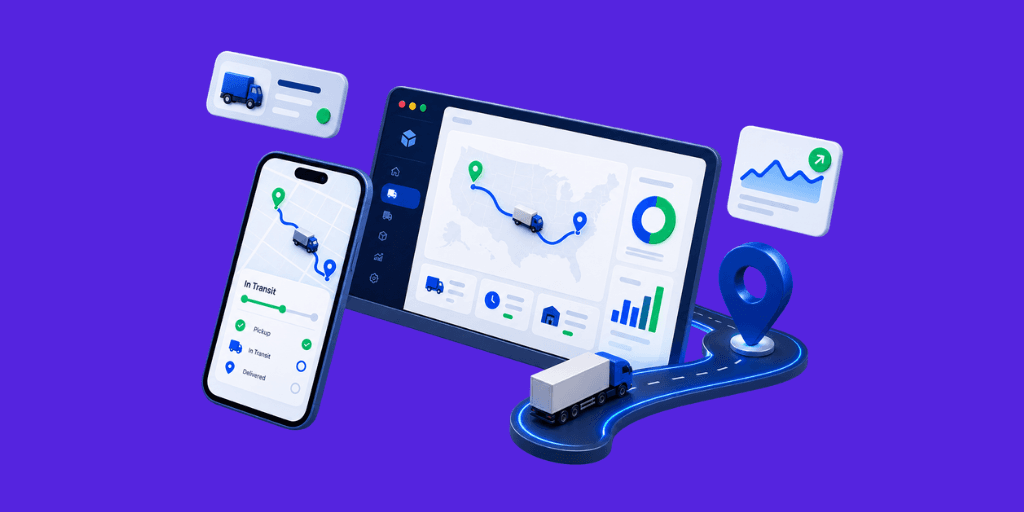
A transportation management system (TMS) is a software platform for planning, executing, and monitoring how you move goods. It replaces manual tools with one central system. This platform connects shippers and carriers to handle everything from route planning to freight auditing.
Manufacturers, retailers, and logistics providers use a TMS to manage shipments across road, rail, air, and ocean freight.
In short, it is the single system that runs your entire logistics operation.
How Does a Transport Management System Work?
A TMS integrates into your workflow through six stages:
Order Entry
Orders flow into the TMS automatically from your warehouse or order systems.
Planning and Optimization
The system selects the best routes and carriers based on cost, speed, and service.
Carrier Selection and Tendering
The platform compares rates in real time and automatically sends shipment requests to carriers.
Execution and Documentation
The TMS creates shipping labels and customs forms, then schedules the pickup.
Shipment Tracking and Visibility
The system tracks shipments live. Alerts flag delays so your team can resolve issues quickly.
Freight Audit and Reporting
The platform matches invoices against quotes to catch errors. It also creates reports on carrier performance and costs.
Core Features of a Transportation Management Platform
A well-built transportation management platform covers these functional areas.
Feature | What it Does |
Route Optimization | Calculates the most cost- and time-efficient route for each shipment |
Carrier Management | Compares carriers by rate, performance, and service level |
Load Planning | Consolidates multiple orders into optimal loads to reduce empty space |
Real-Time Tracking | Provides live shipment visibility across all modes and carriers |
Freight Audit and Payment | Automates invoice matching and flags overcharges |
Analytics and Reporting | Tracks KPIs like cost per mile, on-time delivery, and carrier performance |
Document Management | Generates BOLs, customs forms, shipping labels, and packing slips |
ERP/WMS Integration | Connects to existing systems so data flows without manual re-entry |
The best TMS platforms also include rate shopping across multiple carriers simultaneously. This allows you to compare hundreds of options in seconds rather than hours.
Types of Transportation Management Systems
Not every TMS is structured the same way. The right type depends on your business size, complexity, and how much control you need over your system.
Cloud-Based TMS
This is the most popular option. A vendor hosts and maintains the software on remote servers. You access it through a web browser. It offers lower startup costs, fast setup, and automatic updates. This is ideal for businesses that want to start quickly without managing their own IT systems.
Typical Cost: $300-$1,500+ per month, scaling with usage and features
On-Premise TMS
You install this software on your own servers. While it requires high upfront costs for hardware and IT staff, it gives you full control over your data. This model is becoming less common as cloud technology improves.
Typical Cost: $50,000 - $250,000+ in initial licensing and setup
Integrated TMS (within ERP or WMS)
These modules are embedded directly into larger enterprise suites such as Oracle, SAP, or Microsoft Dynamics. This setup is highly effective for organizations already operating within these ecosystems, though these native modules may lack the deep specialization found in independent platforms.
Custom-Built TMS
This involves custom logistics software development, built from the ground up to support your unique logistics workflows, carrier networks, and specific data integration needs. It offers maximum flexibility to align with your exact compliance and operational requirements.
Key Benefits of Using a TMS for Logistics
The return on investment for a TMS for logistics is well-documented, with many companies seeing immediate cost reductions. However, the true value extends far beyond simple freight savings.
A centralized platform significantly boosts operational efficiency by digitizing repetitive manual tasks. It also provides financial protection by catching invoice discrepancies through automated auditing and drives revenue growth by improving on-time delivery rates. When these factors are combined, the impact on the bottom line adds up fast.
Key advantages of implementation include:
Cost Reduction: Rate shopping across multiple carriers on every shipment consistently surfaces cheaper options than manual comparison. Automated freight auditing catches overcharges that would otherwise go unnoticed.
Operational Efficiency: Tasks, like carrier selection, documentation, tracking updates, and invoice reconciliation, previously required hours of manual effort. With a TMS, they become automated steps that take seconds
Full Supply Chain Visibility: Real-time tracking across all shipments and carriers gives your team, and your customers, an accurate picture of where goods are and when they will arrive.
Regulatory Compliance: For businesses shipping internationally, a TMS automates customs documentation and keeps shipments compliant with trade regulations across multiple jurisdictions.
Scalability: As your shipment volume grows, a TMS handles the increase without a proportional increase in headcount. The system does more as you grow rather than requiring you to hire more people to keep up.
Who Uses a TMS?
Industries like:
Retailers and eCommerce Brands use TMS to manage the movement of goods from distribution centers to customers, optimize last-mile delivery, and maintain the real-time tracking visibility that customers expect.
Manufacturers rely on TMS to coordinate inbound raw materials from suppliers and outbound finished goods to distributors managing complex multi-leg shipments across multiple transport modes.
Third-party logistics providers (3PLs) use TMS to manage shipments for multiple clients simultaneously from a single platform, with separate visibility and reporting for each account.
Freight brokers use TMS to match shippers with carriers, compare rates, and manage the transaction and documentation process at scale.
Food and beverage companies depend on TMS with temperature-controlled transport management and tight delivery window enforcement where a delay is not just a cost issue but a product safety one.
Pharmaceutical and healthcare businesses require TMS with chain-of-custody documentation, compliance tracking, and specialized handling requirements built in.
Is a TMS Right for Your Business?
Not every business needs a TMS. Let us explain.
A TMS adds real value when several of the following are true for your business:
You are managing 50+ shipments per week and spending significant time on manual carrier comparison.
Your freight costs feel unpredictable and you lack visibility into why.
Carrier invoices regularly arrive with errors you only catch sporadically.
Customers are escalating delivery complaints that your team cannot resolve quickly because shipment status is unclear.
You are managing multiple transport modes, like road, air, and ocean, and they are tracked in different places.
Your logistics operation is growing faster than your team can scale manually.
If only one or two of these apply, a simpler solution, like better carrier integrations or a streamlined audit process, may deliver more value with less complexity. A TMS is the right investment when the volume and complexity of your transportation operation has outgrown manual management.
Custom TMS vs. Off-the-Shelf: Which One is Right for You?
When Off-the-Shelf Makes Sense:
Your workflows match industry standards and do not require significant customization
You need to be operational quickly, cloud TMS can deploy in weeks
Your tech stack supports the integrations the platform offers natively
Budget for upfront development is limited and ongoing SaaS fees are manageable.
Best fit: SMEs and mid-market businesses with standard freight operations across common carriers and modes.
When Custom-Build TMS Makes Sense
Your operation has specific workflows, compliance requirements, or carrier relationships that standard platforms cannot accommodate.
You need deep integration with proprietary internal systems, like legacy ERPs, custom WMS, or industry-specific software, that most platforms do not support natively.
You want to own the system, its data, logic, or roadmap completely without dependency on a vendor’s pricing or product decisions.
You operate in a specialized sector (pharmaceutical cold chain, hazmat, cross-border trade in specific markets) where generic platforms fall short.
Best fit: Businesses with complex, non-standard logistics operations, enterprises with heavy integration requirements, or companies scaling logistics as a core competitive function.
The Honest Middle Ground
Many businesses start with an off-the-shelf platform and discover its ceiling within 12–18 months. The cost of migrating to a custom solution after the fact is significantly higher than getting the right architecture in place from the start.
The decision is worth investing proper time in before committing.
What Does a TMS Cost in 2026?
Here is an honest breakdown of TMS costs:
Solution Type | Cost Range | What Affects It |
Cloud TMS (SaaS) | $300-$3,000+/month | Shipment volume, number of users, feature tier |
Enterprise cloud TMS | $5,000 - $20,000+/month | Multi-modal, global operations, enterprise integrations |
On-premise TMS | $50,000–$300,000+ upfront | Licensing, hardware, implementation services |
Custom-built TMS | $40,000–$200,000+ (build cost) | Complexity, integrations, team size, compliance requirements |
Custom TMS ongoing support | $2,000–$8,000/month | Maintenance, updates, feature development |
Hidden costs to account for in any TMS investment:
Integration work, like connecting your TMS to your ERP, WMS, or carrier APIs often requires additional development
Data migration, like moving historical shipment and carrier data from legacy systems
Training, like getting your logistics and operations team comfortable with the new system
Customization with SaaS platforms, because many “off-the-shelf” platforms charge significant fees for custom configuration
The businesses that get the most ROI from TMS investments are the ones that scope the total cost of ownership before making a decision.
TMS Implementation
The implementation phase is where most TMS projects either succeed or struggle, and almost no guide covers what actually happens.
Common implementation failure points:
Poor data readiness is the most frequent issue. A TMS is only as good as the data feeding it. Carrier data, historical shipment records, and rate structures that are incomplete or inconsistent produce inaccurate outputs from day one. Auditing and cleaning your data before implementation starts is not optional. It is the foundation.
Underestimating integration complexity is the second most common issue. Connecting a TMS to existing ERP and WMS systems sounds straightforward and rarely is. APIs may be incomplete, data formats may not match, and legacy systems may require custom middleware. Scope this carefully before signing any implementation contract.
User adoption is consistently undervalued. A system your logistics team does not trust or understand will be worked around, not used. Training, change management, and a phased go-live that lets teams build confidence incrementally are all worth the time.
Realistic timelines:
Cloud TMS with standard setup: 4–12 weeks
Cloud TMS with significant integration work: 3–6 months
Custom-built TMS: 4–9 months depending on complexity
Build the Right TMS for Your Operation
Transportation management at any meaningful scale requires more than spreadsheets and carrier websites. The right transportation management system cuts freight costs, gives your team real-time visibility, and scales with your business, without requiring proportional growth in headcount or manual effort.
At Deliverables Agency, we work with logistics and operations businesses to design and build custom logistics software development solutions, including TMS platforms, built around how their specific operation works. We integrate with your existing ERP, WMS, and carrier systems, design for the workflows your team actually uses, and stay involved post-launch as your needs evolve.
Whether you are evaluating off-the-shelf platforms or considering a custom build, the conversation starts with understanding your operation, not with a product pitch.
Build a Transportation Management System That Fits Your Operations
Your logistics workflows should not be limited by generic software. Build a TMS around your carrier network, shipment volume, integrations, and business requirements to improve control, visibility, and efficiency.
Some Topic Insights:
What problems does a transportation management system solve?
A transportation management system reduces manual shipment planning, high freight costs, poor shipment visibility, carrier management issues, and invoice errors. It brings transportation planning, execution, tracking, and reporting into one system.