
Time to read :
1 min read
Enterprise software is no longer a support function; it has become a core growth engine. Digital products, internal platforms, data systems, and automation tools now directly influence revenue, customer experience, operational efficiency, and competitive positioning. However, traditional software development models are increasingly unable to keep pace with rising enterprise expectations.
Developing AI-augmented software responds to this shift by integrating artificial intelligence throughout the software development lifecycle. Rather than relying on isolated automation or experimental tools, AI is applied deliberately to improve developer productivity, reduce delivery risk, and elevate software quality across large and complex systems. For enterprises, the objective is clear: accelerate development while preserving governance, security, and regulatory compliance.
This blog focuses on AI-augmented software development from an enterprise engineering perspective, explaining why organizations are adopting this model, which AI-driven capabilities enhance development efficiency and quality, how implementation is executed across the software lifecycle, the cost impact at scale, and how to select a development partner for long-term delivery success.
Why Enterprises Are Adopting AI-Augmented Software Development?
Enterprises are modernizing their software engineering practices as systems grow more complex and business dependency on digital platforms increases. AI-augmented software development is being adopted not as a toolset, but as a strategic upgrade to how enterprise software is built, scaled, and governed.
Software Is Now Core Business Infrastructure
Enterprise applications directly support revenue, operations, and customer experience
System reliability and performance impact business continuity
AI augmentation improves resilience and long-term maintainability of critical platforms
Pressure for Faster Delivery With Predictable Outcomes
Shorter release cycles are now a business requirement
Manual coordination and late-stage testing increase delivery risk
AI-driven analysis enables early issue detection and more predictable timelines
Growing Complexity of Enterprise-Scale Systems
Modern platforms rely on microservices, cloud infrastructure and API integration
Manual impact analysis slows innovation and increases failure risk
AI supports dependency mapping and safer system evolution at scale
Engineering Efficiency Is a Cost-Control Priority
Linear team scaling increases operational and maintenance costs
Repetitive engineering tasks reduce developer effectiveness
AI-powered automation improves productivity without expanding headcount
Security and Compliance Must Be Continuous
Enterprises operate under strict regulatory and security requirements
Post-development audits slow releases and increase exposure
AI-augmented development embeds security and compliance checks into the SDLC
Shift Toward Data-Driven Engineering Decisions
Experience-based decisions lack predictability at enterprise scale
AI provides insights into delivery risk, performance trends, and quality metrics
Enables better planning, prioritization, and alignment with business goals
Key Benefits of Building AI-Augmented Software for Enterprises
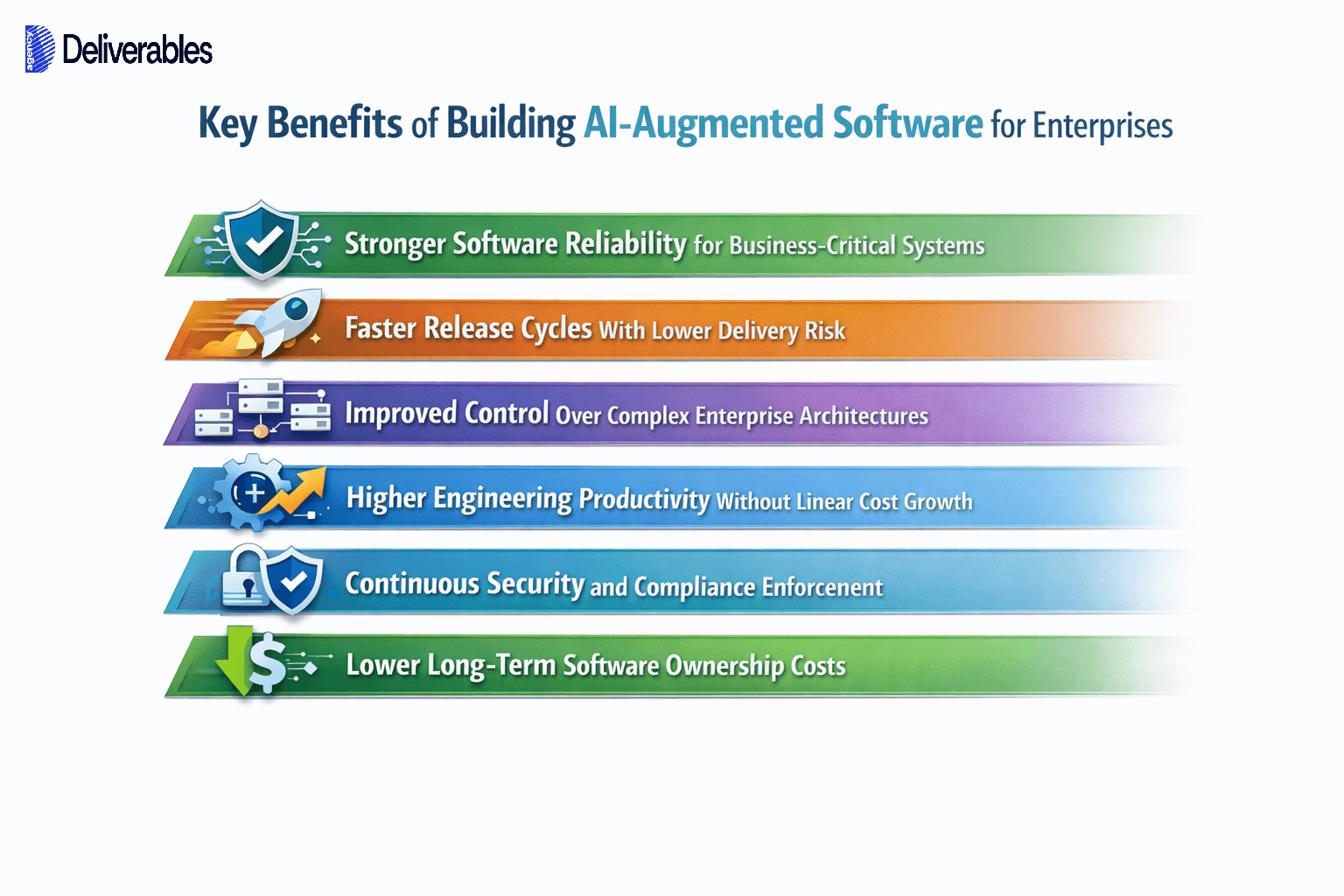
Enterprises are modernizing software engineering as digital platforms become core to operations and growth. AI-augmented software development delivers clear, business-aligned benefits by improving how software is built, scaled, and governed across the SDLC.
Stronger Software Reliability for Business-Critical Systems
Enterprise applications directly support revenue, operations, and customer experience. AI augmentation improves system stability and long-term maintainability, reducing the risk of downtime and performance degradation in critical platforms.
Faster Release Cycles With Lower Delivery Risk
Shorter release timelines are now a business requirement. AI-driven code analysis, testing, and monitoring identify issues earlier in the development lifecycle, enabling faster delivery without increasing production risk.
Improved Control Over Complex Enterprise Architectures
Modern systems rely on microservices, APIs, cloud infrastructure, and integrations. AI-augmented development improves visibility into dependencies and change impact, allowing safer system evolution at enterprise scale.
Higher Engineering Productivity Without Linear Cost Growth
Scaling development teams increases operational costs and coordination overhead. AI-powered automation reduces repetitive engineering work, enabling teams to deliver more without expanding headcount.
Continuous Security and Compliance Enforcement
Enterprise software must meet strict security and regulatory standards. AI-augmented development embeds automated security checks and compliance validation directly into the SDLC, reducing audit overhead and minimizing exposure.
Lower Long-Term Software Ownership Costs
By reducing defects, rework, and technical debt, creating an AI-augmented software lowers maintenance effort and lifecycle costs. Enterprises benefit from improved ROI across long-lived custom software platforms.
Technical Foundations of AI-Augmented Enterprise Software Delivery
Enterprise AI-augmented software development is defined by technical capabilities that extend traditional engineering with intelligence and automation across the software development lifecycle.
SDLC Intelligence and Workflow Optimization
AI enhances end-to-end SDLC execution by identifying inefficiencies, predicting bottlenecks, and improving coordination across large engineering programs.
Technical scope:
Analysis of delivery metrics and workflow patterns
Optimization of planning, development, testing, and deployment pipelines
Reduced coordination overhead across distributed engineering teams
AI-Driven Code Quality and Optimization
AI assists developers by continuously evaluating code quality, architectural alignment, and performance characteristics during development.
Technical scope:
Real-time code quality analysis and architectural consistency checks
Detection of performance bottlenecks and maintainability risks
Support for continuous code improvement during development
Automated Testing and Continuous Quality Validation
AI shifts quality assurance earlier in the SDLC by automating testing and enforcing quality standards throughout development.
Technical scope:
Intelligent test case generation and regression detection
Early-stage validation integrated into the SDLC
Consistent quality enforcement across releases
Dependency Analysis and Change Impact Prediction
AI improves visibility into complex system dependencies, reducing uncertainty during code changes and system upgrades.
Technical scope:
Mapping of microservices, APIs, and system dependencies
Prediction of downstream impact from code and configuration changes
Reduced deployment and integration risk
Security and Compliance Automation
AI embeds security and compliance controls directly into development workflows to ensure continuous enforcement.
Technical scope:
Continuous vulnerability scanning and policy enforcement
Embedded compliance checks within development workflows
Reduced reliance on post-release audits
Performance Monitoring and Reliability Intelligence
AI continuously monitors system behavior to identify performance degradation and reliability risks before they impact users.
Technical scope:
Runtime performance monitoring and anomaly detection
Early identification of stability and scalability issues
Support for proactive system optimization
Engineering Process Optimization at Scale
AI provides visibility into engineering execution, enabling continuous improvement across large-scale software delivery programs.
Technical scope:
Analysis of defect trends, delivery velocity, and system health
Continuous optimization of engineering workflows
Data-backed improvements to enterprise software delivery
Enterprise Use Cases for AI-Augmented Software Development
Developing AI-augmented software is implemented across enterprise environments where system complexity, delivery scale, and governance requirements exceed the limits of traditional engineering models. The following use cases represent common enterprise adoption scenarios.
Legacy Application Modernization
Enterprises apply AI to analyze large, legacy codebases, identify dependencies, and assess change impact during modernization initiatives. This supports safer refactoring, cloud migration, and architectural restructuring without disrupting business-critical systems.
Large-Scale Custom Software Development
AI is used to support development of complex, multi-module enterprise platforms by enforcing architectural consistency, automating quality checks, and coordinating work across distributed engineering teams.
High-Frequency Release and Continuous Delivery Environments
Enterprises with rapid release cycles use AI to automate testing, validate changes, and detect risks earlier in the SDLC, enabling stable and repeatable deployments at scale.
Enterprise Integration and API-Driven Architectures
AI supports development across integration-heavy environments by mapping service dependencies and predicting downstream impact of changes across internal systems, partner platforms, and third-party APIs.
Security-Sensitive and Regulated Software Systems
Enterprises operating under regulatory and security constraints use AI-augmented development to embed continuous security checks, policy enforcement, and compliance validation into engineering workflows.
Performance-Critical Enterprise Applications
AI is applied to monitor runtime behavior and performance trends, helping engineering teams detect bottlenecks and degradation risks before they affect business operations.
Long-Term Maintenance of Enterprise Software Platforms
For long-lived enterprise applications, AI assists with identifying technical debt, prioritizing refactoring, and maintaining software quality over extended product lifecycles.
Technologies We Leverage for AI-Augmented Software Development
AI-augmented software development depends on a carefully structured technology stack that supports modern engineering at scale. Choosing the right tools enables organizations to develop an AI-augmented software solution where intelligent capabilities are built directly into everyday development, release, and governance workflows—not treated as standalone initiatives. Below is a breakdown of the technologies that enable reliable, scalable, and enterprise-grade software delivery.
Technology Layer | Tools & Technologies | Purpose & Business Value |
AI & Machine Learning | TensorFlow, PyTorch, Hugging Face Transformers, Scikit-Learn | Enables intelligent code assistance, predictive analytics, NLP-driven workflows, automated testing, and continuous learning across development processes |
Data Processing & Analytics | Apache Kafka, Apache Spark, dbt | Supports real-time data ingestion, large-scale data processing, and reliable data pipelines required for AI-driven insights |
Databases & Storage | PostgreSQL, MySQL, MongoDB, Cassandra, Elasticsearch | Manages structured, unstructured, and analytical data to ensure AI models and applications operate on consistent, high-quality datasets |
Cloud Infrastructure | AWS, Microsoft Azure, Google Cloud Platform | Provides scalable, secure, and high-availability infrastructure for AI workloads and enterprise applications |
Containerization & Orchestration | Docker, Kubernetes | Enables efficient deployment, scaling, and management of AI services and microservices architectures |
DevOps & CI/CD | GitHub Actions, GitLab CI/CD, Jenkins | Automates build, test, and deployment pipelines to accelerate delivery while maintaining engineering consistency |
MLOps | MLflow, Kubeflow, Seldon Core | Manages AI model training, versioning, deployment, and monitoring to ensure stable and governed AI operations |
Backend Development | Python (FastAPI, Flask, Django), Node.js, Java (Spring Boot) | Builds scalable backend systems and exposes AI capabilities through secure, high-performance services |
API & Integration Layer | REST, GraphQL, gRPC | Enables seamless integration of AI services with existing enterprise platforms and third-party systems |
Frontend & UX | React, Angular, Vue.js, React Native, Flutter | Delivers intuitive interfaces where AI integration and automation are embedded into user and developer workflows |
Security & Governance | OAuth 2.0, OpenID Connect, JWT, IAM, SIEM tools | Ensures data protection, access control, auditability, and regulatory compliance across AI-augmented systems |
Monitoring & Observability | Prometheus, Grafana, Datadog, Sentry | Provides real-time visibility into application performance, AI behavior, and system reliability |
Step-by-Step Enterprise AI-Augmented Software Development Process
AI-augmented software development integrates machine-learning–driven intelligence across the software development lifecycle to improve engineering efficiency, delivery predictability, and system reliability at enterprise scale.
Step 1: System Analysis and Data Baseline Creation
The process begins with a comprehensive analysis of existing systems, codebases, infrastructure, and development workflows. AI models ingest source code repositories, architectural artifacts, logs, and historical issue data to establish baseline metrics for complexity, dependency density, defect patterns, and delivery performance. This baseline enables data-driven planning, early risk identification, and accurate estimation before implementation begins.
Step 2: Architecture Definition and AI Integration Planning
Enterprise architecture is designed or refined to support AI-assisted engineering workflows. Service boundaries, data flows, integration points, and governance controls are defined to ensure AI capabilities operate securely within the SDLC. AI integration is planned across development, testing, security, and monitoring pipelines to ensure consistent application across teams.
Step 3: AI-Assisted Code Development
During development, AI systems continuously analyze code changes to identify defects, performance issues, and architectural inconsistencies. Developers receive real-time feedback aligned with enterprise coding standards. This improves code quality while reducing manual review overhead across large, distributed codebases.
Step 4: Intelligent Test Generation and Continuous Validation
AI models generate test cases based on application logic, usage patterns, and historical defects. Functional, integration, and performance testing is executed continuously as code evolves. Quality validation shifts earlier in the lifecycle, reducing late-stage defect discovery and rework.
Step 5: Dependency Mapping and Change Impact Assessment
AI analyzes relationships between services, APIs, databases, and infrastructure components to predict the impact of code and configuration changes. Historical change data is used to assess regression risk. This enables safer updates across complex enterprise architectures.
Step 6: Embedded Security and Compliance Automation
Security and compliance controls are integrated directly into development workflows. AI continuously scans code, configurations, and dependencies for vulnerabilities, policy violations, and regulatory gaps. Compliance is enforced throughout the SDLC rather than after deployment.
Step 7: Deployment Readiness and Release Validation
Before deployment, AI evaluates release readiness by analyzing test coverage, dependency stability, configuration consistency, and historical deployment outcomes. Potential failure points are identified prior to production rollout. This supports predictable and repeatable enterprise deployments.
Step 8: Runtime Monitoring and Performance Optimization
After deployment, AI monitors system behavior, performance trends, and reliability metrics. Anomaly detection identifies degradation or stability risks early. Operational insights are fed back into development to optimize future releases.
Step 9: Continuous Learning and SDLC Optimization
AI systems learn from development and operational data to refine models and improve accuracy. Engineering workflows and quality thresholds are continuously optimized based on observed outcomes. This creates a closed-loop SDLC that scales with enterprise software growth.
AI-Augmented Software Development Cost for Enterprises
The cost of building AI-augmented software in enterprise environments is determined by how deeply artificial intelligence is embedded across the software development lifecycle. Unlike traditional development, costs are not limited to coding effort alone. They also include system analysis, MVP development for early validation, AI enablement, quality automation, security enforcement, and long-term operational optimization.
Enterprise programs are typically executed in structured phases, with investments distributed across assessment, MVP build and validation, full-scale implementation, deployment, and continuous improvement. The table below outlines a phase-wise cost breakdown commonly seen in enterprise AI-augmented software development initiatives.
Enterprise AI-Augmented Software Development Cost Breakdown
Development Phase | Technologies / Tools | Estimated Cost (USD) | Timeline | Description |
|---|---|---|---|---|
System Analysis & Engineering Assessment | Code analysis tools, architecture scanners, SDLC analytics platforms | $5,000 – $10,000+ | 2–4 weeks | Evaluating existing codebases, system complexity, dependencies, delivery risks, and readiness for AI-augmented workflows. |
Architecture Design & AI Enablement Planning | Cloud architecture tools, API frameworks, governance and access-control tooling | $8,000 – $18,000 | 1–2 months | Designing enterprise-grade architecture and defining where AI capabilities are integrated across development, testing, security, and monitoring. |
AI-Assisted Development Implementation | AI coding assistants, static analysis engines, automation frameworks | $10,000 – $15,000+ | 2–4 months | Implementing AI-augmented coding workflows to improve developer productivity, consistency, and code quality at scale. |
Automated Testing & Quality Engineering | AI-driven testing tools, CI/CD pipelines, test automation frameworks | $7,000 – $14,000 | 1–3 months | Integrating intelligent test generation, regression detection, and continuous quality validation into the SDLC. |
Dependency Mapping & Impact Analysis | Service dependency analyzers, API observability tools | $4,000 – $8,000 | 1–2 months | Mapping microservices and API dependencies to predict change impact and reduce regression risk in complex systems. |
Security & Compliance Automation | Vulnerability scanners, policy enforcement tools, compliance frameworks | $5,000 – $12,000 | 1–3 months | Embedding continuous security checks, compliance validation, and policy enforcement into development pipelines. |
Deployment & Release Automation | CI/CD tools, infrastructure automation, configuration management | $12,000 – $20,000 | 1–2 months | Automating deployment validation, environment checks, and stable enterprise-grade releases. |
Monitoring & Performance Optimization | Observability platforms, AI-based anomaly detection tools | $6,000 – $10,000 | Ongoing | Monitoring runtime performance, detecting anomalies, and optimizing reliability post-deployment. |
Why Choose Deliverables Agency for AI-Augmented Software Development Services
Deliverables Agency is a leading provider for enterprises adopting AI-augmented software development as a structured, scalable engineering model rather than an experimental capability. AI is embedded across the software development lifecycle to improve efficiency, quality, and delivery predictability while aligning with established enterprise engineering standards.
With strong expertise in custom software development, Deliverables Agency ensures that AI augmentation strengthens system architecture, long-term maintainability, and scalability across complex platforms. Security, compliance, and governance are integrated directly into development workflows, enabling continuous enforcement without slowing delivery.
The delivery model is designed for enterprise scale, supporting phased implementation, distributed teams, and long-term partnerships. This approach reduces delivery risk, improves execution transparency, and enables enterprises to evolve software platforms with confidence.
Conclusion
AI-augmented software development enables enterprises to manage growing system complexity, accelerate delivery, and maintain control over quality, security, and compliance. By embedding intelligence across the software development lifecycle, organizations move beyond manual, reactive processes toward a more predictable and scalable engineering model. Deliverables Agency helps enterprises adopt this approach through structured implementation, enterprise-grade technology stacks, and long-term delivery models that support scalable, production-ready software systems.
Partner with Us for AI-Augmented Development
Work with a delivery-focused partner that embeds AI into enterprise engineering workflows with governance, security, and scalability built in.
Some Topic Insights:
What is AI-augmented software development?
AI-augmented software development integrates intelligent analysis and automation into the SDLC to improve planning, coding, testing, security, and system monitoring in enterprise environments.