


Time to read :
1 min read
Artificial intelligence is no longer limited to automation or analytics, it is changing how people interact with digital products. One clear example of this shift is the growing interest in AI girlfriend apps, which are designed to offer consistent virtual companionship through intelligent, emotionally aware conversations.
Today, AI girlfriend app development goes far beyond simple chatbot functionality. These platforms combine conversational intelligence, personalization, and scalable backend systems to create experiences that feel continuous and responsive. Instead of one-off interactions, users engage with digital companions that remember context, adapt over time, and remain available whenever needed.
As demand grows, startups and product teams are increasingly exploring how to build AI girlfriend platforms as structured, long-term products. This evolution is driving a new category of applications focused on engagement, reliability, and responsible design rather than novelty alone.
AI Girlfriend App Overview for Businesses and Startups
An AI Girlfriend app is designed to offer virtual companionship through intelligent, human-like conversations.
These apps use artificial intelligence and natural language processing to move beyond basic chatbot responses. Instead of generic replies, users interact with a digital companion that adapts to their mood, remembers preferences, and maintains conversation continuity.
It’s not just casual chat—it’s about creating a sense of connection. For startups and product teams, this emotional engagement is the core focus when building an AI girlfriend app.
AI Girlfriend Apps vs. Traditional Dating Platforms
AI girlfriend apps and traditional dating platforms are built on fundamentally different interaction models. While dating apps rely on user participation and mutual engagement, AI girlfriend apps are designed around always-available, AI-driven companionship. Below highlights the most relevant differences from a product and scalability perspective.
Aspect | AI Girlfriend Apps | Traditional Dating Platforms |
Interaction Model | One-on-one interaction with an AI-powered virtual companion | User-to-user matching and messaging |
Personalization | AI adapts to user preferences and conversation style | Limited to profile data and manual interactions |
Emotional Continuity | Maintains conversation context and memory | Conversations often reset or stop abruptly |
User Experience | Private, judgment-free, and consistent | Competitive, profile-driven, and unpredictable |
Scalability | Easily scalable through AI and cloud infrastructure | Growth depends on active user participation |
Monetization Model | Subscriptions, premium features, add-ons | Ads, subscriptions, in-app purchases |
Why Companies Are Building AI Girlfriend and Virtual GF Apps
Companies are building AI girlfriend and virtual GF apps because these platforms are engineered around AI-driven interaction rather than user-to-user dependency. By leveraging structured MVP development, businesses can validate demand using controlled conversational flows powered by AI integration.
From a technical perspective, these applications use backend orchestration, context-aware language models, and modular API integration to deliver consistent engagement at scale. This architecture allows product teams to maintain predictable performance, personalization logic, and response quality without relying on network effects.
As a result, AI girlfriend app development supports faster scaling, stable infrastructure growth, and flexible monetization while maintaining full control over user experience and system behavior.
Must-Have Features of an AI Girlfriend Application
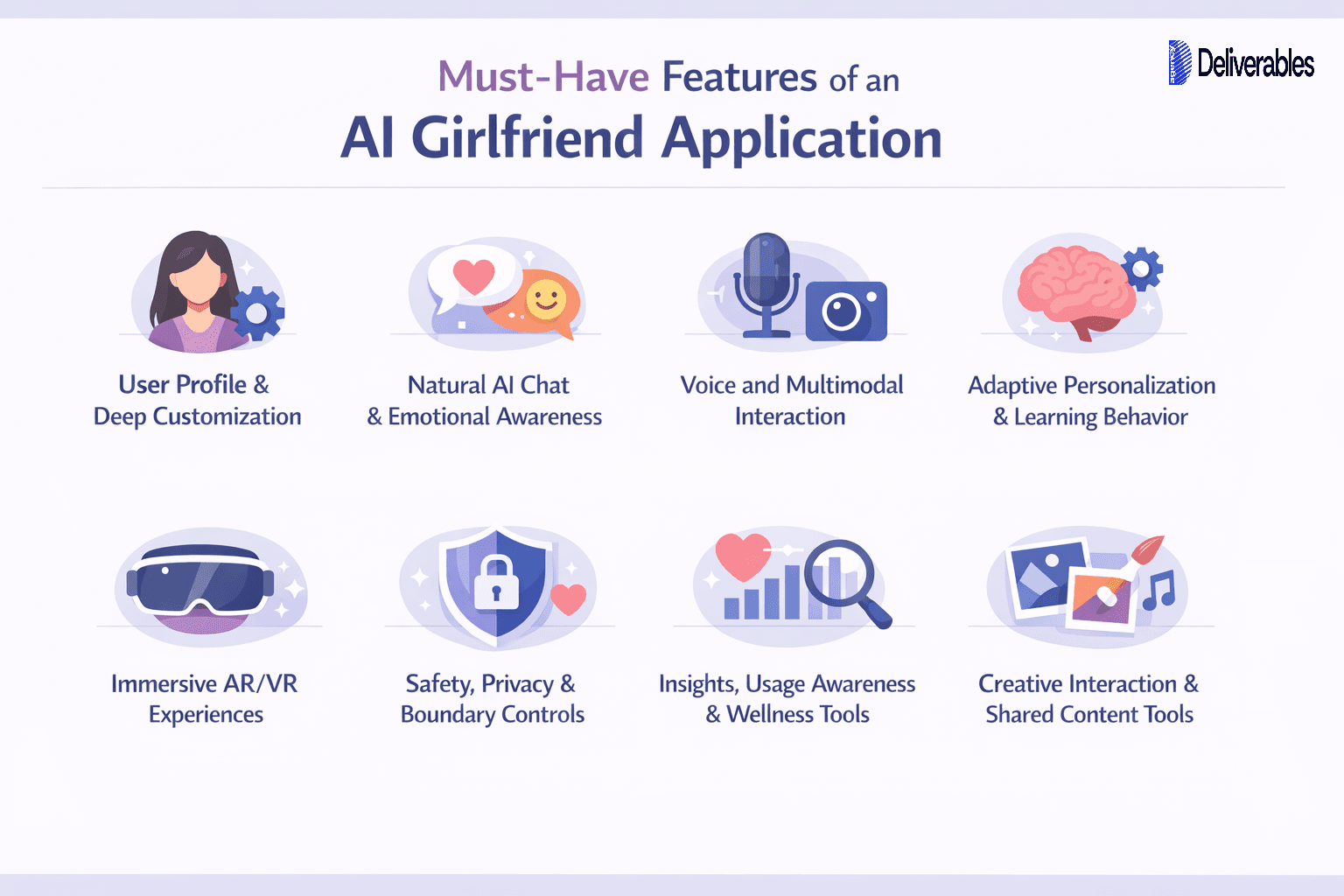
When users talk about what keeps them engaged in companion or dating-style applications, the answer almost always comes down to features. The experience lives or dies by how natural, personal, and comfortable the interaction feels.
Choosing the right feature set is critical when building an AI girlfriend app. Below are the must-have features that define a compelling, user-centric AI girlfriend experience.
User Profile & Deep Customization
An AI girlfriend app should allow users to shape how the virtual companion behaves and communicates. This includes defining personality traits, conversational tone, boundaries, and preferred interaction style.
Customization options may cover avatar appearance, themes, notification cadence, and interaction intensity. Quick onboarding quizzes and simple toggles help personalize the experience without overwhelming users, while keeping everything private and controlled.
Natural AI Chat & Emotional Awareness
Conversation quality is the heart of any AI girlfriend app. The system should respond based on user mood, intent, and pacing rather than producing static or repetitive replies.
By analyzing sentiment and conversational flow, the AI can mirror energy levels, slow down when empathy is needed, and recall shared moments. This creates exchanges that feel organic, emotionally responsive, and progressively meaningful.
Voice and Multimodal Interaction
Beyond text, voice interaction adds realism and immediacy. Low-latency voice conversations with interruption support allow for more natural dialogue.
Advanced implementations may include expressive text-to-speech, avatar lip-syncing, adjustable voice modes, and optional background environments. Accessibility features such as captions, noise suppression, and discreet listening modes enhance usability across different contexts.
Adaptive Personalization & Learning Behavior
True personalization goes beyond static settings. An AI girlfriend app should learn from user behavior, conversation frequency, preferred topics, interaction timing and adjust naturally over time.
Memory-based learning helps the system deliver timely callbacks, surprises, and relevant dialogue while avoiding repetitive or overly dependent behavior. This balance keeps the experience engaging without feeling intrusive.
Immersive AR/VR Experiences (Optional Expansion)
For advanced platforms, AR and VR features can create shared virtual moments. Users may explore environments together, engage in guided activities, or simply spend time in immersive digital spaces.
Spatial audio, environmental visuals, and light interaction feedback help deepen the sense of presence and make interactions feel more experiential rather than conversational only.
Safety, Privacy & Boundary Controls
Safety must be built into the experience from the start. Consent settings, interaction limits, and clear boundary controls protect users while maintaining comfort.
Automated moderation systems filter sensitive content, while privacy-focused data handling ensures user information remains secure. This is especially important for platforms supporting optional adult or NSFW interaction modes.
Insights, Usage Awareness & Wellness Tools
A responsible AI girlfriend app can provide users with visibility into their interaction habits. Features like session summaries, mood indicators, and gentle usage reminders promote healthier engagement.
Optional journaling, memory management, or cooldown modes allow users to maintain control over their experience without feeling monitored or restricted.
Creative Interaction & Shared Content Tools
Content co-creation adds depth to companionship. Users can build shared stories, roleplay scenarios, or save favorite interaction styles as quick actions.
This feature encourages playful exploration while maintaining clear rules and boundaries, helping users feel creatively involved rather than passively consuming conversations.
Popular AI Girlfriend Apps Gaining Attention in 2026
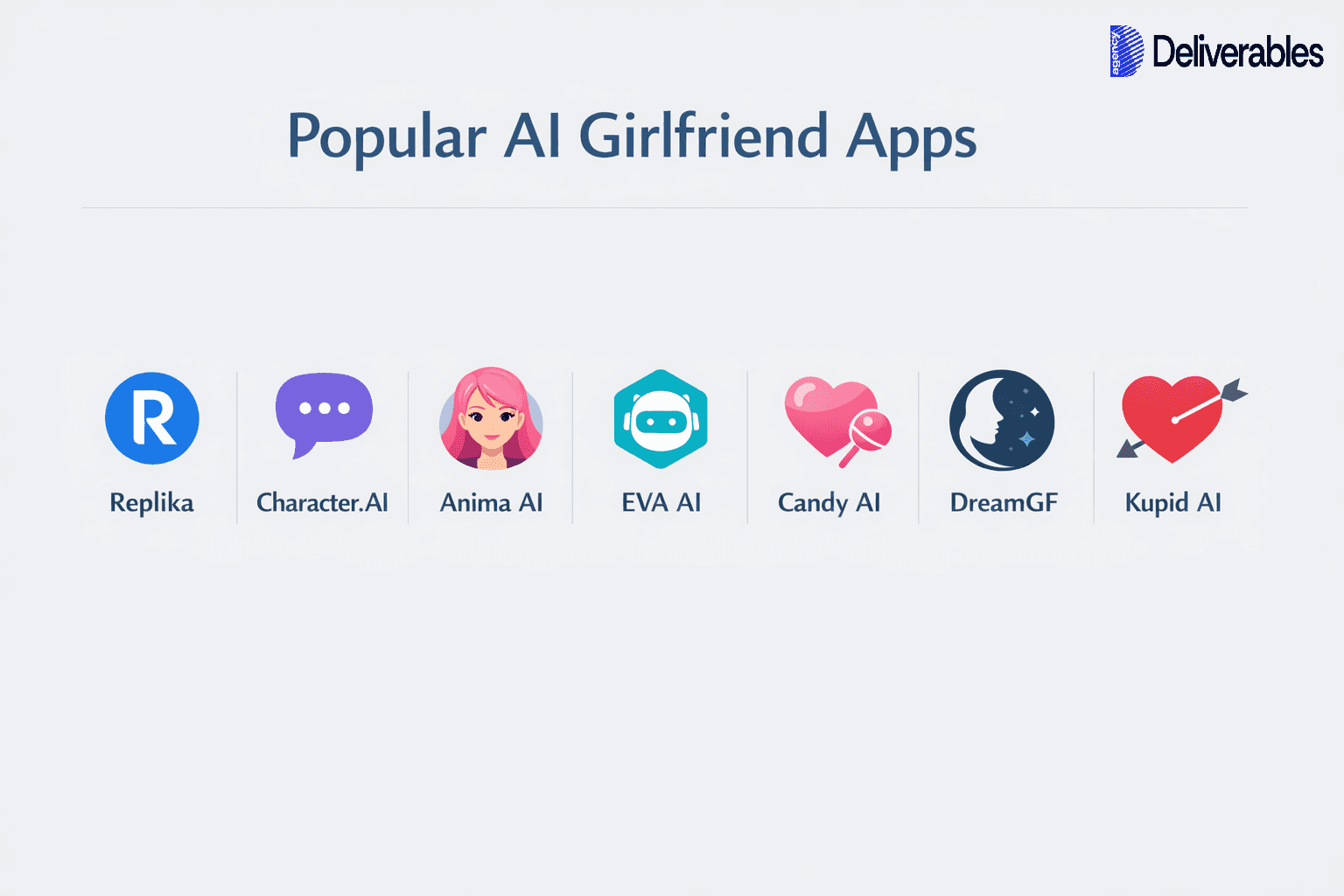
As virtual companion platforms continue to evolve, several applications have gained strong traction by focusing on conversation quality, personalization, and long-term engagement. These apps are shaping user expectations for digital companionship in 2026 and serve as strong reference points for product teams and startups.
Replika
Replika is one of the most widely known virtual companion platforms. It focuses on ongoing conversation, emotional continuity, and personalized interaction. The app emphasizes long-term engagement through memory retention, customizable relationships, and optional voice communication.
Character.AI
Character.AI allows users to interact with personality-driven virtual characters, including girlfriend-style companions. The platform is known for deep conversational flow, character consistency, and large-scale infrastructure that supports millions of interactions simultaneously.
Anima AI
Anima AI centers around relationship-style conversations with customizable personalities and emotional tone. It prioritizes privacy, controlled interaction settings, and consistent conversational behavior, appealing to users seeking one-on-one digital companionship.
EVA AI
EVA AI is positioned specifically as a virtual girlfriend application. It offers character customization, emotionally responsive chat, and voice-based interaction, demonstrating how focused companion platforms can build subscription-driven engagement.
Candy AI
Candy AI is gaining popularity for its avatar-centric experience combined with conversational interaction. The platform highlights visual customization, user control, and optional adult-oriented features, reflecting demand in virtual girlfriend and companion markets.
DreamGF
DreamGF is built specifically around virtual girlfriend use cases. It combines character creation, flirt-focused conversations, and premium access models, showing how niche positioning can drive strong user engagement.
Kupid AI
Kupid AI follows a hybrid approach, blending virtual companionship with dating-style interaction patterns. It demonstrates how elements of discovery and personalization can coexist with persistent companion experiences.
How to Develop an AI Girlfriend App From Planning to Launch?
Building an AI girlfriend app is a structured product journey that balances emotional experience with technical execution. Instead of treating it like a standard chatbot project, teams need to think in terms of long-term engagement, safety, and scalability from day one.
Below is a refined breakdown of the development journey, written in a clean, readable format suitable for a website blog.
Step 1: Market Research & Competitor Analysis
Every successful product starts with understanding real demand. At this stage, the goal is to identify why users would return daily, companionship, casual conversation, emotional relief, or creative interaction.
Rather than focusing only on feature lists, teams should analyze how existing apps perform in areas like response quality, personalization depth, moderation, and pricing. User reviews often reveal gaps that products fail to address, such as repetitive conversations or weak memory.
Early validation through surveys, landing pages, or limited-access signups helps confirm whether users are willing to pay before development begins.
Step 2: Define Unique Value Proposition
Once the market is understood, the next step is narrowing focus. A strong AI girlfriend app is built around one clear strength: faster conversations, better memory, calmer tone, or stronger boundaries.
This clarity helps avoid feature overload and ensures users immediately understand the product’s purpose. The value should be felt within the first interaction, not explained through long onboarding flows.
Clear positioning also simplifies pricing decisions and feature prioritization later in development.
Step 3: Choose the Right Tech Stack
Technology decisions directly affect performance, operating costs, and future flexibility. The tech stack must support real-time conversations, persistent memory, and content moderation without adding unnecessary complexity.
Choosing reliable, well-supported tools allows teams to scale gradually and maintain control over infrastructure. Long-term ownership and stability matter more than adopting the newest tools available.
Step 4: Build AI/NLP Models for Conversations
Conversation quality defines user perception. Instead of focusing on long responses, systems should prioritize relevance, emotional tone, and timing.
Models are paired with orchestration layers that manage prompts, memory injection, and safety checks. Everything should be measurable, logged, and easy to adjust so issues can be resolved quickly.
Fast responses and consistent behavior matter more than perfect wording.
Step 5: UI/UX Design for Emotional Engagement
The interface should feel calm, intuitive, and supportive. Simple layouts, readable text, and minimal friction help users stay focused on the conversation.
Controls for tone, interaction frequency, and boundaries should be easy to access without disrupting the experience. Small design details-like subtle animations or haptic feedback often create more emotional impact than complex visuals.
Accessibility and comfort should be treated as core design principles.
Step 6: Develop the App
Development focuses on assembling core systems: authentication, conversation flow, memory handling, moderation, and payments.
Shipping in short cycles allows teams to test stability and user response early. Feature flags and rollback mechanisms are essential to maintain quality while moving fast.
The focus remains on reliability and clarity rather than feature volume.
Step 7: App Testing
Testing goes beyond basic functionality. The app must be evaluated under real-world conditions such as slow networks, long sessions, and edge-case conversations.
Safety testing is continuous, ensuring moderation systems behave predictably even in unexpected scenarios. Clear monitoring and response plans help teams resolve issues quickly.
Step 8: Launch & Optimize for Users
Launching the app is only the beginning. Post-launch optimization focuses on improving conversation quality, retention, and system performance.
User feedback, analytics, and usage patterns guide ongoing improvements. Small, frequent updates help build trust and keep the experience fresh.
Over time, this iteration turns an initial release into a reliable, long-term product.
Technology Stack for AI Girlfriend App Development
A well-defined technology stack is essential for building a stable, scalable, and responsive AI girlfriend application. Below is a practical breakdown of the technologies commonly used across each layer of the system.
Frontend Layer
React Native / Flutter for cross-platform mobile development
Swift (iOS) and Kotlin (Android) for native performance needs
WebSockets for real-time chat updates
UI libraries for chat interfaces and avatar rendering
Backend Layer
Node.js / NestJS / FastAPI for application logic
REST or GraphQL APIs for client–server communication
Redis for session management and caching
PostgreSQL / MySQL for structured data storage
AI & Conversation Layer
Large language models for conversational response generation
Prompt orchestration for personality and tone control
Function calling for memory, tools, and moderation
Separate moderation and safety classifiers
Memory & Context Management
Vector databases for semantic memory recall
Relational databases for user profiles and preferences
Session-based memory for active conversations
Long-term memory pruning and relevance scoring
Voice & Real-Time Communication
WebRTC for low-latency voice interaction
Speech-to-text services for voice input processing
Text-to-speech engines for natural voice output
Audio streaming with interruption handling
Security & Moderation Layer
OAuth / JWT for authentication
Role-based access control
Content filtering and policy enforcement
Encryption for data at rest and in transit
Cloud Infrastructure & DevOps
AWS / Google Cloud / Azure for hosting
Docker for containerization
Kubernetes for scaling and orchestration
CI/CD pipelines for automated deployment
Monitoring and logging tools for performance tracking
How Much Does It Cost to Build an AI Girlfriend App?
The cost of building an AI girlfriend app isn’t about a single number, it’s about how far you want the experience to go.
A simple chat-based companion costs very differently than a platform that remembers users, responds naturally, and scales to thousands of conversations at once. Many founders underestimate this because they compare it to a standard mobile app or a basic chatbot. In reality, an AI girlfriend app sits between a conversational product and a real-time interaction platform, which is why cost varies by depth and complexity.
Below is a breakdown of estimated development costs based on the level of experience being built.
App Experience Level | What This Version Includes | Estimated Cost Range |
|---|---|---|
Basic Chat Companion | Text-based conversations, limited memory, basic personalization, safety controls | $8,000 – $14,000 |
Enhanced Companion | Persistent memory, deeper personalization, analytics, monetization setup | $14,000 – $24,000 |
Advanced Experience | Real-time voice, long-term memory, scalable backend, moderation systems | $24,000 – $30,000+ |
Future Trends in Virtual Companion App Development
The landscape of virtual companion apps is evolving rapidly. As underlying technologies mature and user expectations grow, the next generation of companion platforms will be defined not just by better conversation but by richer, more personalized experiences. Below are the key trends shaping the future of virtual companion and AI girlfriend app development.
Deeper Personalization Through Adaptive Learning
Instead of static personality settings, future apps will continuously learn from individual interactions. Companion systems will adjust tone, conversational style, and emotional responses based on long-term usage patterns. This means the companion feels more familiar over time, not just “responsive” in isolated sessions.
Multimodal Interaction Beyond Text
Text chat is only the beginning. Future platforms will incorporate voice, visuals, and gesture recognition to make interactions feel more natural. Users may talk, gesture, or even send expressions — and the system will adjust responses accordingly. This creates a more embodied sense of presence and engagement.
Emotion Sensitivity and Context Awareness
Advances in sentiment analysis and contextual understanding will make companions more emotionally intelligent. Instead of generic replies, they will tailor responses based on mood cues, pacing, and conversation history, creating a deeper sense of connection.
Immersive Experiences with Spatial and Ambient Features
Augmented reality (AR) and virtual reality (VR) will expand how companions are presented. Users could engage in shared virtual spaces, explore digital environments together, or participate in guided activities that add depth to the relationship experience.
On-Device Personalization and Privacy Controls
As awareness around data privacy grows, future apps will offer on-device memory control, encrypted storage, and granular consent options. Users will be able to choose what the companion remembers, how long it retains memory, and how private interactions remain.
Ethical Design and Safety Automation
Companion apps will continue to mature in how they handle sensitive content, consent boundaries, and emotional support. Advanced safety systems will include automated risk detection, consent presets, real-time moderation, and personalized safety profiles.
Integration with Daily Digital Ecosystems
Instead of existing as standalone apps, companion platforms will integrate with calendars, health data, media, and productivity tools. This will allow companions to assist with reminders, suggest activities, or engage users in meaningful ways tied to their daily life.
Economic Models and New Monetization Paths
Subscription models will evolve into hybrid experiences that include premium personalization layers, contextual experiences, or shared scene features. Future monetization will focus less on one-time purchases and more on ongoing user value.
Why Choose Deliverables Agency for AI Girlfriend App Development?
At Deliverables Agency, we help turn AI girlfriend app ideas into real, usable products — not just prototypes. We focus on building experiences that feel natural, responsive, and comfortable for users from the very first interaction.
We support the entire journey, from MVP development to full launch, handling AI integration, backend systems, and scalability along the way. Safety, moderation, and performance are built into the product early, so you don’t have to fix critical issues later.
Our approach is practical and collaborative. We work closely with you, move in clear stages, and help you launch faster while building a foundation that can grow over time.
Conclusion
AI girlfriend app development is shaping a new category of digital products focused on companionship, personalization, and continuous engagement. What makes these platforms successful is not just advanced technology, but how thoughtfully that technology is applied to create comfortable, responsive, and safe user experiences.
Building an AI girlfriend app involves clear planning, the right feature set, a scalable technology stack, and realistic cost expectations. Starting with a focused MVP, validating user behavior, and gradually expanding features allows teams to grow without unnecessary risk.
For businesses and startups, the opportunity lies in treating virtual companions as long-term products rather than short-term experiments. With the right approach, AI girlfriend apps can evolve into reliable, engaging platforms that users return to consistently.
Launch a Scalable AI Girlfriend Platform
We help you build AI girlfriend apps with clean architecture, strong personalization, and safety-first design—ready for real users.
Some Topic Insights:
How long does it usually take to build an AI girlfriend app?
Development timelines vary based on features and complexity, but a focused MVP is typically completed within a few months.