


Time to read :
1 min read
Businesses today operate under constant pressure to deliver mobile products faster while keeping development budgets under control. Clients expect seamless performance across platforms. Stakeholders expect clear timelines and stable costs. Product teams struggle when separate iOS and Android builds stretch resources and slow down releases.
Maintenance grows heavier with every update. Costs rise without warning. This reality pushes many organizations to rethink how they approach mobile development and the cost of developing a Flutter app. Deliverables Agency helps you understand the cost to develop a Flutter app and other details in this post.
An Introduction to Flutter App
Flutter entered the market as a practical response to these challenges. Google built Flutter to support a single codebase that works across multiple platforms. Development teams write a single codebase and deploy it to iOS and Android. Project cycles shorten. Engineering effort stays focused. Long-term maintenance becomes easier to plan. For businesses, this approach brings clarity around budgets and delivery schedules.
Recent market studies show the global cross-platform app development framework market is valued at around $140 billion in 2024. Analysts expect it to approach $500 billion by 2031. That growth reflects a compound annual rate of about 20%. Smartphone usage keeps rising worldwide. Businesses demand learner development models. Flutter fits that demand. By 2026, Flutter isn't just for mobile, it is the industry standard for seamlessly deploying to Web, Desktop, and Wearables from that same single codebase, further maximizing your ROI.
Cost of Flutter App Development in a Nutshell
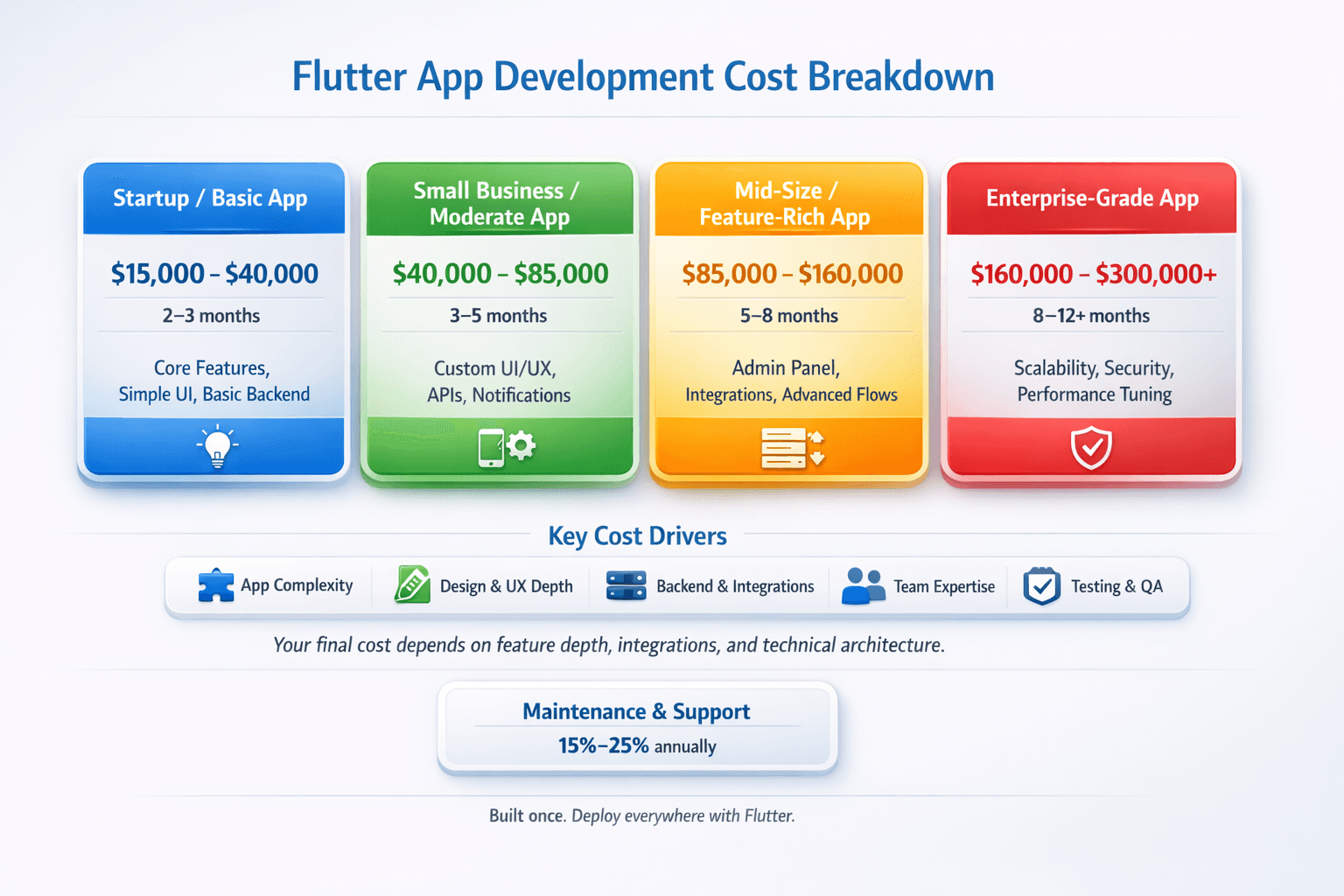
Businesses must weigh their goals, required features, and market timelines to choose the right development package. The table below outlines approximate cost brackets, typical development durations, and what’s generally included at each level. Here’s estimating Flutter app development costs with approximate figures:
Business Type or App Scale | Approximate Cost Range | Duration (Months) | Core Features Included |
|---|---|---|---|
Startup / Basic App | $15,000 - $40,000 | 2 - 3 months | Core features, simple UI, basic backend, analytics integration |
Small Business / Moderate App | $40,000 - $85,000 | 3 - 5 months | Custom UI/UX, moderate backend, APIs, push notifications |
Mid-Size Business / Feature-Rich App | $85,000 - $160,000 | 5 - 8 months | Complex features, third-party integrations, admin panel |
Enterprise / Large-Scale App | $160,000 - $300,000+ | 8 - 12+ months | Scalable architecture, advanced security, performance tuning |
Maintenance & Support (Optional) | 15% - 25% of the development cost annually | Ongoing | Updates, QA, server support, feature improvements |

By 2026, AI-assisted development (like GitHub Copilot and Flutter's enhanced DevTools) has shortened development timelines by 15-20% compared to 2023, though specialized AI-feature integration may increase Core Feature costs.
Need One Reason to Invest in a Flutter App? Here are 6
Investing in Flutter app development gives businesses a clear path to faster delivery and controlled spending. Using a single framework helps teams manage resources better and avoid platform-specific duplication. Product roadmaps stay predictable. Release cycles move faster. Maintenance remains easier to plan over time. For organizations focused on scalability and efficiency, Flutter supports growth without adding unnecessary development overhead.
Faster Product Launch Cycles
Shorter development cycles matter in competitive markets. Flutter allows engineering teams to work from a single codebase, reducing parallel effort across iOS and Android. Feature development moves more speedily. Testing takes less time. Releases reach the market sooner without compromising stability. This pace helps organizations validate ideas faster and adapt products based on real user behavior.
Consistent Cross-Platform Experience
Brand consistency plays a major role in user trust. Flutter delivers a consistent design and behavior across platforms. Interface elements remain aligned. Interactions feel familiar on every device. This consistency reduces user confusion and support tickets while strengthening brand presence across mobile ecosystems.
Easier Maintenance Over Time
Maintaining multiple codebases slows teams down. Flutter removes that burden. Bug fixes apply across platforms in a single update. Feature improvements follow a smoother release process. This approach keeps technical debt under control and allows teams to focus on product improvements rather than constant rework.
Scalable Foundation for Growth
Product requirements evolve. Flutter supports that growth without forcing teams to restructure core architecture. New features integrate smoothly. Backend services connect without heavy refactoring. This flexibility allows products to scale while keeping development effort steady and organized.
Long-Term Framework Stability
Technology choices carry long-term impact. On that note, Flutter benefits from active support, frequent updates, and a growing ecosystem. Tooling continues to improve. Community adoption keeps talent availability strong. This stability reduces risk and supports sustainable product development over the years.
Strong Performance Across Devices
Flutter compiles directly to native code, which results in smooth performance on both iOS and Android. Animations remain fluid. Screen transitions feel responsive. This level of performance supports user retention and reduces complaints tied to lag or instability, especially in apps with frequent interactions or dynamic content.
Top Parameters Impacting the Cost to Build a Flutter Mobile App
The final cost of a Flutter app does not come solely from development. Several interconnected decisions shape the budget from day one. Scope clarity, technical depth, design expectations, and delivery approach all influence timelines and pricing. Below is a clear breakdown of the main cost drivers that affect Flutter app development.
Feature Depth & App Complexity
App complexity defines how much engineering effort the product needs. A simple app with static screens and basic flows stays affordable. A complex app with real-time features, role-based access, and heavy data handling demands more development hours. As complexity grows, teams need stronger architecture planning and longer development cycles. This directly increases the cost to develop a Flutter app and extends delivery timelines.
Complexity Level | Timeline | Approx Cost |
|---|---|---|
Basic feature set | 2 to 3 months | 15000 to 30000 USD |
High complexity | 5 to 8 months | 70000 to 140000 USD |
By 2026, a "standard" app is often no longer enough to stay competitive. Integrating AI has become a primary cost driver. Whether it is using LLMs (Large Language Models) for smart search, predictive analytics for user behavior, or AI chatbots using Flutter’s latest plugins, these features require specialized logic and API configurations. AI Integration Type Estimated Added Cost Basic AI (API-based) (e.g., ChatGPT API integration) +$5,000 – $10,000 Custom ML Models (Proprietary data training) +$20,000 – $50,000+
Design Scope & User Experience
Design requirements shape both effort and perception. Standard layouts with platform-friendly components cost less. Custom visuals, animations, and interactive flows require additional design iterations and frontend development time.
UX research, wireframes, and usability testing add further cost. When design becomes a core differentiator, teams spend more time refining details. This increases Flutter app development pricing but improves product acceptance and engagement in competitive markets.
Design Level | Timeline | Approx Cost |
|---|---|---|
Standard UI | 3 to 4 weeks | 4000 to 7000 USD |
Advanced UX | 6 to 8 weeks | 10000 to 18000 USD |
Backend Systems & Integrations
Backend development supports data storage, user actions, and system logic. Simple apps rely on basic APIs and databases. Advanced apps require real-time processing, third-party integrations, and secure data handling.
The more systems involved, the higher the backend effort. API quality, data volume, and sync frequency affect timelines. Backend scope plays a major role in estimating the cost of Flutter app development.
Backend Scope | Timeline | Approx Cost |
|---|---|---|
Basic backend | 1 to 2 months | 8000 to 15000 USD |
Complex backend | 3 to 5 months | 25000 to 45000 USD |
Product Scope & Platform Strategy
The scope defines whether the app launches as an MVP or a scalable product. MVPs focus on core functionality and faster release. Scalable products plan for growth, performance, and future features from the start.
Scalability planning requires stronger architecture and testing. While MVPs reduce initial spend, scalable builds increase upfront cost but lower future rework. This choice directly impacts the cost to build a Flutter mobile app.
Product Type | Timeline | Approx Cost |
|---|---|---|
2 to 3 month | 20000 to 35000 USD | |
Scalable product | 5 to 7 months | 60000 to 120000 USD |
Team Location and Skill Level
Development costs vary based on team location and expertise. Senior developers deliver faster with fewer errors but charge higher rates.
Junior teams cost less but require more supervision and testing. Location affects hourly pricing and communication cycles. Choosing the right balance between cost and experience impacts delivery quality. This factor strongly influences the cost to hire Flutter app developers.
Team Type | Hourly Rate | Approx Monthly Cost |
|---|---|---|
Mid level team | 30 to 45 USD | 12000 to 18000 USD |
Senior team | 50 to 80 USD | 20000 to 30000 USD |
Testing & Launch
Testing protects app quality and user trust. Basic testing covers functionality and device compatibility. Advanced testing includes performance, security, and load checks.
Deployment planning and store compliance also add effort. Skipping quality assurance reduces short-term costs but increases the need for post-launch troubleshoots. A structured testing phase supports stable releases and lowers long-term maintenance costs.
Testing Level | Timeline | Approx Cost |
|---|---|---|
Basic QA | 2 weeks | 3000 to 5000 USD |
Full QA cycle | 4 to 6 weeks | 8000 to 15000 USD |
External Tools & Licensing Costs
Many Flutter apps rely on external SDKs for analytics, payments, messaging, or maps. Some tools remain free at low usage levels. Others charge based on requests, users, or features. Licensing costs grow as the app scales.
The integration effort also varies depending on the SDK's quality and documentation. Teams often spend additional time handling version updates and compatibility issues. These costs do not always appear in early estimates, yet they affect the overall cost of developing a Flutter app over time.
Usage Level | Timeline | Approx Cost |
|---|---|---|
Basic SDK usage | 1 to 2 weeks | 2000 to 4000 USD |
Paid or licensed tools | 2 to 4 weeks | 6000 to 12000 USD |
App Speed and Cross-Device Stability
User expectations around speed remain high. Flutter apps must perform consistently across phones, tablets, and OS versions. This process involves profiling load times, optimizing animations, and managing memory use. Older devices often need special handling.
Testing across multiple environments increases effort. This factor becomes critical for apps with media content, live updates, or heavy user interaction.
Optimization Scope | Timeline | Approx Cost |
|---|---|---|
Basic optimization | 2 weeks | 4000 to 6000 USD |
Device wide tuning | 4 to 5 weeks | 9000 to 15000 USD |
Support After Launch
Launching the app marks the start of ongoing work. Post-launch support includes bug fixes, OS updates, feature tweaks, and monitoring. Flutter apps need regular updates to remain stable as platforms change.
The cost depends on how often updates roll out and how complex the app remains. Planned support reduces downtime and prevents user dissatisfaction.
Support Level | Duration | Approx Cost |
|---|---|---|
Light support | Monthly | 1500 to 3000 USD |
Active maintenance | Monthly | 4000 to 7000 USD |
Infrastructure Growth Planning
As usage grows, backend infrastructure must scale. This includes servers, databases, storage, and monitoring tools. Flutter apps with real-time activity or high traffic need stronger infrastructure planning.
Poor scaling leads to crashes and performance drops. Building with future growth in mind raises early costs but prevents expensive fixes later.
Scale Level | Timeline | Approx Cost |
|---|---|---|
Moderate traffic | 3 to 4 weeks | 6000 to 10000 USD |
High scale readiness | 6 to 8 weeks | 15000 to 30000 USD |
The factors above shape the final Flutter app budget in a measurable way. Cost clarity improves when scope, design, and technical depth stay defined early. Smart planning does not mean cutting features. It means aligning priorities with long-term product goals and realistic timelines.
Cost Planning for Flutter App Development – How to Keep It Minimum as per Your Needs
Cost planning works best when the app scope stays aligned with real business goals. Flutter offers flexibility, but budget control depends on how clearly features are defined early on. Overbuilding increases cost without adding value.
Smart planning focuses on what users need today and what can wait. By choosing the right development tier, businesses can manage the cost to develop a Flutter app without sacrificing performance or future growth.
Basic Cost Range and Scope
A basic Flutter app is well-suited to early-stage products and internal tools. This level focuses on essential functionality and faster delivery. It keeps development lean and avoids complex integrations.
Approximate Cost Range: 15000 to 30000 USD
Development Timeline: 2 to 3 months
Here are the features that may be included in this range-
User Authentication & Login- Supports sign up, login, and password recovery. Provides secure access to app features without complex verification.
Event Creation & Editing- Users can create, edit, and manage events. Basic logic supports notifications and scheduling.
Event Reminders & Notifications- Push notifications keep users informed about upcoming events. Simple scheduling logic is included.
Basic UI and UX Design - Standard Flutter components and layouts. Clean, functional interface with limited animations. Focuses on usability over branding complexity.
Mid-Level Cost Range
Intermediate planning fits growing products that need better user experience and integrations. This tier balances cost and functionality while preparing the app for moderate scale.
Approximate Cost Range: 35000 to 70000 USD
Development Timeline: 3 to 5 months
This level supports public-facing apps with active users.
Browsing and Checkout - Supports product or content browsing with simple purchase or booking flows. Includes cart and checkout integration.
Profile Management- Allows users to manage personal information, settings, and preferences. Includes basic account controls.
Feed- Displays dynamic content, updates, or posts. Supports basic filtering and sorting options.
Data Recording- Captures user activity, inputs, or metrics. Stores data securely in the backend for later retrieval.
Data Visualization: Charts, graphs, or reports present data to users or admins. Supports insights without complex analytics.
Advanced Cost Range
Advanced planning supports scalable products with long-term growth goals. This tier demands stronger architecture and higher upfront investment.
Approximate Cost Range: 75000 to 150000 USD
Development Timeline: 5 to 8 months
This setup suits enterprise apps and high-traffic platforms.
Real-Time Tracking- Tracks location or activity live. Requires backend synchronization and fast updates for multiple users.
In-App Communication- One-to-one or group messaging, media sharing, and notifications in real time. Includes chat backend support.
AR/VR Functionality- Immersive experiences using augmented or virtual reality. Integrates 3D models, camera feeds, and interactive elements.
AI-Powered Chatbot- Intelligent conversational assistant like Replika. Handles user queries, suggestions, and simple personalization.
AI/ML-Powered Personalization- App learns from user behavior to suggest content, offers, or features. Includes basic analytics integration for recommendations.
Multi-Tenant Architecture- Supports multiple organizations or user groups from a single platform. Segmented data, permissions, and dashboards included.
Keeping Flutter app development costs minimal depends on choosing the right tier at the right time. Starting lean and scaling with intent protects budgets while keeping products flexible for growth.
Cost to Develop a Flutter App Depending on Your Niche
The cost of developing a Flutter app varies depending on the industry it serves. Each niche demands unique features, integrations, and user experiences, which directly impact the budget. Understanding niche-specific requirements can help you estimate costs and plan your app development efficiently. Here’s an overview of popular app niches:
E-commerce Apps – $20,000 – $100,000+
E-commerce apps require features like product browsing, search, shopping cart, checkout, secure payment gateways, and user account management. Multi-vendor platforms, AI-driven recommendations, and loyalty programs add complexity, increasing development time and cost. These apps aim to provide a smooth, intuitive shopping experience for customers.
Healthcare Apps – $30,000 – $150,000+
Healthcare apps often include appointment booking, telehealth consultations, electronic health record (EHR) integration, symptom checkers, and medicine trackers. Ensuring HIPAA compliance and secure handling of patient data is critical. Advanced features such as AI diagnostics or wearable integration further increase development complexity and overall cost.
Fitness Apps – $15,000 – $75,000+
Fitness apps offer workout routines, progress tracking, diet plans, and integration with wearable devices. Gamification and social interaction features increase engagement. Personalized coaching or AI-driven fitness plans enhance functionality but raise costs. These apps focus on improving user health and fitness through interactive and motivational tools.
On-demand Service Apps – $20,000 – $100,000+
On-demand apps provide real-time service booking, geolocation tracking, status updates, and in-app payments. Examples include taxi, home services, or delivery apps. Advanced features such as logistics integration, dynamic pricing, or route optimization increase development effort, making them more expensive than basic on-demand apps.
Entertainment Apps – $10,000 – $50,000+
Entertainment apps include video/music streaming, content browsing, subscriptions, offline access, and personalization. Apps like on-demand video platforms or music streaming services require smooth playback, recommendation engines, and scalable backend architecture. Implementing DRM protection or live streaming features may further increase development costs.
Educational Apps – $15,000 – $85,000+
Educational apps feature interactive learning modules, gamification, progress tracking, CMS/LMS integration, and adaptive learning algorithms. They help students and learners engage effectively with content. Apps with live classes, multi-language support, and AI-driven, personalized learning enhance functionality and increase costs, making them suitable for large-scale educational platforms.
Social Networking Apps – $25,000 – $125,000+
Social apps include profiles, feeds, posts, likes, comments, messaging, and scalable architecture. Features like media sharing, live streaming, and AI moderation make development complex. The goal is to enhance user engagement and interaction, which requires robust backend infrastructure and constant updates, influencing overall development costs.
Travel & Booking Apps – $20,000 – $90,000+
Travel apps allow flight/hotel bookings, itinerary planning, real-time availability, payments, and reviews. Integrating third-party APIs, maps, and travel guides enhances usability. Features like dynamic pricing, seasonal offers, and personalized recommendations increase complexity, making accurate budgeting for these apps crucial.
Food Delivery Apps – $20,000 – $100,000+
Food delivery apps offer restaurant browsing, menu selection, order tracking, payment processing, and ratings. Advanced features include AI-based delivery time prediction, loyalty programs, and multi-partner integrations. The app must handle real-time updates efficiently, making backend development and user interface design key cost drivers.
Finance & Banking Apps – $30,000 – $150,000+
Finance apps include account management, transactions, investment dashboards, budgeting tools, and compliance features. Security, encryption, and regulatory adherence are critical. Integrating payment gateways, financial APIs, and real-time analytics increases complexity. High-level security and extensive features make these apps among the costliest to develop.
How to Reduce Flutter App Development Cost
Building a Flutter app doesn’t always have to break the budget. With smart planning and strategic choices, it’s possible to reduce costs without compromising quality. Here are six effective ways to save on development:
Begin with a Minimum Viable Product
Focus on the essential features needed to test your idea and gather user feedback. Launching an MVP reduces upfront investment and helps refine the app based on real user insights.
Leverage a Single Codebase
Flutter allows developers to write one codebase for both iOS and Android. Reusing code saves time, reduces maintenance costs, and speeds up development across platforms.
Prioritize High-Impact Features
Identify the most valuable user functionalities and implement them first. Non-essential or complex features can be added later, helping to control costs and ensure timely app delivery.
Use Ready-Made Widgets & Packages
Flutter offers a wide range of pre-built UI components and third-party libraries. Using these tools reduces the effort required for custom development and accelerates the app-building process.
Follow Agile Development Practices
Agile methodology promotes iterative development, frequent testing, and real-time feedback. This approach improves project control, prevents costly mistakes, and ensures the final app meets user needs efficiently.
Country-Wise Breakdown of the Cost of Flutter App Development
How much does Flutter app development cost depending on the location? Let’s find them out:
Country / Region | Hourly Rates (Approx) | Typical App Cost (USD |
|---|---|---|
United States | $90 – $150+ | $80,000 – $150,000+ |
Canada | $80 – $130 | $75,000 – $120,000+ |
United Kingdom | $70 – $120 | $70,000 – $110,000+ |
Germany & Western Europe | $65 – $115 | $65,000 – $100,000+ |
Australia | $80 – $120 | $75,000 – $120,000+ |
India | $15 – $40 | $5,000 – $70,000+ |
Ukraine & Eastern Europe | $25 – $50 | $20,000 – $80,000+ |
China | $20 – $45 | $15,000 – $60,000+ |
South Africa & Africa | $20 – $45 | $17,000 – $40,000+ |
Let’s Build Your Flutter App Together
We at Deliverables Agency love turning ideas into apps that people enjoy using. As one of the reliable Flutter app development companies, we focus on understanding your goals and creating solutions that fit your budget and timeline. Our team combines experience, creativity, and the latest technology to build apps that perform smoothly and look great.
From simple MVPs to feature-rich applications, we guide you through every step of development. Ready to see your idea come to life? Reach out to us today, and together we’ll craft a Flutter app that truly connects with your users and brings your vision to reality.
Have an Idea for an App or Website?
At Deliverables, we specialize in building custom digital products that solve real-world problems. Tell us your idea, and our expert team will help you craft a plan to build your dream.
Some Topic Insights:
How much does a Flutter developer charge per hour?
Flutter developer hourly rates vary by region. In the U.S., rates range from $90–$150/hour, while in India or Eastern Europe, rates are significantly lower at $15–$50/hour depending on experience and project complexity.
How can startups reduce Flutter app development costs?
Is Flutter suitable for both iOS and Android apps?
How long does it take to develop a Flutter app?
Does using Flutter really reduce mobile app development costs?