



Time to read :
1 min read
The gap between how fast software teams want to move and how stable systems need to be has never been wider. Almost every organization agrees that DevOps improves performance, yet more than half of them still struggle to hire and retain the right talent. This ongoing shortage has made DevOps outsourcing both a practical and an increasingly strategic solution for many enterprises.
Globally, technology has reached a turning point. What used to be a simple IT support has evolved into a complex network of global collaboration. The global DevOps market size is expected to be worth around USD 66 billion by 2033. This reflects how rapidly organizations are adapting to this new delivery model.
Therefore, the question is not whether DevOps is important, but whether building and scaling it internally still makes sense. In this guide, we will explore DevOps outsourcing through an enterprise lens. So, let’s get started.
What DevOps Outsourcing Really Means?
A lot of organizations consider DevOps outsourcing a process of handing off operations to an external vendor. However, DevOps outsourcing services include CI/CD pipelines, infrastructure automation, cloud management, and performance monitoring. These experts live and breathe continuous delivery, which helps organizations move faster and operate more efficiently.
Unlike traditional IT outsourcing, DevOps partnerships need close alignment with your internal workflows and company culture. They rely on collaboration, shared accountability, and continuous improvement to achieve real and measurable results. Automation, cloud operations, monitoring and security, and scalability are the core components of DevOps outsourcing.
Common Engagement Models
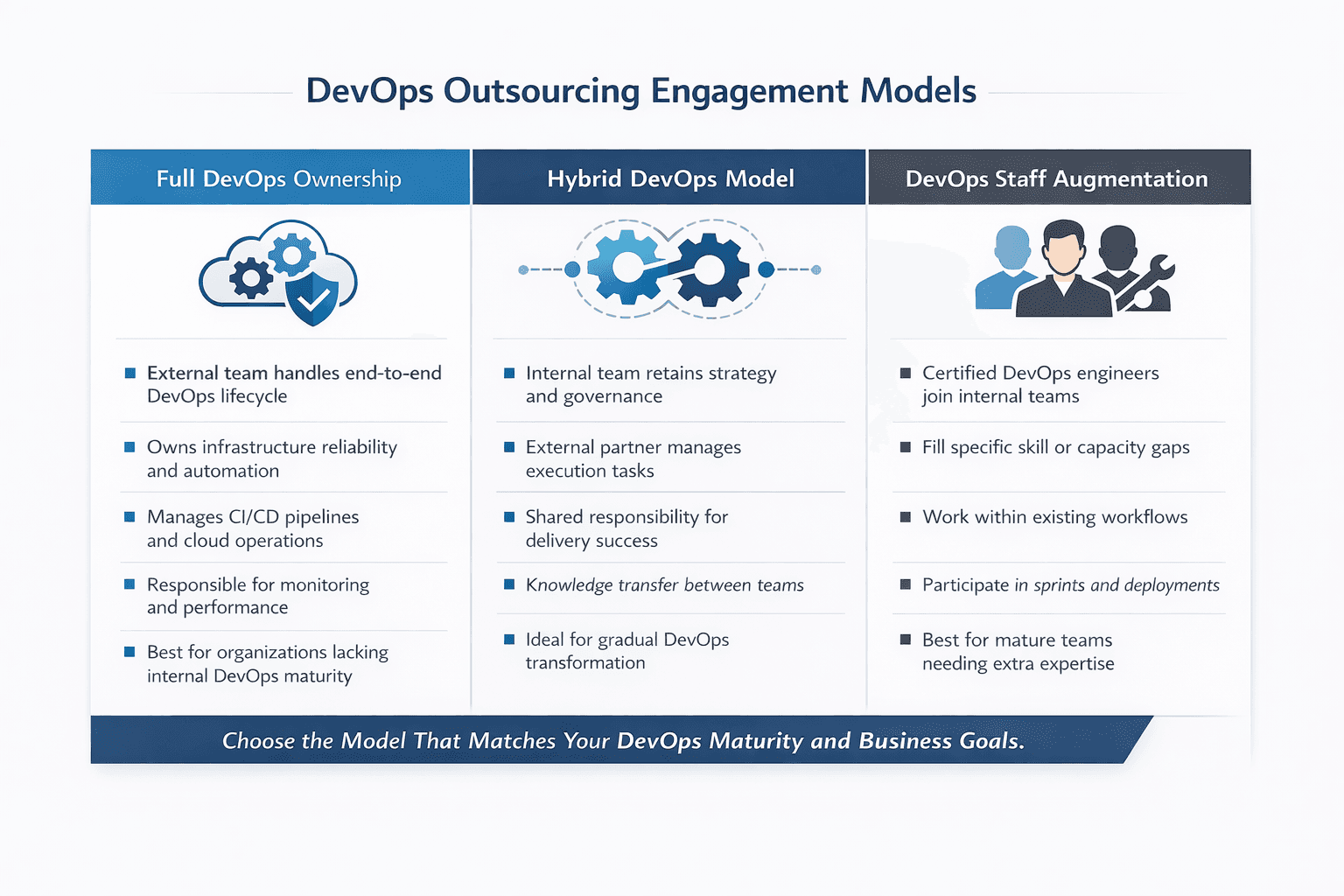
Modern DevOps outsourcing consists of three engagement models:
Full DevOps as a Service: In this model, the external team manages the entire DevOps lifecycle. They work alongside internal teams but maintain primary accountability for infrastructure reliability, deployment frequency, and operational metrics. This model is ideal for organizations that lack DevOps capabilities or prioritize rapid transformation over gradual capability building.
Hybrid Model: Here, internal teams retain strategic oversight, while external partners handle execution. They manage automation implementation, tool configuration, pipeline maintenance, and routine deployments. This approach balances control with expertise, which enables organizations to build internal knowledge while using specialized skills for complex technical work.
Staff Augmentation: In this model, certified DevOps engineers embed within existing teams to address specific skill gaps or capacity constraints. Unlike consultants, augmented staff function as team members. They participate in sprint planning, on-call rotations, and long-term roadmap development. This model is the best for organizations with established DevOps practices but no bandwidth or niche expertise.
Why Enterprises are Turning to DevOps Outsourcing?
The global DevOps market is rising rapidly. This growth involves several factors, reshaping enterprise delivery models.
1. The Talent Gap is Structural, Not Temporary
DevOps is one of the most in-demand tech disciplines worldwide. Recruiting senior engineers certified in AWS, Azure, or Kubernetes can take six months or more. Furthermore, retaining them is challenging, especially when global tech giants are paying record salaries.
Therefore, having outsourced DevOps teams makes a real difference. It gives enterprises immediate access to skilled specialists and proven industry frameworks, without the overhead of hiring, training, or long-term retention.
2. Cost Predictability and Operational Use
On paper, in-house teams appear to be cheaper. However, hidden costs, like tools, training, certifications, and attrition, inflate total ownership. Outsourcing converts unpredictable overhead into a transparent monthly investment tied to measurable outcomes. Outsourcing DevOps services can reduce infrastructure cost and even improve the mean time to recover significantly.
3. Managing Complexity at Scale
Modern enterprise stacks are hybrid by-default. Managing these layers internally takes years of experience and often results in trial-and-error inefficiency. When you outsource DevOps workflow management to experienced partners, you gain access to battle-tested playbooks. This helps standardize and stabilize complex environments while reducing operational risks.
4. Continuous Compliance and Security
Regulations like GDPR, SOC 2, and HIPAA demand persistent vigilance. DevOps outsourcing firms help by building strong security practices, known as DevSecOps, directly into the delivery process. They automate security checks, compliance scans, and audit logs so that enterprises can stay secure and meet regulations without losing focus on product development.
5. Standardization and Governance
When different teams follow their own DevOps methods, it often leads to confusion, delays, and mistakes. External experts help solve this by introducing DevOps for businesses. It is a standardized framework that brings development, operations, and compliance together into one smooth and consistent delivery process.
Tangible Business Benefits of DevOps Outsourcing Services
When executed with the right partner, DevOps outsourcing delivers measurable business impact across the enterprise.
1. Faster Time-To-Market
Automated CI/CD pipelines and environment provisioning reduce release cycles from weeks to hours. It improves deployment frequency and shortens the time from idea to implementation.
2. Improved Reliability
Experienced providers use proactive monitoring, automated testing, and rollback capabilities, cutting downtime significantly. Top-performing DevOps organizations achieve faster recovery and lower change failure rates than traditional teams.
3. Productivity Uplift
When the product team hands over infrastructure maintenance to an external team, they get more time to focus on building new features and improving the product. On average, this saves about 10 to 15 hours per engineer every week. This time can be used for innovation instead of routine tasks.
4. Elastic Scalability
External teams make it easy to increase or decrease your resources based on project needs. You can scale up when workloads are high and scale down when they are not, without long hiring processes or permanent job commitments.
5. Cost Efficiency Through Automation
Using tools like Infrastructure-as-Code, containerization, and FinOps helps companies use their resources more efficiently. These practices reduce waste and make operations simpler, faster, and more transparent.
The Real Risks and How to Mitigate Them
Outsourcing DevOps teams also comes with some challenges. Enterprises that jump in without clear governance or cultural preparation often face friction and dependency issues.
1. Security Exposure
Giving external teams access to your systems can increase security risks if not managed properly. Therefore, give access only to people who truly need it and use multi-factor authentication. Work with partners who are certified under SOC 2 or ISO 27001. Ensure to include security checks and automated compliance tools in every step of the outsourcing DevOps workflow. Also, set clear rules for how incidents are reported and handled.
2. Knowledge Gaps and Vendor Lock-In
If all the system knowledge stays with the vendor, switching providers or bringing work back in-house can be difficult. It is essential to ensure all setups and changes are properly documented and stored in version control. You can hold regular sessions for knowledge sharing between the internal and external teams. Also, make sure to keep internal control over key areas like system design and security. Use open tools instead of vendor-specific ones to avoid being locked in.
3. Communication and Cultural Differences
Outsourcing DevOps from different time zones and work cultures can cause delays or misunderstandings. You can reduce this risk by ensuring at least a few hours of overlap between teams every day. Set up clear communication routines, like daily meetings, weekly reviews, and monthly progress checks. You can also use shared dashboards so everyone can see the same data and progress in real time.
4. Quality Issues
Not every outsourcing partner provides you with the same level of quality. Poor automation or testing can lead to major issues. Therefore, set clear quality goals in your contract, using DORA metrics like deployment frequency, recovery time, and failure rate. Start with a small pilot project to test the partner’s work before expanding. Include performance-based clauses in the agreement to ensure accountability.
5. Hidden Management Costs
Even if you have outsourced good partners, you will still need time and effort to manage priorities, quality, and alignment. You can avoid this by assigning an internal manager or team lead to oversee the partnership. Make sure to include management time when calculating overall ROI. Also, use shared tools and transparent reporting to keep everything visible and organized.
Strategic Considerations Before You Outsource DevOps
Before signing any outsourcing contract, you should address key strategic questions:
Which functions stay in-house?
Functions like core architecture, compliance, and vendor strategy should be retained internally. Outsource execution-heavy tasks such as pipeline maintenance, environment automation, and 24/7 monitoring.
What defines success?
The best way to define success in DevOps outsourcing for enterprises is by setting Key Performance Indicators (KPIs) tied to the DORA metrics. These metrics include:
Deployment Frequency: How often new code goes live.
Lead Time for Changes: How quickly code moves from development to production.
Mean Time to Recover (MTTR): How fast teams can recover from a failure or outage.
Change Failure Rate: How often changes cause production issues.
How will knowledge be retained?
One of the biggest risks in outsourcing DevOps is losing critical knowledge when external teams handle most of the work. To avoid this, make knowledge transfer a built-in part of the contract. Ask your partner to document everything, including infrastructure diagrams, runbooks and playbooks, and configuration details clearly.
What security standards should be applied while outsourcing?
Security must be a top priority from one. Before signing any agreement, ask for proof of security certifications like SOC 2, ISO 27001, or others relevant to your industry.
Additionally, include clear security protocols in the contracts:
Define how and when incidents are reported.
Set up a detailed escalation process for any breaches.
Specify who is responsible for responding to and fixing security issues.
These steps help build a partnership based on trust and ensure compliance with all required regulations.
How will communication work?
Smooth communication is essential for a successful DevOps outsourcing. Set up a clear governance structure before starting the work so everyone knows how and when to connect.
A simple schedule that works for most enterprises includes:
Daily stand-ups for tactical syncs
Weekly planning for priorities
Monthly reviews for performance metrics
Quarterly strategy sessions for roadmap alignment
Best Practices of DevOps Outsourcing for Enterprises
Building a strong DevOps strategy for enterprises includes creating the right structure, culture, and partnerships. The following best practices help enterprises manage outsourcing effectively.
Selecting the Right DevOps Partner
The partner you choose determines 90% of your outcome. Although technical knowledge is essential, what truly sets great partners apart is their operational maturity and how well they fit your company’s culture and way of working.
Key Evaluation Criteria
Evaluation Area | Why it Matters | Recommended Weight |
Technical Expertise | The partner should have proven experience with your cloud setup and CI/CD tools like AWS, Kubernetes, and Terraform. | 35% |
Security & Compliance | Protects your data and ensures all work meets required regulations and standards. | 25% |
Cultural & Time-Zone Fit | Helps both teams work together easily, communicate faster, and solve issues quickly. | 20% |
Pricing Transparency | Keeps the partnership clear and prevents unexpected costs or hidden charges. | 15% |
Scalability | Ensures the partner can quickly add or reduce resources as your needs change. | 5% |
Due Diligence Steps
Before finalizing a DevOps partner, take time to check their quality and credibility.
Ask for infrastructure code samples or architecture diagrams to understand their work.
Verify technical certifications like AWS Architect, Kubernetes (CKA), or Terraform Associate.
Speak with clients of similar size and industry to learn about their experience.
Start with a short pilot project (around three months) to test their communication, quality, and delivery speed before scaling up.
Building a Strong SLA
A basic service agreement is not enough for DevOps projects. You need a detailed Service Level Agreement (SLA) that covers both technical performance and process quality. A clear SLA helps both sides stay accountable and ensures there are no surprises later.
Some of the key elements a DevOps SLA should include are:
Uptime and Availability: Systems should be up and running at least 99.9% of the time.
Incident Response: For critical issues, the partner should respond within one hour or less.
Deployment Success Rate: At least 95% of deployments should go live without problems.
Technical Debt Management: There should be a clear plan to reduce work and maintain clear and efficient code.
Knowledge Transfer: Documentation should be updated regularly so that knowledge is never lost.
Smart enterprises often set their internal goals (SLOs) slightly higher than the agreed SLAs. This safety margin helps maintain high performance and encourages continuous improvement.
Governance and Knowledge Transfer
Successful DevOps outsourcing is an ongoing partnership built on teamwork and transparency. Both internal and external teams should stay connected and take shared responsibility for results.
Some of the best practices for this process include:
Using shared dashboards so everyone can see the same performance data in real time.
Scheduling regular review meetings to check progress, discuss SLAs, and make improvements when needed.
Pairing internal engineers with outsourced experts during important deployments to encourage learning and smooth coordination.
Keeping documentation up to date after every infrastructure change so knowledge is always current and easy to access.
AI-Driven Evolution
Artificial Intelligence (AI) is becoming an essential part of modern DevOps. Today, almost every enterprise uses AI tools to improve speed and accuracy in software delivery. These tools can write code faster, predict issues before they happen, and help teams manage complex systems more efficiently.
However, more code does not always mean better code. AI can sometimes create new challenges if it is not managed properly. That is why enterprises should work with partners who know how to use AI responsibly.
Modernizing Legacy
Old or outdated systems often slow down digital transformation. DevOps outsourcing helps solve this by using proven modernization methods that upgrade systems step by step, without causing downtime or data loss.
Infrastructure as Code (IaC), containerization, and continuous testing are some of the key techniques that let enterprises modernize safely while keeping critical operations running smoothly.
The Human-Machine Future
The future of outsourcing DevOps lies in combining the strengths of both human and machine. AI can handle repetitive or data-heavy tasks, while human engineers focus on creativity, decision-making, and problem-solving. Together, they form a more powerful and efficient team.
Enterprises that adopt this balanced approach will be better prepared to stay ahead of their competition.
Key Takeaway
Choosing to outsource DevOps is a sign of growth and maturity. It shows a commitment to building faster, stronger, and more innovative systems. When done strategically, DevOps outsourcing cuts costs, helps you gain flexibility, improves delivery speed, and allows internal teams to focus on what truly drives value.
In the end, a strong DevOps strategy for enterprises is about combining in-house expertise with specialized partners. Enterprises that approach outsourcing with a clear vision and long-term mindset will simplify operations and create a more resilient technology foundation for the future.
Have an Idea for an App or Website?
At Deliverables, we specialize in building custom digital products that solve real-world problems. Tell us your idea, and our expert team will help you craft a plan to build your dream.
Some Topic Insights:
What is DevOps outsourcing?
DevOps outsourcing involves hiring an external team to manage and integrate DevOps services, helping companies improve development processes and operations.
Why is DevOps outsourcing important for businesses?
How much does it cost to outsource DevOps?
What are the benefits of DevOps outsourcing?
How can DevOps outsourcing help with CI/CD pipelines?